Cooking for a crowd starts with one simple question: how much dry rice or pasta actually feeds one adult? Guessing usually ends in a half-empty pot or a mountain of leftovers nobody asked for. A dependable starting point makes the whole job easier, and the same starting point scales up cleanly the moment the guest list grows.
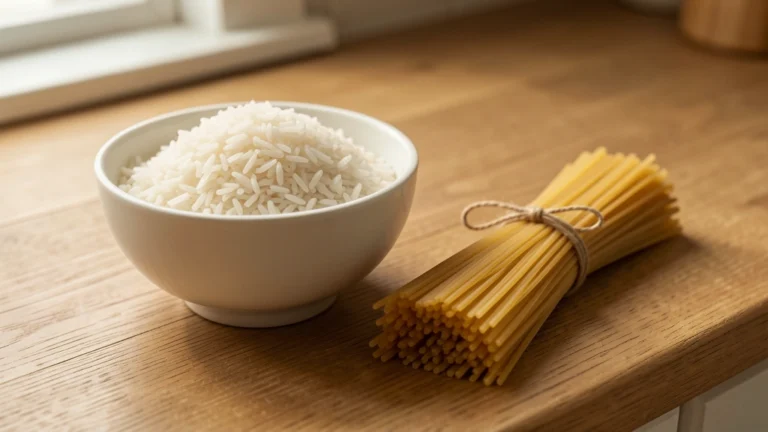
Plan on about 1/2 cup (about 100g) of uncooked rice per adult as a main dish, or about 2 oz (about 56g) of uncooked pasta per adult as a main dish. Side-dish portions run smaller, closer to 1/3 cup (about 60g) of rice or 1.5 oz (about 40g) of pasta. For a group of 8 eating rice as the main, that is 4 cups (800g) of uncooked rice, which cooks up to roughly 12 cups. For 8 people eating pasta as the main, that is 16 oz or 1 lb (448g) of uncooked pasta, which cooks up to roughly 2 lb. These are common general guidelines, not fixed rules, since appetites and recipes vary. The Proportion Calculator handles the scaling math for any headcount, since no dedicated portion-size tool exists and portions scale proportionally with the number of people.
How Much Rice Should You Cook Per Person?
A standard main-dish portion of rice runs about 1/2 cup (about 90 to 100g) of uncooked rice per adult. That amount cooks up to roughly 1.5 cups of finished rice, enough to anchor a plate alongside a protein and a vegetable.
Restaurants and recipe developers land on this figure again and again, which is why it shows up as the common default across cookbooks and extension guides alike. Long-grain white rice, brown rice, and basmati all land close to this same range, though brown rice can run slightly heavier per cup due to its bran layer.
A side-dish portion of rice sits smaller, closer to 1/3 cup (about 60g) uncooked per adult, since a side shares the plate with other food instead of carrying the meal on its own. A rice-heavy dish like a pilaf or a stir-fry base can lean toward the higher end of the main-dish range, since rice plays a bigger structural role in those meals.
How Much Pasta Should You Cook Per Person?
A standard main-dish portion of pasta runs about 2 oz (about 56g) of uncooked pasta per adult. Long shapes like spaghetti and short shapes like penne both use this same rough weight, even though a 2 oz bundle of spaghetti looks like a different volume than 2 oz of penne in a measuring cup.
Weighing dry pasta on a kitchen scale beats eyeballing it, because shape and cut change how much space the same weight takes up. A luggage-strap trick of circling a coin-sized bundle of spaghetti with your fingers gets close, but a scale removes the guesswork entirely.
A side-dish portion of pasta sits smaller too, closer to 1.5 oz (about 40g) uncooked per adult. A pasta salad served as one of several sides at a potluck can lean even lighter, since guests are also filling their plates with other dishes.
| Food | Role on the Plate | Uncooked Amount Per Adult |
|---|---|---|
| Rice | Main dish | About 1/2 cup (about 100g) |
| Rice | Side dish | About 1/3 cup (about 60g) |
| Pasta | Main dish | About 2 oz (about 56g) |
| Pasta | Side dish | About 1.5 oz (about 40g) |
Why Does Rice Triple and Pasta Only Double in Volume?
Rice roughly triples in volume once it cooks, while pasta roughly doubles. Both foods absorb water as they cook, but the starch structure and cooking method behind each one produce a different rate of expansion.
Rice sits in a measured amount of water and absorbs nearly all of it during cooking, which is why the grain swells so dramatically. A cup of uncooked long-grain rice typically yields close to 3 cups of cooked rice, a ratio worth memorizing since it appears in nearly every rice recipe.
Pasta cooks in a large pot of boiling water instead of a measured amount, and it sheds some of that absorbed water back out when drained. That difference in method is the main reason pasta lands closer to double its dry volume rather than triple.
This expansion matters most when a recipe lists a cooked amount but your kitchen scale only shows the uncooked weight sitting in the box. Knowing the rough multiplier lets you work backward to figure out how much dry rice or pasta to start with.
How Do You Scale Portions for a Group of 8?
Multiply the per-person amount by the headcount to scale rice or pasta for any group size. For rice as a main dish, that means 8 people times 1/2 cup each, which equals 4 cups (800g) of uncooked rice.
That 4 cups of uncooked rice cooks up to roughly 12 cups of finished rice, using the rough tripling rule from the section above. A dinner party can plan serving bowls around that 12-cup figure instead of guessing at the table.
For pasta as a main dish, 8 people times 2 oz each equals 16 oz, or exactly 1 lb (448g), of uncooked pasta. That pound of dry pasta cooks up to roughly 2 lb once it absorbs water at the stove, using the rough doubling rule for pasta.
Scaling this way works the same for any group size, small or large, since the math is a straight multiplication of a fixed per-person amount. The Proportion Calculator is built for exactly this kind of scaling: enter the per-person amount and the new headcount, and it returns the total instantly instead of requiring mental math at the counter. Pairing a scaled portion amount with the rest of a recipe is also covered in the sibling guide on how to scale a recipe up or down, which walks through adjusting every other ingredient the same way.
| Food | Per Person | For 8 People (Uncooked) | Approximate Cooked Yield |
|---|---|---|---|
| Rice | 1/2 cup (100g) | 4 cups (800g) | About 12 cups |
| Pasta | 2 oz (56g) | 16 oz / 1 lb (448g) | About 2 lb (32 oz) |
Need portions for a different headcount? Enter your per-person amount into the Proportion Calculator and scale rice, pasta, or any other ingredient to the exact number of guests at your table.
How Do Kids and Big Eaters Change These Numbers?
Kids typically eat about half the adult portion, though a picky toddler and a hungry twelve-year-old can land at opposite ends of that range. A reasonable planning shortcut is to count two young kids as roughly one adult portion when totaling up a shopping list.
Big eaters push the other direction, sometimes closer to 1.5 times the standard adult portion, especially at a casual gathering where rice or pasta doubles as the bulk of the meal rather than sharing the plate with a large protein serving. A birthday dinner built around a pasta bake calls for a heavier per-person estimate than a formal plated dinner with several courses.
Mixed groups are common at real gatherings, so a useful approach counts heads by category. Take a party of 8 made up of 5 adults, 1 big eater, and 2 kids: that roughly equals 5 plus 1.5 plus 1 (two kids at half portion each), or about 7.5 adult-equivalent portions instead of a flat count of 8.
Leftovers factor into the same math, since rice and pasta both reheat well and many hosts intentionally cook slightly more than the headcount requires. Adding roughly one extra adult portion to a group total is a common way to guarantee lunch the next day without running short at dinner.
What Should You Do With Leftover Uncooked Rice or Pasta?
Store uncooked rice and pasta in a sealed container in a cool, dry pantry, where both keep well for many months past the amount used in a single meal. Buying in bulk rarely creates waste, since a slight overestimate just becomes next week’s side dish instead of spoiled food.
Cooked rice and pasta both store safely in the refrigerator for a few days in a sealed container, and both reheat easily with a splash of water to restore moisture. Planning a slightly larger batch on purpose, rather than cutting portions too close to the exact headcount, is a common practical habit among people who cook for groups regularly.
Freezing cooked rice in flat, portioned bags is another common trick for stretching a big batch across several future meals. Pasta freezes less predictably, since the texture can turn soft after reheating, so many cooks prefer to freeze the sauce separately and cook fresh pasta each time.
FAQs About Rice and Pasta Portions
Is It Better to Cook Too Much Rice or Pasta Than Too Little?
Not automatically. Overcooking a huge surplus wastes food and money just as much as running short embarrasses a host. The better approach adds a small buffer, roughly one extra adult portion for a group, rather than doubling amounts out of habit.
Is a Cup of Cooked Rice the Same Amount as a Cup of Cooked Pasta?
No, the two are not directly comparable by cup. A cup of cooked rice and a cup of cooked pasta pack differently, since rice grains sit tightly packed while pasta shapes trap more air pockets. Weighing uncooked amounts stays more reliable than comparing cooked cup measurements.
Should You Cook Extra Rice or Pasta on Purpose for Leftovers?
Yes, many cooks add roughly one extra adult portion when leftovers are wanted. Both foods reheat well within a few days when stored in a sealed container in the refrigerator, so a planned surplus rarely goes to waste.
What Is the Most Common Mistake When Portioning Rice or Pasta?
The most common mistake measures the cooked amount instead of the uncooked amount a recipe calls for. Since rice roughly triples and pasta roughly doubles once cooked, measuring after cooking produces a portion far smaller than intended.
How Does the Proportion Calculator Help With Rice or Pasta Portions?
The Proportion Calculator takes a per-person amount and a new headcount and returns the scaled total instantly. Enter 1/2 cup of rice per person and a headcount of 8, for example, and it returns 4 cups without manual multiplication.
How Do You Adjust Portions for a Mixed Group of Adults and Kids?
Count kids as roughly half an adult portion and big eaters as roughly 1.5 times an adult portion, then total the adjusted headcount before multiplying. A group of 5 adults, 1 big eater, and 2 kids works out to about 7.5 adult-equivalent portions instead of a flat count of 8.
How Much Rice and Pasta Do You Need for a Dinner of 8?
A rice main for 8 adults needs 4 cups (800g) of uncooked rice, yielding about 12 cups cooked. A pasta main for 8 adults needs 16 oz or 1 lb (448g) of uncooked pasta, yielding about 2 lb cooked.
Sources
Reference Sources Used in This Article
This article is general cooking education, not food-safety or professional culinary advice. Always use a food thermometer and follow your local health authority’s guidance for safe minimum cooking temperatures. Reviewed for accuracy by Prof. Dr. Khalil Mudassar, PhD. Last updated September 23, 2026.
Author

Shakeel Muzaffar is the Founder and Editor-in-Chief of MultiCalculators.com, bringing over 15 years of experience in digital publishing, product strategy, and online tool development. He leads the platform's editorial vision, ensuring every calculator meets strict standards for accuracy, usability, and real-world value. Shakeel personally oversees content quality, formula verification workflows, and the platform's commitment to publishing tools that are genuinely useful for students, professionals, and everyday users worldwide.