Every great cup of coffee starts with a ratio, not a guess. Coffee-to-water ratio is simply the weight of ground coffee compared to the weight of water used to brew it, and getting that number right does more for flavor than any other single variable in the process. A widely cited starting point known as the golden ratio sits around 1:16 to 1:18, coffee to water by weight, and each brew method nudges that number up or down from there.
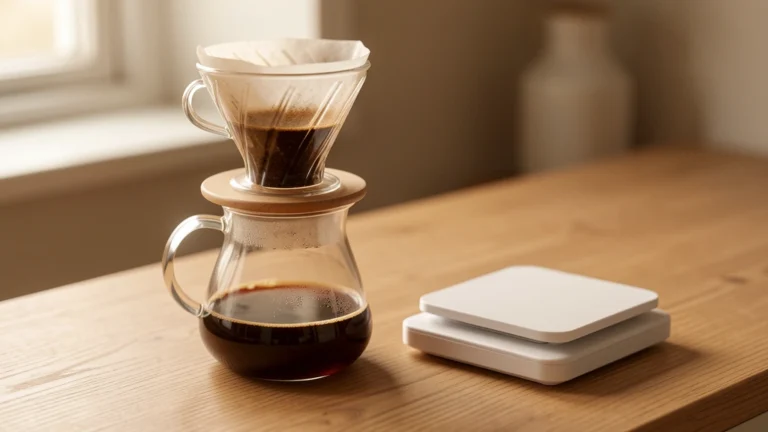
The golden ratio for coffee is commonly cited as 1:16 to 1:18, meaning 1 gram of coffee for every 16 to 18 grams of water. For 20 grams of coffee, that works out to 320 to 360 grams of water. French press runs stronger, often 1:12 to 1:15. Pour-over sits close to the golden ratio at 1:16 to 1:17. Cold brew concentrate is much stronger, often around 1:8, since it gets diluted before drinking. Weigh both coffee and water in grams with a kitchen scale for the most consistent results, and use the Ratio Calculator to scale any ratio up to a full pot.
What Is the Golden Ratio for Coffee?
The golden ratio for coffee is a widely cited starting point of about 1:16 to 1:18, coffee to water by weight. That means 1 gram of ground coffee for every 16 to 18 grams of water. Coffee professionals and brewing guides reference this range so often that it earned the nickname “golden,” though it works as a starting point rather than a fixed law.
Ratio, in this context, means a fixed proportion between two amounts that stays constant no matter how much you brew. A 1:16 ratio applies the same way to a single cup or a full carafe, because the relationship between the two numbers never changes, only the total quantity does.
Coffee strength and coffee ratio are related but not identical ideas. A stronger ratio means less water relative to coffee, which usually produces a bolder, more concentrated cup. A weaker ratio means more water relative to coffee, producing a lighter, more diluted cup. Neither end of the range is objectively correct, since taste preference and brew method both shift the ideal number.
How Do You Calculate a Coffee Ratio Recipe?
Multiply the weight of your coffee by your chosen ratio number to find the weight of water needed. Pick a ratio, such as 1:16, then multiply the coffee amount by 16 to get the water amount in grams.
Say you start with 20 grams of ground coffee and choose the golden ratio of 1:16. Multiply 20 by 16 to get 320 grams of water. That single calculation is the entire method: coffee weight times ratio number equals water weight.
Water weighs almost exactly 1 gram per milliliter at room temperature, so 320 grams of water is close enough to 320 milliliters for kitchen brewing purposes. That lets a kitchen scale double as a volume measurement without any extra conversion step.
Scaling to a bigger batch works the same way. Doubling the coffee to 40 grams at the same 1:16 ratio calls for 640 grams of water, since the ratio itself never changes, only the total amount brewed. The Ratio Calculator handles this math instantly for any coffee amount and any ratio, which helps since no dedicated coffee-brewing tool exists and the underlying math here is a straightforward ratio problem.
How Does the Ratio Change by Brew Method?
Brew method shifts the ideal ratio because contact time and filtration change how much flavor the water pulls from the grounds. A method that steeps grounds for a long time typically uses a stronger ratio, while a fast-flowing method often lands closer to the golden ratio.
French press uses full immersion, where grounds sit directly in water for several minutes before a metal plunger separates them. That long contact time paired with a metal filter, which lets more oils and fine particles through, commonly calls for a stronger ratio of about 1:12 to 1:15.
Pour-over sends hot water through grounds and a paper filter in a steady, controlled stream. The paper filter catches more fine particles and oils than a metal press filter, which keeps pour-over close to the golden ratio itself, commonly around 1:16 to 1:17.
Cold brew concentrate steeps coarse grounds in room-temperature or cold water for many hours instead of minutes. That long, slow extraction at a low temperature pulls flavor more gently, so the ratio runs much stronger, often around 1:8, since the result is a concentrate meant for dilution with water or milk before drinking rather than a ready-to-drink cup.
| Brew Method | Typical Ratio | Water for 20g Coffee |
|---|---|---|
| Cold brew concentrate | About 1:8 | 160g |
| French press | About 1:12 to 1:15 | 240g to 300g |
| Golden ratio (general) | About 1:16 to 1:18 | 320g to 360g |
| Pour-over | About 1:16 to 1:17 | 320g to 340g |
Notice how the water amount climbs as the ratio number climbs, since a larger second number always means proportionally more water for the same amount of coffee. These ranges work as common starting points, since actual grind size, water temperature, and bean freshness all shift the ideal number slightly for any single brew method.
Why Do Grams Beat Volume Scoops for Consistency?
Grams beat scoops because a scoop measures volume, and ground coffee packs differently depending on grind size and roast. A coarse grind for French press takes up more space per gram than a fine grind for espresso, so a single scoop of each holds a different actual coffee weight.
A kitchen scale removes that variable entirely by measuring the one thing that actually matters for a ratio: mass. Two people using the same scale and the same ratio number produce the same strength of coffee, regardless of grind size, bean density, or how tightly the grounds settle into a scoop.
Water measurement benefits from the same approach. A scale set to zero with an empty carafe or filter on top lets you pour water directly to a target gram weight, which is faster and more accurate than reading a volume line on the side of a container.
Repeatability is the real payoff. A written-down ratio, such as 20 grams of coffee to 320 grams of water, reproduces the exact same cup every time it gets used, while a scoop-based recipe can drift noticeably from one brew to the next.
How Do You Adjust the Ratio to Taste?
Adjust the ratio number itself to make coffee stronger or weaker, moving in small steps rather than large jumps. Lowering the ratio number, such as moving from 1:16 to 1:14, uses less water relative to coffee and produces a stronger cup.
Raising the ratio number, such as moving from 1:16 to 1:18, uses more water relative to coffee and produces a milder cup. Small changes of one or two points on the ratio scale usually produce a noticeable difference, so testing in that range works better than jumping straight from 1:10 to 1:20.
Personal taste, bean origin, and roast level all play a role in the ideal number for any one drinker. A darker roast often tastes balanced at a slightly weaker ratio, while a lighter roast sometimes holds up well at a slightly stronger one, though these are general tendencies rather than fixed rules.
Keep every other variable steady while testing a new ratio, including grind size, water temperature, and brew time. Changing more than one variable at once makes it hard to tell which change actually caused a difference in the finished cup.
What Does a Full Worked Example Look Like?
A full worked example ties the whole method together using one consistent set of numbers. Start with 20 grams of ground coffee for a golden-ratio pour-over at 1:16.
Multiply 20 by 16 to get 320 grams of water, matching the figure in the Quick Answer above. Weigh both amounts on a kitchen scale, then heat the water and pour it over the grounds in a slow, steady stream for an even extraction.
Scaling that same recipe for a larger household is a simple multiplication. Tripling the coffee to 60 grams at the same 1:16 ratio calls for 960 grams of water, since 60 multiplied by 16 equals 960, and the ratio itself stays completely unchanged.
The Ratio Calculator handles either direction of this math, scaling a small test batch up to a full pot or scaling a large recipe down to a single cup, always keeping the same proportion intact. Anyone building out a broader kitchen routine can apply the same scaling logic covered in how to scale a recipe up or down, and the same proportional thinking shows up again in how much rice or pasta per person.
Ready to dial in your next brew? Enter your coffee weight and target ratio into the Ratio Calculator to get the exact water weight for any batch size.
FAQs About Coffee-to-Water Ratio
Does a Stronger Ratio Always Make a Better Cup of Coffee?
No. A stronger ratio only makes coffee more concentrated, not automatically better tasting. Over-extraction from too little water can turn a cup bitter, so the goal is a balanced ratio suited to the brew method and the drinker’s taste, not the strongest possible number.
How Does French Press Ratio Compare to Pour-Over Ratio?
French press commonly uses a stronger ratio of about 1:12 to 1:15, while pour-over sits closer to the golden ratio at about 1:16 to 1:17. The difference comes from a metal filter and long steep time in a French press versus a paper filter and fast flow in pour-over.
What Ratio Works Best for Cold Brew Concentrate?
Cold brew concentrate commonly uses a much stronger ratio, often around 1:8, coffee to water. That strength is intentional, since cold brew concentrate gets diluted with water or milk before drinking, unlike a ready-to-drink cup from other brew methods.
What Is the Most Common Mistake When Measuring a Coffee Ratio?
The most common mistake is measuring coffee by volume scoops instead of weight. Ground coffee density varies by grind size and roast, so a scoop can hold a different actual gram weight each time, throwing off the intended ratio without the brewer realizing it.
How Do I Use the Ratio Calculator for a Coffee Recipe?
Enter the coffee weight and the ratio number, such as 20 grams at 1:16, into the Ratio Calculator. It returns the matching water weight instantly, and the same tool scales that same ratio up or down for any batch size.
How Do I Adjust My Ratio to Make Coffee Weaker Without Changing the Method?
Raise the ratio number in small steps, such as moving from 1:16 to 1:17 or 1:18. That adds more water relative to the same amount of coffee, producing a milder cup while keeping the same brew method and grind size unchanged.
What Does a 1:16 Ratio Look Like for 20 Grams of Coffee?
A 1:16 ratio for 20 grams of coffee calls for 320 grams of water, found by multiplying 20 by 16. That figure works for a single pour-over cup, and scales directly to 960 grams of water for 60 grams of coffee at the same ratio.
Sources
Reference Sources Used in This Article
This article is general cooking education, not food-safety or professional culinary advice. Always use a food thermometer and follow your local health authority’s guidance for safe minimum cooking temperatures. Reviewed for accuracy by Prof. Dr. Khalil Mudassar, PhD. Last updated September 23, 2026.
Author

Shakeel Muzaffar is the Founder and Editor-in-Chief of MultiCalculators.com, bringing over 15 years of experience in digital publishing, product strategy, and online tool development. He leads the platform's editorial vision, ensuring every calculator meets strict standards for accuracy, usability, and real-world value. Shakeel personally oversees content quality, formula verification workflows, and the platform's commitment to publishing tools that are genuinely useful for students, professionals, and everyday users worldwide.