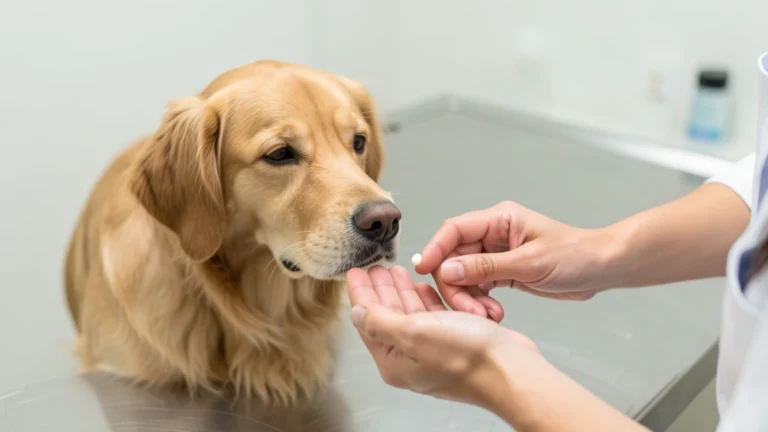
A leftover pill bottle in the cabinet can feel like free medicine for your pet. It is not, and using it that way can be genuinely dangerous. This guide explains how veterinarians actually think about medication dosage, why it is never a simple flat amount, and why the real number should always come from a vet, never from a guess.
Veterinarians usually base pet medication dosage on body weight, often measured as milligrams per kilogram, not a flat amount for every animal. The same drug can be safe for a dog and dangerous or fatal for a cat, and weight is only one of several factors a vet weighs. This article explains the general concept so you understand your vet’s instructions, not so you can calculate a dose yourself. Never guess a dose, reuse an old prescription, or share medication between pets. Always get the real number from your veterinarian or a licensed pharmacist.
Why Dosage Is Based on Body Weight
Most drugs work by reaching a certain concentration inside the body, not by a fixed amount everyone takes. A bigger body has more blood, tissue, and fluid to spread that drug through.
That is why vets typically dose medication using a weight-based measure, often written as milligrams of drug per kilogram of body weight. A heavier pet generally needs more total drug than a lighter pet to reach the same effect.
This article will not walk you through that math for a specific drug. The exact number depends on the medication, the condition being treated, and your individual pet, and only your vet has that full picture.
Think of weight-based dosing as a starting principle, not a formula you can safely apply at home. Your vet turns that principle into a real, safe number using training, references, and knowledge of your pet’s health history.
Why the Same Drug Can Help a Dog and Harm a Cat
Dogs and cats are not just different sizes of the same animal. Their bodies break down and clear drugs in different ways, sometimes very different ways.
Cats are missing or low in certain liver enzymes that dogs and humans use to process some common drugs. Without that enzyme pathway, a drug can build up in a cat’s body instead of clearing out safely.
This is why some pain relievers made for people, such as acetaminophen, are well known to be highly toxic to cats even in small amounts. Certain dog medications and human drugs can be dangerous for cats too, for the same underlying reason.
Species is not a small detail you can skip past. It changes which drugs are even an option, and it changes how any weight-based number gets used. That is one more reason dosage should never be estimated at home.
Why Weight Alone Never Tells the Whole Story
Body weight is only the starting point. Several other things change how a pet’s body handles a drug, and a vet checks all of them together.
Age matters because puppies, kittens, and senior pets often process drugs differently than healthy adults. Young organs may not be fully developed, and older organs may work more slowly.
Kidney and liver function matter a great deal, since those organs clear most drugs from the body. A pet with reduced kidney or liver function may need a lower amount, or a different drug entirely.
Other medications matter too, because some drugs interact badly when combined. Pregnancy or nursing can also change which drugs are safe to use at all.
A vet reviews your pet’s full history before recommending anything. That is information no article or online tool has access to, which is exactly why this stays a job for a professional.
The Real Danger of Guessing or Reusing a Prescription
It can be tempting to reuse a leftover prescription or borrow medication from another pet. This is one of the riskiest things a pet owner can do.
A leftover prescription was dosed for a specific pet, a specific weight, and a specific condition at a specific time. Your pet today may weigh differently, have a different problem, or have a health change since then.
Borrowing a dose meant for a different pet, even a similar-sized one, ignores everything that made that original prescription safe. Species, age, and health status can all be different, even between two pets that look alike.
Guessing a dose because “it worked last time” or “the internet said so” removes the safety checks a vet would normally do. What looks like a small shortcut can lead to a serious, sometimes fatal, mistake.
Why Accurate Measuring Matters
Getting the right amount prescribed is only half the job. Measuring it accurately at home matters just as much.
Liquid medications are usually meant to be measured with the oral syringe or dosing device that comes with the prescription. These tools are built for small, precise amounts.
A household spoon is not a reliable measuring tool. Kitchen spoons vary in size, and a “teaspoon” from one drawer is not guaranteed to match another.
Using the wrong tool can mean giving too little medication, which may not treat the problem, or too much, which raises the risk of side effects. Always ask your vet or pharmacist for the correct measuring device and how to read it.
What a Vet or Veterinary Pharmacist Actually Checks
A vet does far more than multiply your pet’s weight by a number. The table below shows some of what goes into a real, safe dosing decision.
| Factor | Why It Matters |
|---|---|
| Current body weight | Sets the general scale for how much total drug is appropriate |
| Species | Dogs and cats process many drugs very differently, and some drugs suit only one |
| Age and life stage | Puppies, kittens, and seniors often need adjusted care and monitoring |
| Kidney and liver function | These organs clear most drugs, so reduced function can change what is safe |
| Other medications | Some drug combinations interact and raise the risk of side effects |
| Pregnancy or nursing status | Some drugs cross to unborn or nursing offspring and must be avoided |
An owner cannot check all of this at home, even with the best intentions. That is exactly why the real number should always come from a licensed professional who has examined your pet.
Converting Your Pet’s Weight the Right Way
Vets and prescription labels often list dosage using metric units, such as milligrams per kilogram. Most US pet owners think of their pet’s weight in pounds, not kilograms.
That mismatch can make a prescription label confusing, even when the vet has already worked out the real amount for your pet. Understanding what the label says starts with knowing your pet’s weight in the same units the label uses.
This is the one place a simple tool genuinely helps. Our Metric to Imperial Converter converts your pet’s weight between pounds and kilograms, so a label written in kilograms makes sense to you.
To be clear, this converter only changes units. It does not calculate a dose, and it does not replace your vet’s instructions. Use it to understand the label, not to work out an amount on your own.
Trying to make sense of a prescription label written in kilograms? Convert your pet’s weight from pounds to kilograms with our Metric to Imperial Converter, then confirm the actual dose with your veterinarian or pharmacist.
If You Suspect an Overdose, Act Fast
If your pet may have received too much medication, or got into a bottle on their own, treat it as an emergency. Do not wait to see if symptoms appear.
Call your veterinarian right away, even outside normal hours, since many clinics have emergency lines or can direct you to one. You can also contact a pet poison control hotline, such as the ASPCA Animal Poison Control Center, for immediate guidance.
Have the medication name, strength, how much may have been taken, and your pet’s weight ready before you call. This information helps the vet or hotline give you faster, more accurate advice.
Never wait, and never try to treat a suspected overdose yourself with home remedies. Fast professional guidance gives your pet the best chance at a safe outcome.
Frequently Asked Questions About Pet Medication Dosage
Why Is Pet Medication Dosage Usually Based on Body Weight?
Body weight affects how much blood, tissue, and fluid a drug has to spread through in a pet’s body. Vets often use a weight-based measure, such as milligrams per kilogram, as a starting point for a safe amount. This article explains the concept only, not a formula you should use yourself.
Can the Same Medication Be Safe for a Dog but Dangerous for a Cat?
Yes. Cats process some drugs very differently than dogs because of differences in their liver enzymes. Some human and dog medications, including certain pain relievers, are well known to be dangerous or fatal to cats even in small amounts. Species always matters, not just size.
Is Body Weight the Only Thing That Affects a Safe Dose?
No. Age, kidney and liver function, other medications, and pregnancy or nursing status can all change what amount is safe. A vet reviews your pet’s full health history before recommending a dose. Weight is an important input, but it is never the whole picture.
Is It Safe to Reuse a Leftover Prescription for My Pet?
No. A leftover prescription was dosed for a specific pet, weight, and condition at a specific time, which may no longer match your pet today. Reusing it, or borrowing medication meant for another pet, skips the safety checks a vet would normally make. This can lead to a serious or even fatal mistake.
Why Does It Matter How I Measure Liquid Pet Medication?
Household spoons vary in size and are not reliable for measuring medication. The oral syringe or dosing device that comes with a prescription is built for accurate, consistent amounts. Using the wrong tool can mean giving too little or too much medication.
Can the Metric to Imperial Converter Calculate My Pet’s Dose?
No. The Metric to Imperial Converter only converts your pet’s weight between pounds and kilograms, which helps you understand a prescription label written in metric units. It does not calculate a dose or replace veterinary advice. Always get the actual dosing amount from your vet or pharmacist.
What Should I Do If I Think My Pet Got Too Much Medication?
Treat it as an emergency and act immediately. Call your veterinarian or a pet poison control hotline, such as the ASPCA Animal Poison Control Center, right away. Have the medication name, strength, amount, and your pet’s weight ready to share when you call.
Sources
Authoritative Sources Used in This Article
This article is for general education only, not veterinary or medical advice. Every pet is different, so always confirm feeding amounts, medications, and health decisions with a licensed veterinarian. Reviewed for accuracy by Prof. Dr. Khalil Mudassar, PhD. Last updated September 15, 2026.
Author

Shakeel Muzaffar is the Founder and Editor-in-Chief of MultiCalculators.com, bringing over 15 years of experience in digital publishing, product strategy, and online tool development. He leads the platform's editorial vision, ensuring every calculator meets strict standards for accuracy, usability, and real-world value. Shakeel personally oversees content quality, formula verification workflows, and the platform's commitment to publishing tools that are genuinely useful for students, professionals, and everyday users worldwide.