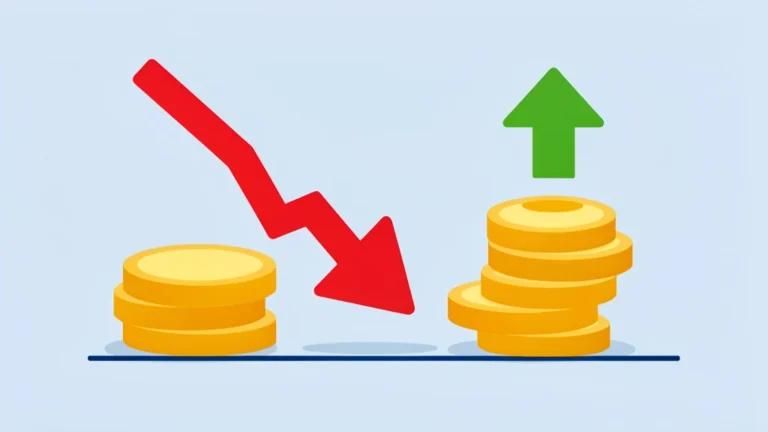
What if a losing investment could actually cut your tax bill? That is the idea behind tax-loss harvesting. You sell an investment that has dropped below what you paid, which turns a paper loss into a real one. That realized loss then offsets your capital gains, so you owe tax on a smaller amount. It is a normal, legal planning move that many investors use each year.
Tax-loss harvesting means selling investments at a loss on purpose to lower your taxes. The loss first cancels out your capital gains, gain for gain. If losses are left over, up to $3,000 per year can offset ordinary income, and the rest carries forward to future years. You must avoid the wash-sale rule by not rebuying the same investment within 30 days. This is general education, not tax advice, and the dollar limits can change.
What Is Tax-Loss Harvesting?
Tax-loss harvesting is the practice of selling an investment for less than you paid. The drop on paper becomes a realized capital loss once the sale is final. That loss has real value because it reduces the gains you get taxed on.
Say you bought a stock for $6,000 and it is now worth $4,000. Selling it locks in a $2,000 loss. You can use that loss to cancel out $2,000 of gains from your winners.
The goal is not to lose money. It is to make an existing loss work for you at tax time instead of sitting idle.
How Losses Offset Your Gains
Losses are matched against gains in a set order before anything else happens. This matters because short-term and long-term gains are taxed differently.
- Short-term losses first offset short-term gains.
- Long-term losses first offset long-term gains.
- Any leftover loss then crosses over to offset the other type of gain.
For how those two gain types are taxed at different rates, see our sibling guide, Capital Gains Tax Explained. Here we stay focused on using losses, not the rate tables.
After all gains are offset, you may still have losses left. That extra amount moves to the next step below.
The Three Jobs a Capital Loss Can Do
A single loss can work in up to three ways, in a fixed order. The table below lines them up so you can see where your loss goes first.
| Step | What the Loss Does | Limit |
|---|---|---|
| 1. Offset gains | Cancels capital gains, matched by type first, then across | No dollar cap |
| 2. Offset income | Reduces ordinary income such as wages | $3,000 per year ($1,500 if married filing separately) |
| 3. Carry forward | Rolls the rest into future tax years | No time limit until used up |
Notice the order never changes. Gains come first, then income, then the carryforward. You do not get to skip a step or pick a bigger income offset.
The $3,000 Ordinary Income Rule
Sometimes your losses are bigger than all your gains combined. The tax rules give that extra loss a second job.
Up to $3,000 of net loss per year can offset ordinary income, like wages. If you are married filing separately, that yearly limit is usually $1,500.
Any loss beyond that yearly cap does not vanish. It carries forward to future years, where it can offset gains again and another $3,000 of ordinary income. This can repeat until the loss is fully used.
A Worked Example You Can Follow
Numbers make this clearer. Imagine you have $8,000 of realized capital gains this year from selling winners.
Now you sell some losers and lock in a $5,000 loss. That loss cancels $5,000 of your gains. Your taxable gains drop from $8,000 to $3,000.
At an illustrative 15% rate, tax on $8,000 would be $1,200. Tax on $3,000 is only $450. That is a $750 difference from one planning move.
What if your loss were larger, say $11,000? First, $8,000 cancels all your gains. Then $3,000 offsets ordinary income, and $0 carries forward. If the loss were $12,000 instead, $1,000 would carry forward to next year.
The Wash-Sale Rule You Must Know
The wash-sale rule stops people from claiming a loss while keeping the same position. It is the biggest trap in harvesting.
The rule says you cannot buy the same or a substantially identical security within 30 days before or after the sale. That creates a 61-day window to watch around the sale date.
If you break it, the loss is disallowed for now and added to the cost of the new shares. To stay safe, investors often wait out the window or buy a different, non-identical investment.
Does It Work for Crypto Too?
Tax-loss harvesting works for stocks, funds, and many other investments. It often applies to crypto as well, though the rules can differ.
Crypto and stock tax treatment is not always the same, and guidance can change. So a move that is fine for one asset may work differently for another.
Because the details vary, it helps to run the numbers before you sell. A tool can estimate your potential loss and savings in a few clicks.
When Does Tax-Loss Harvesting Make Sense?
Harvesting is most useful when you already hold investments trading below their cost. It shines in years when you also booked sizable capital gains.
It can still help in a year with few gains, because of the $3,000 income offset and the carryforward. Those leftover losses wait for you until future years.
But it is not a reason to dump a solid long-term holding. The tax saving should never drive a choice that hurts your investing plan.
Common Mistakes to Avoid
A few simple errors can cancel the benefit or create a tax surprise. Keep these in mind before you sell.
- Triggering a wash sale by rebuying the same investment too soon.
- Forgetting that a repurchase in another account, like an IRA, can still count.
- Selling a strong holding only to chase a small tax break.
- Ignoring trading costs that may eat into your savings.
- Assuming this year’s dollar limits will stay the same next year.
When in doubt, slow down and check the current rules. A little planning keeps a smart move from backfiring.
Want to see your own numbers? Estimate your losses, offsets, and potential savings with our Tax-Loss Harvesting Calculator. It turns these rules into a clear, personalized result so you can plan with confidence.
Frequently Asked Questions About Tax-Loss Harvesting
What Is Tax-Loss Harvesting in Simple Terms?
Tax-loss harvesting is selling an investment that has dropped below what you paid. That turns a paper loss into a realized loss you can use at tax time. The loss offsets your capital gains, so you owe tax on a smaller amount. The goal is to make an existing loss useful rather than waste it.
How Do Capital Losses Offset Gains?
Losses are matched by type first. Short-term losses offset short-term gains, and long-term losses offset long-term gains. Any leftover loss then crosses over to offset the other type. Once all gains are covered, a remaining loss can offset ordinary income up to the yearly limit.
What Is the $3,000 Loss Limit?
If your losses are bigger than all your gains, up to $3,000 of the net loss per year can offset ordinary income like wages. For married filing separately, the limit is usually $1,500. Any loss beyond the cap carries forward to future years. These figures can change, so confirm current IRS rules.
What Is the Wash-Sale Rule?
The wash-sale rule blocks a loss if you buy the same or a substantially identical security within 30 days before or after the sale. That is a 61-day window around the sale date. If you break it, the loss is disallowed and added to your new shares’ cost basis instead.
Can I Carry Forward Unused Losses?
Yes. Losses you cannot use this year do not disappear. They carry forward to future years, where they can offset gains again and another $3,000 of ordinary income. This can continue year after year until the loss is fully used up.
Does Tax-Loss Harvesting Work for Crypto?
It often can, because crypto sold at a loss may produce a usable capital loss. However, crypto and stock rules are not always identical, and guidance can change. Check current IRS rules and consider a tax professional before applying the same steps to crypto.
Is Tax-Loss Harvesting Worth It?
It can lower your tax bill when you already hold investments at a loss. The benefit depends on your gains, your income, and your tax situation. It is a planning tool, not a reason to sell a good long-term holding. Running your own numbers helps you decide.
Sources
Authoritative Sources Used in This Article
This article is for general education only, not tax advice. Tax laws, rates, brackets, and limits change often and vary by state and situation, so check the current IRS rules and consult a tax professional for your situation. Reviewed for accuracy by Prof. Dr. Khalil Mudassar, PhD. Last updated September 12, 2026.
Author

Shakeel Muzaffar is the Founder and Editor-in-Chief of MultiCalculators.com, bringing over 15 years of experience in digital publishing, product strategy, and online tool development. He leads the platform's editorial vision, ensuring every calculator meets strict standards for accuracy, usability, and real-world value. Shakeel personally oversees content quality, formula verification workflows, and the platform's commitment to publishing tools that are genuinely useful for students, professionals, and everyday users worldwide.