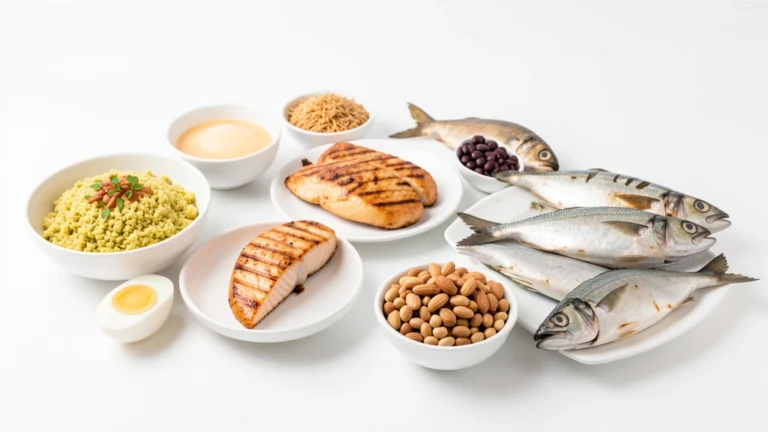
The baseline for general adults is about 0.8 grams of protein per kilogram of body weight per day, the amount set by the RDA. Active people, older adults, and those building muscle or losing fat often benefit from more, with commonly cited ranges of 1.2 to 2.0 grams per kilogram. For steady results, spread your protein across meals and favor complete protein sources.
- The RDA baseline is roughly 0.8 grams of protein per kilogram of body weight for a general, healthy adult.
- Higher goals such as staying active, preserving muscle with age, building muscle, or losing fat often call for 1.2 to 2.0 grams per kilogram.
- To convert, multiply your weight in kilograms by the target per kilogram; a 70 kilogram adult at 0.8 needs about 56 grams a day.
- Spreading protein across meals, rather than loading it into one, helps the body use it for muscle repair.
- Complete protein sources supply all the essential amino acids; mixing plant foods can cover the same range.
- People with kidney disease and certain other conditions need individualized targets from a clinician.
How Much Protein Do You Need per Day?
The short answer is that a general, healthy adult needs about 0.8 grams of protein for each kilogram of body weight every day. That figure is the Recommended Dietary Allowance, usually shortened to RDA, and it represents the amount that meets the basic needs of nearly all healthy adults. It is a floor for preventing deficiency, not a ceiling, and many people have good reasons to eat more.
Protein does more than build muscle. Your body uses it to repair tissue, make enzymes and hormones, support your immune system, and carry substances through the blood. Because the body cannot store spare protein the way it banks fat, a steady daily supply matters. MedlinePlus, the consumer health service of the National Institutes of Health, describes protein as a building block found in every cell of the body.
Your exact number depends on your body weight and your goals. The higher end of the common ranges is tied to activity, age, and whether you are trying to add muscle or hold onto it while losing fat. If you want to see how protein fits inside your total daily energy needs, the Calorie Calculator estimates the calories that surround these grams.
What the RDA Baseline Means
The 0.8 grams per kilogram figure is set for the average sedentary adult, and it is expressed per kilogram of body weight rather than as a single flat number so that it scales with body size. A larger person needs more total grams than a smaller person to meet the same relative target.
To use it, take your weight in kilograms and multiply. If you weigh 70 kilograms, then 70 times 0.8 gives about 56 grams of protein a day at the baseline. If you know your weight only in pounds, divide by 2.2 first to get kilograms, then multiply.
Protein Targets by Goal
Once you move past the baseline, the right amount depends on what you are asking your body to do. The table below shows the commonly cited ranges by goal, along with example grams for a 70 kilogram adult so the arithmetic is easy to follow. The figures are general references, not prescriptions, and individual needs vary.
| Goal | Grams per Kilogram | Example at 70 kg |
|---|---|---|
| General adult (RDA baseline) | 0.8 | about 56 grams |
| Active or endurance training | 1.2 to 1.4 | about 84 to 98 grams |
| Building muscle or losing fat | 1.6 to 2.0 | about 112 to 140 grams |
The jump from the baseline to the muscle-building range roughly doubles the daily grams for the same person. That is why your goal, not just your weight, drives the number. The chart below shows the three targets side by side for a 70 kilogram adult.
Active and Endurance Training
People who train regularly use and rebuild muscle protein more often, so they usually sit above the baseline, commonly around 1.2 to 1.4 grams per kilogram. Endurance athletes fall near the lower part of this band, while heavier training pushes it upward.
Building Muscle or Losing Fat
When the goal is to add muscle or to lose fat while keeping the muscle you have, higher intakes of roughly 1.6 to 2.0 grams per kilogram are often cited. During fat loss, protein helps preserve lean tissue and supports fullness. If this is your aim, the sibling guides on the best macros for building muscle and the best macros for weight loss show how protein fits with carbohydrates and fat.
How to Spread Protein Across Meals
How you distribute protein through the day matters, not only the daily total. Splitting your target across meals gives your body a steadier supply of amino acids for repair, rather than one large load it cannot fully use at once. A simple approach is to aim for a similar amount of protein at each main meal, with the rest coming from snacks.
The chart below takes a 105 gram daily target and divides it into three balanced meals of about 30 grams each, with roughly 15 grams left for a snack. The exact split is flexible; the point is that no single meal has to carry the whole day.
Complete vs Incomplete Protein Sources
Protein is made of amino acids, and nine of them are essential, meaning the body cannot make them and must get them from food. A complete protein contains all nine in useful amounts. Most animal foods, such as eggs, dairy, meat, poultry, and fish, are complete. Soy is a notable complete plant source.
Many plant foods, including beans, lentils, grains, nuts, and seeds, are lower in one or more essential amino acids on their own. That does not make them poor choices. Eating a variety across the day, such as beans with rice, easily supplies the full set. MedlinePlus notes that a mix of plant proteins can meet the body’s needs, so a plant-forward diet can reach the same ranges with planning.
The World Health Organization frames protein foods within an overall healthy diet built on variety, plenty of vegetables and fruit, and limits on excess salt, sugar, and certain fats. Protein does not sit in isolation; it works best as part of that broader pattern. To see how your protein grams translate into a full macro split, the Macronutrient Calculator breaks the day into protein, carbohydrates, and fat.
Who May Need More, Less, or a Custom Target
The general ranges cover most healthy adults, but several groups have different needs, and a few require professional guidance.
Older Adults
Muscle is naturally harder to maintain with age. Many older adults are advised toward the higher end of the general ranges to help preserve strength and function, though the right amount depends on health status and activity.
Pregnancy, Illness, and Recovery
Needs can rise during pregnancy and breastfeeding, and during recovery from illness, surgery, or injury when tissue repair increases. These situations are individual, and a healthcare provider or registered dietitian can set an appropriate target.
Kidney Disease and Other Conditions
People with chronic kidney disease or certain other medical conditions may need to limit or carefully manage protein, and the general ranges here do not apply to them. If you have a diagnosed condition that affects how your body handles protein, do not adjust your intake on your own. Talk to a healthcare provider or registered dietitian who can tailor a plan to your situation.
FAQs About Protein Intake
How Much Protein Do I Need per Day?
A general healthy adult needs about 0.8 grams per kilogram of body weight, the RDA baseline. Active people, older adults, and those building muscle or losing fat often aim higher, commonly 1.2 to 2.0 grams per kilogram.
What Does the RDA for Protein Actually Mean?
The RDA is the Recommended Dietary Allowance, the amount that meets the needs of nearly all healthy adults. For protein it is about 0.8 grams per kilogram of body weight. It is a minimum to prevent deficiency, not a limit.
How Do I Convert Grams per Kilogram Into Total Grams?
Multiply your weight in kilograms by the target. A 70 kilogram adult at 0.8 needs about 56 grams a day. If you know only pounds, divide by 2.2 to get kilograms first, then multiply by your target.
Do I Need More Protein to Build Muscle?
Building muscle or losing fat while keeping muscle often calls for more, with ranges around 1.6 to 2.0 grams per kilogram commonly cited. Protein supports repair and helps preserve lean tissue, alongside training and overall calories.
Should I Spread Protein Across the Day?
Spreading protein across meals gives your body a steadier supply of amino acids for repair rather than one large load. A common approach is a similar amount at each main meal, with the rest from snacks.
Can I Get Enough Protein From Plants?
Yes. Soy is a complete plant protein, and mixing sources such as beans, lentils, grains, nuts, and seeds across the day supplies all the essential amino acids. A varied plant-forward diet can reach the same ranges with planning.
Can Too Much Protein Be a Problem?
For most healthy adults, moderately higher protein within a balanced diet is generally fine. People with kidney disease or certain conditions may need to limit protein and should follow individualized advice from a healthcare provider or registered dietitian.
Sources
Authoritative Sources Used in This Article
- MedlinePlus (National Institutes of Health), Protein in Diet: medlineplus.gov
- MedlinePlus (National Institutes of Health), Nutrition: medlineplus.gov
- World Health Organization, Healthy Diet: who.int
Not medical advice: This article is general educational information only and is not medical, nutritional, or dietary advice, and it is not a substitute for care from a qualified professional. Protein needs vary with age, weight, activity, pregnancy, and medical conditions, and people with kidney disease or other health issues require individualized targets. Talk to a healthcare provider or registered dietitian before making changes to your diet. Reviewed for accuracy by Dr. Abdullah Khalil, MBBS, as part of our editorial review process. Content last reviewed September 10, 2026.
Author

Shakeel Muzaffar is the Founder and Editor-in-Chief of MultiCalculators.com, bringing over 15 years of experience in digital publishing, product strategy, and online tool development. He leads the platform's editorial vision, ensuring every calculator meets strict standards for accuracy, usability, and real-world value. Shakeel personally oversees content quality, formula verification workflows, and the platform's commitment to publishing tools that are genuinely useful for students, professionals, and everyday users worldwide.