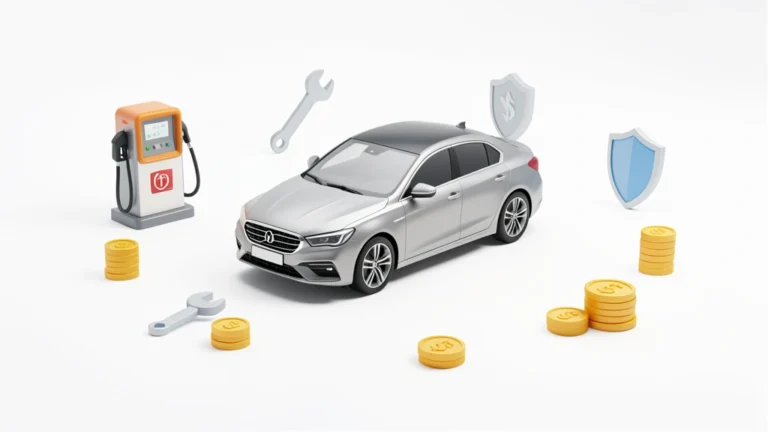
The monthly loan payment is only one slice of what a car costs you. The true cost of car ownership adds depreciation, insurance, fuel or charging, maintenance and repairs, registration and taxes, and the interest on your financing. Add those together and the yearly number is usually far higher than the payment alone, with depreciation quietly leading the pack.
- Total cost of ownership is the payment plus depreciation, insurance, fuel or charging, maintenance and repairs, registration and taxes, and financing interest.
- Depreciation, the value a car loses over time, is usually the single largest cost and the easiest one to overlook because you never write a check for it.
- Fuel and insurance are the next biggest line items for most drivers, and both swing widely with the vehicle you choose.
- A cheaper monthly payment can hide a more expensive car once fuel, insurance, and repairs are counted.
- Estimating every category before you buy protects your budget from surprises down the road.
What Is the True Cost of Car Ownership?
The true cost of car ownership is the full amount a vehicle takes out of your budget each year, not just the loan installment you see on your statement. Buyers tend to shop by monthly payment, because that is the number a dealer quotes. But the payment covers only the price of the car and the interest on the loan. Everything else that keeps the car legal, fueled, insured, and running sits outside that figure.
Think of ownership as six recurring costs stacked on top of one another: depreciation, insurance, fuel or charging, maintenance and repairs, registration and taxes, and financing interest. Some you pay in obvious bills. Others, like depreciation, never send an invoice at all, which is exactly why they are so easy to ignore. To model the loan portion on its own, the Auto Loan and Car Payment Calculator shows how the price, rate, and term shape your payment.
Industry guides that track these numbers, such as AAA in its annual Your Driving Costs research, consistently show that the all-in yearly cost of a typical new vehicle runs well into five figures once every category is counted. The exact total depends on the car, your mileage, and where you live, but the structure is always the same handful of buckets.
The Six Costs That Make Up Total Cost of Car Ownership
Each category behaves a little differently. Some are fixed and predictable, some rise with the miles you drive, and one is almost entirely out of your control. Here is what sits inside each bucket.
Depreciation
Depreciation is the value your car loses as it ages and racks up miles. It is usually the largest single cost of ownership, and for a new car the steepest drop happens in the first few years. You feel it only when you sell or trade in, which is why so many owners never think of it as a cost at all. Buy a car for 35,000 dollars and sell it for 20,000 a few years later, and that 15,000 dollar gap was a real expense, spread quietly across every year you owned it.
Insurance
Auto insurance is a fixed cost you pay whether the car sits in the driveway or crosses the country. Premiums vary with your driving record, location, coverage level, and the vehicle itself, since some models cost more to repair or replace. For many drivers it is the second or third largest line item after depreciation and fuel.
Fuel or Charging
Fuel rises directly with how far you drive and how efficient your car is. A vehicle with strong MPG, or an EV charging at home, can cut this line dramatically compared with a thirsty engine. The US Department of Energy runs a fuel cost tool that compares vehicles based on mileage, driving habits, and local prices, which makes this the easiest cost to estimate before you buy.
Maintenance and Repairs
Routine maintenance, such as oil changes, tires, brakes, and fluids, is fairly predictable and grows as the car ages. Repairs are the wild card. A car under warranty may cost you almost nothing beyond scheduled service, while an older vehicle can hand you a large bill with no warning. Setting aside cash for that surprise is smart, and an emergency fund calculator can help you size a cushion for a repair you did not see coming.
Registration and Taxes
State and local governments charge registration fees, title fees, and often an annual property or excise tax tied to the car’s value. Sales tax at purchase can be thousands of dollars on its own. These vary widely by state, but they are unavoidable and worth checking before you buy.
Financing Interest
If you borrow to buy, interest is the cost of the loan itself, separate from the principal you are repaying. A longer term lowers the monthly payment but raises the total interest you pay over the life of the loan. The Consumer Financial Protection Bureau points out that the total sales price of a financed vehicle includes that interest, so the sticker price understates what the car really costs you.
A Sample Annual Cost Breakdown
The table below shows illustrative yearly ranges for each category, along with a single midpoint figure used later in the charts. The numbers assume a typical new vehicle driven a normal amount each year. They are rounded for clarity and are meant to show the shape of the costs, not a quote for any specific car. Figures of this kind are consistent with published driving-cost research from sources such as AAA and consumer spending data from the Bureau of Labor Statistics.
| Cost Category | Typical Annual Range | Midpoint Used Below |
|---|---|---|
| Depreciation | 3,000 to 4,500 | 3,800 |
| Fuel or charging | 1,500 to 2,500 | 2,000 |
| Insurance | 1,400 to 2,000 | 1,700 |
| Maintenance and repairs | 900 to 1,500 | 1,200 |
| Financing interest | 700 to 1,200 | 950 |
| Registration and taxes | 600 to 1,000 | 800 |
| Total per year | about 8,100 to 12,700 | 10,450 |
The chart below plots those midpoint figures side by side so the ranking is easy to see. Depreciation sits well ahead of the rest, and the two costs most drivers watch closely, fuel and insurance, come next.
Why Depreciation Is the Biggest Hidden Cost
Depreciation earns the title of biggest hidden car cost for one simple reason: no one bills you for it. Fuel, insurance, and registration all arrive as clear payments, so you feel them. Depreciation just sits inside the car’s falling resale value, invisible until the day you sell or trade in.
The share each category takes of the total makes the point clearly. Using the midpoint figures from the table, depreciation alone is roughly a third of the entire yearly cost, larger than any bill you actually pay by hand. The stacked bar below shows how the whole ownership cost divides up.
Two ways to soften depreciation stand out. Buying a lightly used car lets the first owner absorb the steepest early drop, so more of your money buys transportation rather than lost value. Choosing a model known to hold its value slows the decline. Neither erases depreciation, but both shrink the largest cost on the list.
How to Estimate Your Own True Cost of Car Ownership
You do not need every figure to the dollar. A reasonable estimate of each bucket is enough to compare two cars honestly. Work through the categories one at a time.
- Depreciation: estimate what the car will be worth in a few years and subtract that from the price, then spread the gap across the years you plan to keep it.
- Fuel or charging: multiply your yearly miles by the car’s efficiency and your local fuel or electricity price, or use a fuel cost tool to compare models.
- Insurance: get a quick quote for the specific vehicle before you buy, since premiums differ sharply between models.
- Maintenance and repairs: budget for scheduled service and set aside a repair cushion, larger for an older or out-of-warranty car.
- Registration and taxes: check your state’s fees and any annual vehicle tax, plus sales tax at purchase.
- Financing interest: use a loan calculator to see the total interest across the full term, not just the monthly payment.
Add these six estimates for a yearly total, then divide by twelve for a true monthly cost that dwarfs the loan payment alone. This exercise also drives two related decisions. Our guide on how much car you can afford turns these costs into a spending limit, while our comparison of leasing versus buying a car shows how ownership costs shift when you never actually own the vehicle.
FAQs About the Cost of Car Ownership
What Is the True Cost of Car Ownership?
It is the full yearly cost of a car, not just the loan payment. It combines depreciation, insurance, fuel or charging, maintenance and repairs, registration and taxes, and financing interest into one total that is usually far higher than the payment alone.
What Is the Biggest Hidden Cost of Owning a Car?
Depreciation is usually the largest and most overlooked cost. It is the value the car loses over time, and because no one bills you for it, most owners feel it only when they sell or trade in for far less than they paid.
How Much Does It Cost to Own a Car Per Year?
For a typical new vehicle, all-in yearly costs commonly run into five figures once every category is counted. The exact total depends on the car, your mileage, your insurance, and local taxes, so a personal estimate matters more than any average.
Does Depreciation Count if I Never Sell the Car?
Yes, in effect. Even if you keep the car for its whole life, you paid for value you gradually used up, and you give up the resale money you could have recovered. Driving a car until it is worthless simply means you absorbed all of its depreciation.
Are Electric Cars Cheaper to Own Than Gas Cars?
Often on fuel and routine maintenance, an EV can cost less to run than a comparable gas car, especially with home charging. But the full picture still depends on purchase price, depreciation, insurance, and local electricity rates, so compare the total, not one line.
How Can I Lower My Total Cost of Car Ownership?
Buy a model that holds its value and has strong MPG, consider a lightly used car to skip the steepest depreciation, shop your insurance, keep up with maintenance, and choose a loan term that limits total interest rather than only shrinking the payment.
Is Buying or Leasing Cheaper Overall?
It depends on how long you keep the vehicle and how you value ownership. Leasing can lower monthly cost but you never build equity, while buying costs more up front yet leaves you with a car that has resale value. Compare the total cost of each path.
Sources
Authoritative Sources Used in This Article
- Consumer Financial Protection Bureau, What is the total sales price of a vehicle: consumerfinance.gov
- Federal Trade Commission, Financing or Leasing a Car: consumer.ftc.gov
- US Department of Energy, Save Money and Fuel: fueleconomy.gov
- US Bureau of Labor Statistics, Consumer Expenditures News Release: bls.gov
Educational note: This article is general information, not financial advice. Ownership costs vary by vehicle, mileage, location, insurance, and loan terms, and the figures shown are illustrative rather than quotes for any specific car. Estimate the numbers for your own situation and speak with a qualified professional before making a purchase or financing decision. Reviewed for accuracy by Prof. Dr. Khalil Mudassar, PhD, as part of our editorial review process. Content last reviewed September 9, 2026.
Author

Shakeel Muzaffar is the Founder and Editor-in-Chief of MultiCalculators.com, bringing over 15 years of experience in digital publishing, product strategy, and online tool development. He leads the platform's editorial vision, ensuring every calculator meets strict standards for accuracy, usability, and real-world value. Shakeel personally oversees content quality, formula verification workflows, and the platform's commitment to publishing tools that are genuinely useful for students, professionals, and everyday users worldwide.