Updated July 31, 2026
How credit card interest is calculated daily: issuers usually convert your APR into a daily periodic rate, apply that rate to each day’s balance, and add the daily charges for the billing cycle. At 24% APR, the daily rate is about 0.06575%. A constant $5,000 balance for 30 days would generate roughly $98.63 in interest under a non-compounding average-daily-balance calculation.
A 24% APR does not literally become 40% just because interest is calculated daily. If interest compounds every day, its effective annual rate is about 27.11%. The cost can feel much higher when a lost grace period makes new purchases accrue interest immediately, fees increase the balance, cash advances use a higher rate, and minimum payments reduce principal slowly.
The Daily Periodic Rate: What Your APR Becomes Each Day
The daily periodic rate is the daily version of your annual percentage rate. For a card using a 365-day divisor, the basic credit card interest formula is:
Daily periodic rate = APR ÷ 365
With a 24% purchase APR:
0.24 ÷ 365 = 0.000657534, or about 0.06575% per day
If today’s balance is $5,000 and interest is accruing, one day’s estimated interest is:
$5,000 × 0.000657534 = $3.29
That daily amount changes when purchases post, payments or credits are applied, fees are added, or a different APR applies to part of the balance. Your statement should separate balance categories—such as purchases, cash advances, and balance transfers—and show the APR for each.
Some agreements add each day’s interest to the next day’s balance, producing daily compounding. Others use an average daily balance calculation without adding unpaid interest inside the same cycle. The CFPB’s model credit card definitions describe both approaches. Read the “How We Calculate Interest” section of your own agreement for the exact method.
Does 24% APR really equal 40%?
No. Pure daily compounding turns a 24% nominal APR into an effective annual rate of approximately 27.11%, calculated as (1 + 0.24 ÷ 365)365 − 1. A much larger felt cost usually reflects other forces: continuing to spend while paying down debt, transaction fees, a cash-advance APR, penalty pricing, or the loss of a purchase grace period. APR is still the right standardized rate for comparing borrowing costs, but it is not a payoff plan.
The Average Daily Balance Method: How Your Balance Is Calculated
The average daily balance method gives every day in the billing cycle a vote. The issuer records a balance for each day, adds those balances together, and divides by the number of days in the cycle.
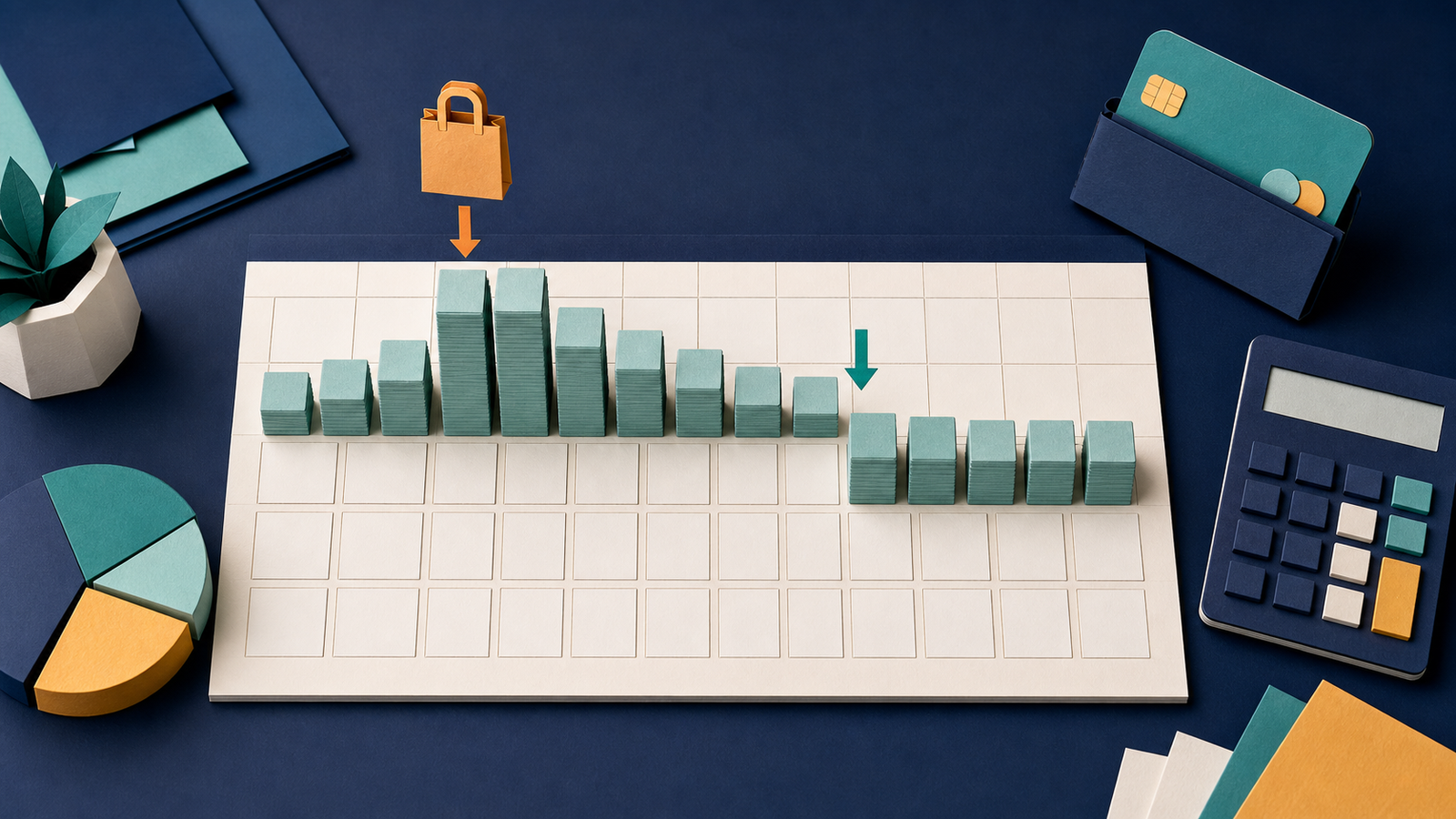
Average daily balance = Sum of daily balances ÷ Number of days in billing cycle
Consider a simplified 30-day cycle:
| Days | Balance | Balance-days |
|---|---|---|
| Days 1–10 | $4,000 | $40,000 |
| Days 11–20 after a $1,000 purchase | $5,000 | $50,000 |
| Days 21–30 after a $1,500 payment | $3,500 | $35,000 |
| Total | 30 days | $125,000 |
The average daily balance is $125,000 ÷ 30 = $4,166.67. At 24% APR, estimated cycle interest is:
$4,166.67 × (0.24 ÷ 365) × 30 = $82.19
This is an educational estimate. Posting dates, transaction categories, minimum interest charges, the divisor used, rounding, and whether interest compounds during the cycle can change the statement result.
Why Carrying a Balance Even for One Day Costs More Than You Think
One day of interest is usually small; the costly part is what that carried balance can do to your grace period. If you do not pay the required statement balance in full, your issuer may charge interest on the unpaid amount and start charging interest on new purchases from each transaction date. That turns a one-time shortfall into a wider stream of interest-bearing days.
There may also be residual or trailing interest. Interest can accrue between the last statement closing date and the date your payoff reaches the issuer. Because that amount was not yet on the previous statement, a small interest charge may appear on the next one even after you paid the displayed balance. Ask the issuer for a current payoff amount if you are trying to bring a revolving account to zero.
The CFPB notes that paying sooner lowers interest when no grace period applies. A payment made halfway through the cycle reduces the balance used for the remaining days; waiting until the due date does not undo the earlier interest-bearing days.
The Grace Period Math: Why Paying in Full Can Save the Entire Month’s Interest
A purchase grace period is the time between the end of a billing cycle and the payment due date during which qualifying purchase interest can be avoided. Federal rules generally require card issuers to deliver statements at least 21 days before the due date, but they do not require every card to offer a grace period.

Suppose you begin with no carried balance, make $3,000 of eligible purchases during the cycle, and your card provides a purchase grace period:
- Pay the full $3,000 statement balance by the due date: purchase interest is generally $0.
- Pay only $2,900: interest may be charged on the unpaid balance, and new purchases may begin accruing interest from their transaction dates.
The precise consequence depends on the agreement. Some issuers require one or more full-payment cycles to restore a lost grace period. The safest instruction is therefore not “pay the current balance whenever convenient,” but pay the statement balance in full by the due date and confirm how your issuer restores a lost grace period.
Cash Advances: Why the Rate and Rules Are Completely Different
Cash advances generally start accruing interest on the transaction date, with no purchase-style grace period. They may also carry a higher APR and a transaction fee. ATM fees can add another cost.
For example, a $1,000 cash advance with a hypothetical 5% fee immediately creates $1,050 of debt. If its APR is 30%, 20 days of simple daily interest would be approximately:
$1,050 × (0.30 ÷ 365) × 20 = $17.26
The combined fee and estimated interest would be about $67.26 before any ATM charge. Check whether transactions such as convenience checks, gambling chips, money orders, person-to-person transfers, or overdraft funding are treated as cash equivalents under your agreement.
Payments above the minimum generally must be allocated first to the balance with the highest APR. The issuer may have more discretion over the minimum-payment portion, which is another reason to review the statement’s interest-charge table.
Balance Transfers: The Math Behind the Promotional Rate Trap
A 0% promotional APR is not necessarily free. The CFPB’s December 2025 Consumer Credit Card Market Report found that balance transfers among the 25 largest issuers carried an average fee of 4.3% in the second half of 2024.
At a 4.3% fee, transferring $8,000 costs $344 upfront, creating an $8,344 payoff target if the fee is added to the balance. To clear it in 15 equal months at 0%, you would need to pay about $556.27 per month. Paying only $400 would leave roughly $2,344 when the promotion ends, before considering any other charges.
There is another trap: on many cards, carrying a promotional transfer means new purchases no longer receive a grace period unless the entire account balance—including the transfer—is paid in full. The CFPB advises consumers to check this interaction. A practical strategy is to avoid new purchases on the transfer card unless its disclosure clearly preserves a purchase grace period.
How Minimum Payments Keep Your Average Daily Balance High
A minimum payment protects the account from being immediately past due; it is not designed to minimize interest. When the payment is only slightly larger than the month’s interest and fees, little reaches principal, so the next cycle begins with nearly the same balance.
Using a simplified fixed-payment example, a $5,000 balance at 24% APR with no new purchases would take about:
| Monthly payment | Approximate payoff time | Approximate interest |
|---|---|---|
| $150 | 56 months | $3,324 |
| $250 | 26 months | $1,449 |
| $400 | 15 months | $812 |
These estimates use a monthly-rate model for comparison, so an issuer’s daily method will differ slightly. Actual minimum payments also change over time and may include a percentage of principal, accrued interest, fees, or a fixed floor. Your statement’s required “Minimum Payment Warning” provides an account-specific payoff estimate assuming no new purchases.
If cash flow is tight, pay at least the required minimum on time, stop adding new charges if possible, and contact the issuer before missing a payment. The CFPB recommends contacting the card company immediately when you cannot make the minimum; you do not need to be behind to ask about hardship options.
Run Your Numbers with Our Credit Card Interest Cost Calculator
Your balance pattern matters more than a single APR label. Model the balance, rate, payment timing, and payoff plan with our credit card interest cost calculator.
- Enter the balance and the APR that applies to that balance category.
- Use your statement’s billing-cycle length and payment details when available.
- Compare the minimum with a realistic fixed payment.
- Test an earlier one-time payment to see how lowering daily balances changes the estimate.
Then use the minimum payment calculator to see the long payoff tail, compare rate terminology with the APR vs. APY calculator, and estimate a finish line with the credit card payoff date calculator.
Frequently Asked Questions
How does credit card interest get calculated?
Many issuers divide the APR by 365 to get a daily periodic rate, apply that rate to daily balances, and total the resulting interest for the billing cycle. A common estimate is: average daily balance × daily periodic rate × number of days. Your card agreement determines the exact method.
What is the daily periodic rate on a 24% APR credit card?
Using a 365-day divisor, 24% ÷ 365 equals about 0.06575% per day, or 0.0006575 in decimal form.
Is credit card interest compounded daily?
It can be. Some issuers add each day’s interest to the next day’s balance, while others calculate interest with an average daily balance method that does not compound inside the cycle. Check the interest-calculation clause in your agreement.
Do I pay interest if I pay the statement balance in full?
If your card offers a purchase grace period and you meet its conditions, paying the full statement balance by the due date generally avoids interest on eligible purchases. Cash advances and many balance transfers typically do not receive that grace period.
Why did I get an interest charge after paying off my card?
Residual interest may have accrued between the statement closing date and the date your payment posted. A small trailing charge can therefore appear on the next statement. Ask the issuer for the current payoff amount and confirm when the balance reaches zero.
Sources and Methodology
The formulas and consumer protections in this article were checked against current CFPB explanations, Regulation Z, and the CFPB’s December 2025 market report. Examples are rounded and illustrative; they are not a reproduction of any one issuer’s statement calculation.
- CFPB: How credit card companies calculate interest
- CFPB: Credit card grace periods
- CFPB: Purchases after a low-rate balance transfer
- Regulation Z § 1026.7: Periodic statement requirements
- CFPB: Consumer Credit Card Market Report, December 2025
Editorial disclosure: This content is educational and does not provide individualized financial, legal, or credit advice. Rates, fees, posting rules, and grace-period terms vary. Check your cardholder agreement and latest statement, or contact the issuer for an account-specific calculation.
Author

Shakeel Muzaffar is the Founder and Editor-in-Chief of MultiCalculators.com, bringing over 15 years of experience in digital publishing, product strategy, and online tool development. He leads the platform's editorial vision, ensuring every calculator meets strict standards for accuracy, usability, and real-world value. Shakeel personally oversees content quality, formula verification workflows, and the platform's commitment to publishing tools that are genuinely useful for students, professionals, and everyday users worldwide.