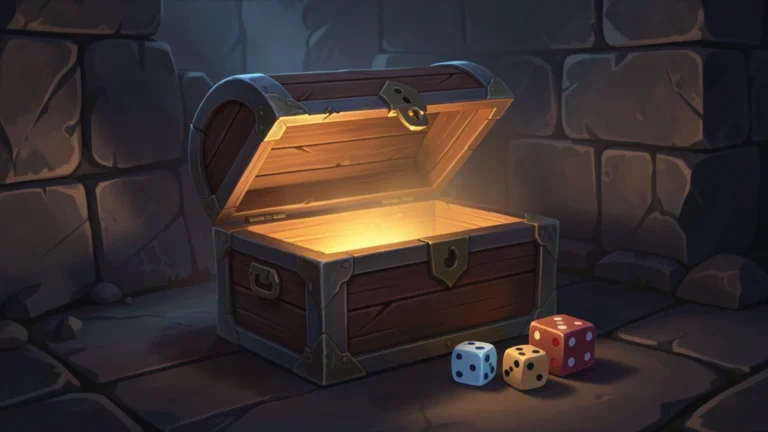
You have killed the same boss forty times and the item still has not dropped. It feels like the game owes you one by now. It does not, and understanding why is the key to reading drop rates correctly. This guide breaks down what a drop rate percentage really means, why low odds are never “due,” and how to estimate your real chances across many attempts.
A drop rate is an independent chance that resets every single time, so a 1 percent item is just as likely on try 200 as it was on try 1. The odds never “build up” from past failures, which is why chasing a rare drop can feel unlucky even when the math is working exactly as designed. To estimate your real chance across many attempts, use 1 minus (1 minus the drop rate) raised to the number of tries. Always confirm whether a listed rate is per kill, per run, or per chest, since that detail changes the true odds. Trust official patch notes or well-documented wikis over rumors and forum guesses.
What a Drop Rate Percentage Actually Means
A drop rate is the chance an item appears on a single try, and nothing more. A 5 percent drop rate means that, on any one kill or chest, there is a 5 in 100 chance of getting the item.
That chance applies fresh every time. The game does not track your bad luck, save it up, or slowly raise your odds because you have been unlucky. Each attempt is its own independent event, unrelated to every attempt before it.
This is why two players can grind the exact same boss and get wildly different results. One might get the item on try 3, another might still be waiting at try 150, and both outcomes are fully consistent with the same listed rate.
It also helps to remember that a drop rate is not a promise about your specific playtime. It is a long-run average across thousands of players and thousands of attempts, not a schedule that applies to any one person’s grind.
The Gambler’s Fallacy: Why a Low-Odds Item Is Never “Due”
The gambler’s fallacy is the mistaken belief that a random outcome becomes more likely simply because it has not happened in a while. It shows up constantly in loot chasing, and it feels very convincing in the moment.
Here is the key idea: a coin, a die, and a loot table all have no memory. If a drop rate is 2 percent, it stays 2 percent on your first try and on your five hundredth try, because the game rolls it independently each time.
Thinking an item is “due” after many failed attempts is a common trap, but it does not match how independent probability actually works. Long streaks without a rare drop are unlucky, not evidence that something is broken.
Some games soften that frustration with a separate pity system, which guarantees an item after a set number of failed tries. That is a different mechanic layered on top of the base drop rate, and our sibling guide on gacha pity systems breaks down how it works.
How to Estimate Your Chance Over Many Attempts
Even though each try is independent, you can still estimate the chance of getting an item at least once across a batch of attempts. The formula is simple: 1 minus (1 minus the drop rate) raised to the number of tries.
Say a drop rate is 1 percent, written as 0.01. After 100 attempts, the chance of getting the item at least once is 1 minus 0.99 raised to the 100th power, which works out to about 63 percent.
Notice that is not 100 percent, and it is not even close to a guarantee. It also is not simply 100 attempts times 1 percent, which would wrongly suggest a sure thing. Probability across repeated independent tries grows more slowly than that kind of simple multiplication.
A lower drop rate needs far more attempts to reach a similar overall chance. At a 0.5 percent rate, 100 tries only gets you to roughly a 39 percent chance of seeing the item at least once.
Per-Kill vs Per-Run vs Per-Chest: Why the Fine Print Matters
A drop rate is only meaningful once you know what one “attempt” actually is. Games measure attempts differently, and mixing them up leads to bad expectations.
A per-kill rate rolls separately for every enemy you defeat, so a long fight against many small enemies gives you many rolls. A per-run rate rolls only once, at the end of a full mission or dungeon, no matter how many enemies you fought inside it. A per-chest rate rolls once each time you open a specific container, regardless of how you got there.
| Rate Type | When It Rolls | Effect on Real Odds |
|---|---|---|
| Per Kill | Once for every enemy defeated | Many small enemies can add up to more total rolls |
| Per Run | Once at the end of a mission or dungeon | One roll no matter how long or hard the run was |
| Per Chest | Once each time a specific chest is opened | Depends entirely on how often that chest is available |
Two games can both advertise a “5 percent drop rate” and mean very different things. Always check which unit the rate applies to before you estimate how long a grind will really take.
Why You Should Trust Patch Notes and Wikis, Not Rumors
Community guesses about drop rates spread fast, and they are often wrong. A number repeated in chat or a forum thread is not the same as a number the developer actually published.
Official patch notes are the most reliable source, since developers sometimes state the exact rate when introducing or adjusting an item. Well-maintained wikis are also useful, especially ones that log large sample sizes from many players over time.
Be cautious with any rate that traces back to a single player’s personal streak. A handful of unlucky or lucky attempts by one person can look very different from the true long-run rate.
When in doubt, look for a source that cites either an official developer statement or a large, tracked sample. Anything smaller is closer to a rumor than a rate.
Also remember that developers sometimes adjust drop rates in balance updates. A rate you read about months ago, or heard from a friend who played an older version, may no longer match the current build. Checking the most recent patch notes for your exact game version helps you avoid planning around an outdated number.
Practicing the Math With a Dice Probability Calculator
Loot drop odds and dice rolls use the exact same kind of math: a fixed chance per try, repeated across many independent attempts. That makes dice an easy, low-stakes way to build intuition for how drop rates behave.
Our Dice Probability Calculator lets you plug in a chance per roll and a number of rolls, then see the real odds of hitting your target at least once. Try entering a small percentage and a large number of attempts to see how slowly the odds climb toward certainty.
Running a few examples this way makes the gambler’s fallacy easier to spot in the moment. Once you see the math laid out clearly, a long dry streak on a rare drop stops feeling like proof the game is against you.
Want to see the odds for yourself instead of guessing? Plug a drop rate and attempt count into our Dice Probability Calculator and watch how the real chance builds across tries.
Frequently Asked Questions About Loot Drop Odds
What Does a Drop Rate Percentage Really Mean?
A drop rate is the chance an item appears on a single attempt, such as one kill or one chest. It does not describe a guarantee within any number of tries. Each attempt rolls that same percentage fresh, independent of every attempt that came before it.
Is a Rare Item “Due” After Many Failed Tries?
No. This idea is called the gambler’s fallacy, and it does not match how independent probability works. A drop rate stays exactly the same no matter how many times it has failed before. Long dry streaks are unlucky, not a sign the odds have changed.
How Do I Calculate the Chance of Getting an Item Within N Attempts?
Use the formula 1 minus (1 minus the drop rate) raised to the number of attempts. For a 1 percent rate over 100 tries, that works out to roughly 63 percent. A Dice Probability Calculator can run this math for you instantly.
Why Do My Actual Drops Feel Different From the Listed Rate?
Small sample sizes vary a lot, even when the underlying rate is correct. Getting an item very early or very late than expected is normal random variation. Over a large number of attempts, results tend to land closer to the published rate.
What Is the Difference Between Per-Kill and Per-Run Drop Rates?
A per-kill rate rolls separately for every enemy defeated, so more kills mean more rolls. A per-run rate rolls only once at the end of a mission, no matter how many enemies were fought inside it. Always check which type a listed rate uses.
Where Can I Find the Real Drop Rate for a Game?
Check official patch notes first, since developers sometimes publish exact rates when adding or changing an item. Well-maintained wikis that track large sample sizes are also reliable. Be cautious of numbers that only trace back to one player’s personal streak.
Can a Long Streak of Bad Luck Mean the Game Is Broken?
Usually not. Long streaks without a rare drop are expected sometimes, especially at low percentages, and they are consistent with normal random behavior. If a rate seems far off from the official number over a very large sample, checking official sources is a better step than assuming a bug.
Sources
Authoritative Sources Used in This Article
This article is for general education only, not financial or gaming advice. Game mechanics and drop rates vary by title and update, so always check the specific game’s official rules. Reviewed for accuracy by Prof. Dr. Khalil Mudassar, PhD. Last updated September 15, 2026.
Author

Shakeel Muzaffar is the Founder and Editor-in-Chief of MultiCalculators.com, bringing over 15 years of experience in digital publishing, product strategy, and online tool development. He leads the platform's editorial vision, ensuring every calculator meets strict standards for accuracy, usability, and real-world value. Shakeel personally oversees content quality, formula verification workflows, and the platform's commitment to publishing tools that are genuinely useful for students, professionals, and everyday users worldwide.