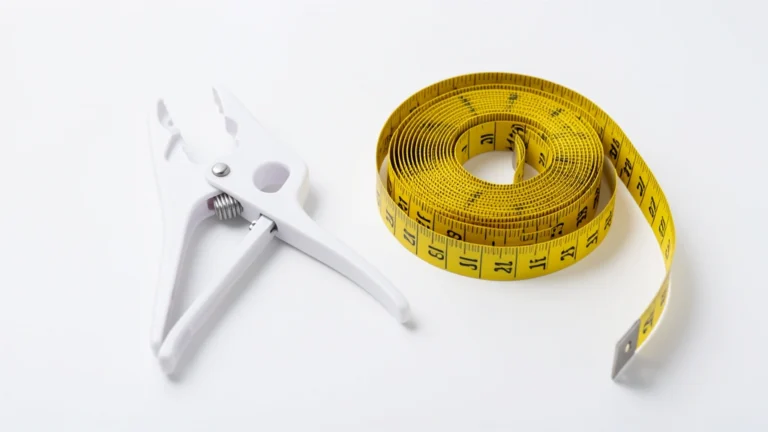
At home you can estimate your body fat percentage in three main ways: skinfold calipers, which pinch the fat under your skin at set sites; a tape measure paired with a formula like the US Navy method, which uses your neck, waist, and hips for women; or a smart scale that sends a tiny current through your body. None of these match a clinical DEXA scan for accuracy, but done consistently they are useful for tracking change over time.
- Home methods estimate body fat; they do not diagnose health conditions.
- Skinfold calipers, a tape measure with the US Navy formula, and smart scales are the three common options.
- Consistency matters more than any single reading: same time, same conditions, same method.
- A DEXA scan is the more precise reference standard but needs a clinic and costs more.
- Use trends over weeks, not one number, and talk to a healthcare provider about what the results mean for you.
What Body Fat Percentage Tells You
Body fat percentage is the share of your total body weight that is fat tissue, with the rest made up of muscle, bone, water, and organs. Two people can weigh the same and look quite different because their fat and muscle proportions differ. That is one reason many people want a measure beyond the number on the scale, and it is also why body composition can add context that weight alone cannot.
It helps to keep expectations grounded. Body fat is essential to health in the right amounts; it stores energy, cushions organs, and supports hormones. There is no single correct number that fits everyone, and healthy ranges vary by age, sex, and individual factors. The goal of measuring at home is not to chase a target or judge your body, but to gather a consistent data point you can watch over time. For a quick screening figure based on height and weight, many people start with a BMI calculator, then use body fat methods to see what BMI cannot show.
How to Measure Body Fat at Home: Three Methods
Each home method trades some accuracy for convenience and cost. Here is how the three most common approaches compare before we walk through each one in detail.
| Method | Rough Accuracy | Typical Cost | Ease of Use |
|---|---|---|---|
| Skinfold calipers | Moderate. Depends heavily on consistent site and technique. | Low. Basic calipers are inexpensive. | Moderate. Easier with a helper; back sites are hard to self-measure. |
| Tape measure with US Navy formula | Moderate. Simple inputs, so it is an estimate, not a precise reading. | Very low. Only a soft tape measure is needed. | Easy. A few circumference measurements plus a quick calculation. |
| Smart scale (bioelectrical impedance) | Variable. Readings shift with hydration and time of day. | Moderate. Costs more than a tape or calipers. | Very easy. Step on and read the estimate. |
| DEXA scan (clinic reference) | High. The common reference standard for comparison. | High. Requires a clinic appointment. | Not a home method. Listed for context only. |
Skinfold Calipers
Skinfold calipers measure the thickness of a fold of skin and the fat just beneath it. You pinch the skin at standard sites, such as the triceps, abdomen, or thigh, close the calipers on the fold, and read the millimeters. Those readings feed into a formula that estimates total body fat. Because fat under the skin tracks loosely with overall fat, this method has been used for decades.
The catch is technique. Pinching a slightly different spot, catching muscle in the fold, or reading the dial inconsistently all change the result. A steady hand and the same sites every time matter more than the caliper brand. Sites on your own back are hard to reach, so calipers are easier and more repeatable when a helper takes the measurements. If you use them, write down each site and always measure under the same conditions.
Tape Measure and the US Navy Method
The US Navy method needs only a soft tape measure and a formula. You measure a few body circumferences, then plug them into an equation that estimates body fat percentage. For men, the inputs are neck and waist plus height. For women, the method adds the hips, so it uses neck, waist, and hips together with height. Because the inputs are simple, this is one of the easiest ways to get a repeatable number at home.
Measure with the tape snug but not digging into the skin, level all the way around, and taken at the same landmarks each time. Small differences in where you place the tape can move the estimate, so consistency is everything. Rather than doing the arithmetic by hand, you can enter your measurements into our body fat calculator to apply the formula and see your estimate right away.
Smart Scales and Bioelectrical Impedance
Smart scales estimate body fat using bioelectrical impedance analysis, or BIA. When you stand on the metal contacts, the scale sends a small, safe electrical current up through your body. Fat, muscle, and water conduct that current differently, and the scale uses the resistance it measures to estimate your body composition. Handheld BIA devices work the same way through your arms.
BIA is the most convenient method, since you just step on and read the number, but it is also the most sensitive to conditions. Hydration, a recent meal, exercise, and even the time of day can shift the reading. Because water conducts the current, being more or less hydrated than usual can nudge the estimate up or down. To get comparable numbers, measure at the same time under the same routine, for example first thing in the morning before eating or drinking.
Getting Consistent, Reliable Readings
Whatever method you pick, consistency is what turns a rough estimate into a useful trend. A single reading carries a margin of error, so one number rarely tells you much. What matters is the direction over several weeks, measured the same way each time.
Build a simple routine and stick to it. Measure at the same time of day, ideally in the morning; keep your hydration and food intake similar before each reading; use the same device and the same technique; and record every result so you can see the pattern. If you switch methods, do not compare the old numbers to the new ones directly, because each method has its own bias. Track within a method, and let the trend, not any single figure, guide how you interpret change.
How Home Methods Compare to a DEXA Scan
A DEXA scan (dual-energy X-ray absorptiometry) is a clinical test often treated as the reference standard for body composition. It uses low-dose X-rays to separate fat, lean tissue, and bone, and it reports results with more precision than any home method. That precision comes at a cost: you need a clinic, an appointment, and usually a fee.
Home methods are not trying to beat DEXA. They aim to be good enough to spot a trend without leaving your bathroom. Calipers, tape formulas, and BIA scales each carry their own margin of error, and their numbers may not agree with one another or with a DEXA result. That is expected. Pick one method, use it consistently, and judge your progress against your own past readings rather than against a clinical scan you are not taking.
Remember What the Number Does and Does Not Mean
Body fat percentage is one data point, not a verdict on your health or your worth. Simple screening tools like BMI and home body fat estimates each have real limits, especially for people whose bodies do not fit the average the formulas were built on. Very muscular people, for instance, can be flagged by height-and-weight measures that were never meant to capture their build, which is why our guide on BMI for athletes exists. To understand where these screening numbers fall short more generally, it is worth reading why BMI can be misleading before you put too much weight on any single figure.
None of these home methods can diagnose a health condition, and none can tell you what a given number means for you personally. Age, sex, muscle mass, and overall health all shape what is healthy for one individual. If you are trying to understand your body composition in the context of your health, or making decisions based on these readings, the right next step is a conversation with a qualified healthcare provider who can look at the whole picture.
Want a quick body composition starting point? Get a fast screening number with the BMI Calculator, then estimate your body fat from a few tape measurements. Use the results to track change over time, and bring any questions to a healthcare provider.
FAQs About Measuring Body Fat
How Can I Measure Body Fat at Home?
The three common home methods are skinfold calipers, a tape measure paired with the US Navy formula, and a smart scale that uses bioelectrical impedance. Each gives an estimate, so use the same method consistently and track the trend rather than a single number.
Which Home Method Is Most Accurate?
All three are estimates with their own margin of error, so none is reliably best for everyone. Careful skinfold caliper readings and the tape-based Navy method can both be repeatable, while smart scales are the most convenient but the most sensitive to hydration and timing.
How Does the US Navy Body Fat Formula Work?
It uses body circumferences and height in an equation. For men it needs the neck and waist; for women it adds the hips, so it uses neck, waist, and hips. Measure with the tape level and snug, then enter the numbers into a calculator to get the estimate.
Are Smart Scale Body Fat Readings Reliable?
They are convenient but can vary with hydration, food, exercise, and time of day, because the current they use is affected by body water. Measuring at the same time under the same routine, such as first thing in the morning, makes the readings more comparable over time.
Do I Need Someone to Help Me Use Calipers?
It helps a lot. Sites on your own back and the backs of your arms are hard to pinch consistently by yourself, and technique strongly affects the result. A helper taking the measurements at the same sites each time usually gives more repeatable readings.
How Accurate Are Home Methods Compared to a DEXA Scan?
A DEXA scan is more precise and is often used as the reference standard, but it requires a clinic and a fee. Home methods are less precise and may not match a DEXA number, yet they are useful for spotting your own trend when used consistently.
Is Body Fat Percentage the Same as BMI?
No. BMI is a screening figure based only on height and weight and does not measure fat directly. Body fat percentage estimates how much of your weight is fat tissue. The two can disagree, especially for very muscular people, so they answer different questions.
Sources
Authoritative Sources Used in This Article
Last updated September 10, 2026. This article is for general education only and is not medical advice; it cannot diagnose any condition, and home body fat methods are estimates rather than clinical measurements. Healthy ranges differ from person to person, so talk to a qualified healthcare provider before making decisions based on these readings. The content was reviewed for accuracy by Dr. Abdullah Khalil, MBBS.
Author

Shakeel Muzaffar is the Founder and Editor-in-Chief of MultiCalculators.com, bringing over 15 years of experience in digital publishing, product strategy, and online tool development. He leads the platform's editorial vision, ensuring every calculator meets strict standards for accuracy, usability, and real-world value. Shakeel personally oversees content quality, formula verification workflows, and the platform's commitment to publishing tools that are genuinely useful for students, professionals, and everyday users worldwide.