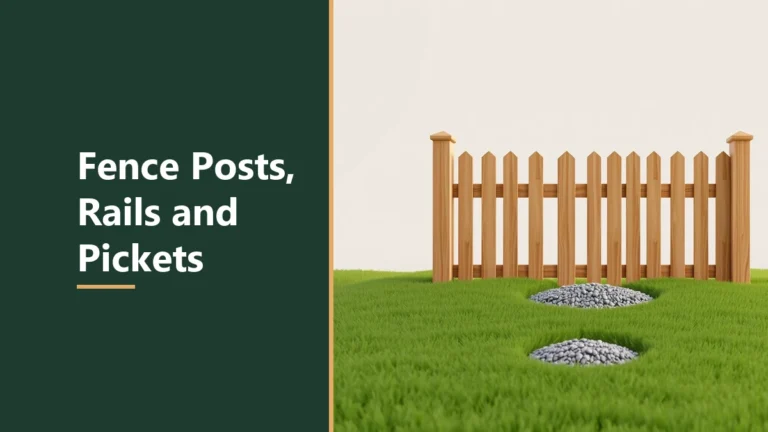
How many posts does a 100 foot fence need? A quick guess of 13 leaves you one post short. Posts, rails and pickets each follow a simple counting rule, and each rule hides one small trap.
Subtract each gate opening from the fence length, divide by post spacing and round up to get sections, then add one end post and one post per gate. Rails equal sections times rails per section. Pickets equal the fenced run in inches divided by picket width plus gap, rounded up. A 100 foot run at 8 foot spacing needs 14 posts.
Start With Posts: Sections Plus One
Posts come first, because rails and pickets hang between them. Divide the fence length by your post spacing and round up. Then add one, since every run needs one more post than it has sections.
Sketch the fence line first, and mark every corner and gate. A simple drawing catches counting errors early. Millard Lumber’s fence guide suggests setting wood posts about 6 to 8 feet apart. This example uses 8 feet. A 100 foot run gives 100 divided by 8, which is 12.5, so you round up to 13 sections. Add one post and the total is 14.
A gate changes the count a little. Its opening has no fence, so subtract the gate width from the length first. Then add one post for the gate, because the opening needs a post on both sides. A 4 foot gate in a 100 foot run leaves 96 feet, which is 12 sections, plus 1 end post and 1 gate post, or 14 posts.
Our fence calculator runs this count for any length and spacing. Corner posts carry fence in two directions, so plan extra bracing at each corner. Round, cap or slant each post top so water drains. Wall framing has a similar counting trap, covered in how many studs you need for a wall.
Rails and Pickets: Count Sections, Then Inches
Rails follow the sections, which are the bays between posts. Multiply the sections by rails per section. The calculator suggests 2 rails up to 6 feet tall, and 3 for taller or heavy fences. Keep the bottom rail at least 2 inches above the ground. Round every result up, because you cannot buy half a rail.
Pickets follow inches. Convert the fenced run to inches, then divide by picket width plus gap, and round up. For 100 feet with no gate that is 1,200 inches. Pickets 3.5 inches wide with no gap give 1,200 divided by 3.5, or 342.86, so you buy 343. With a 4 foot gate the fenced run is 96 feet, or 1,152 inches, which gives 329.14, so you buy 330.
Gaps change the count fast. A 1.5 inch gap makes each picket use 5 inches of run, so the same fence needs only 240. A loose picket makes a handy spacer. Even spacing is also covered in our deck board spacing and quantity guide.
| Style | Picket width | Gap | Run per picket | Pickets |
|---|---|---|---|---|
| Privacy | 3.5 in | 0 in | 3.5 in | 343 |
| Semi-private | 3.5 in | 1.5 in | 5.0 in | 240 |
A Worked Example: 100 Feet, 6 Feet Tall, One Gate
This is the calculator’s default case: 100 feet of privacy fence, 6 feet tall, with one 4 foot gate. Spacing is 8 feet, pickets are 3.5 inches wide with no gap, and each section has 2 rails.
- Fenced length. 100 minus the 4 foot gate is 96 feet. Divided by 8, that is 12 sections.
- Posts. 12 sections plus 1 end post plus 1 gate post gives 14 posts.
- Rails. 12 sections times 2 rails gives 24 rails.
- Post length. The calculator buries a post half the fence height, so 3 feet. A 6 foot fence needs a 9 foot post.
- Pickets and concrete. The pickets come to 330. Three bags per post gives 14 times 3, or 42 bags of 50 pound mix.
The table sets the same fence with and without the gate.
| Item | No gate | One 4 foot gate |
|---|---|---|
| Sections | 13 | 12 |
| Posts | 14 | 14 |
| Rails | 26 | 24 |
| Pickets | 343 | 330 |
| Concrete bags | 42 | 42 |
A gate removes a section and its boards but adds a post, so the post count can stay the same. Each stretch between gates rounds up on its own, so a real layout can need one more section per gate. Treat the result as a planning estimate. A pre-built gate also brings its own boards and hardware.
How Deep Should Fence Posts Go?
The calculator buries each post half the fence height, with a 2 foot minimum. A 6 foot fence therefore uses a 9 foot post with 3 feet underground. That matches the published rules below, but it is still a planning default, not a standard.
Millard Lumber says to bury about one-third of each post’s total length. For a 9 foot post that is 3 feet, or 36 inches. Burying one-third of the post is the same as burying half the fence height. The QUIKRETE project sheet adds 6 inches of gravel to that third, which makes a 42 inch hole.
A QUIKRETE data sheet says the hole depth is half of the above-ground height, or 3 feet for a 6 foot fence. The two QUIKRETE documents differ only by the gravel base, so follow the one printed on your own product. Make the hole slightly wider at the bottom, and treat the buried section with preservative.
Frost matters too. The project sheet says to set structural posts at least 6 inches below the frost line. Check your local frost depth. A deeper hole needs a longer post, so buy the next stock length up from the calculator’s post length.
Concrete Per Post and a Quick Hole Check
The calculator plans about 1 bag of 50 pound concrete per foot of burial for each post. A 3 foot hole gets 3 bags, so 14 posts need 42 bags. That scales a QUIKRETE data sheet figure, so test it with simple volume math.
A hole 10 inches wide and 24 inches deep holds pi times 5 times 5 times 24, or 1,885 cubic inches. A 4×4 post is about 3.5 inches square, so it takes up 294 cubic inches. The top 4 inches stay soil, which removes another 314. That leaves 1,277 cubic inches, or 0.74 cubic feet. A bag yields about 0.375 cubic feet, so the hole takes about 2 bags, which matches the data sheet.
The same math for a 36 inch hole leaves 2,072 cubic inches, or 1.2 cubic feet. That is about 3.2 bags, so 3 is a fair planning number.
That sheet also says to pour fast-setting mix dry to 3 or 4 inches from the top. Then add about 1 gallon of water per bag. Brace each post, and let posts stand several days before you hang fence. For other hole sizes, use the post-hole mode in our concrete calculator. Size the gravel base with the gravel calculator.
Mistakes That Throw Off the Count
Most count errors come from a few habits. Check your own list against these before you order any material.
- Skipping the plus one. Thirteen sections need 14 posts, not 13.
- Forgetting the gate post. A gate opening comes out of the run, but it needs a post on both sides.
- Rounding down. Posts and pickets come whole, so always round up.
- Using 2 rails on a tall fence. The tool suggests 3 for taller or heavy fences.
- Ignoring corners. Corner posts need extra bracing.
- Skipping the property line. Know where it runs, and check your adopted rules with your local building office.
Enter your length, height and gate count in the fence calculator. It returns posts, rails, pickets and concrete bags in seconds.
FAQs About Fence Material Counts
How many posts do I need for 100 feet of fence?
With 8 foot spacing and no gate you need 14 posts. Divide 100 by 8 to get 12.5, round up to 13 sections, then add one post. A 4 foot gate leaves 12 sections plus one end post and one gate post, which is also 14.
Why do I add one to the post count?
Every section needs a post at each end, and neighbors share posts. That leaves one more post than sections. Thirteen sections need 14 posts, or the last section has nothing to hang from.
How many rails go in each fence section?
The calculator suggests 2 rails per section up to 6 feet tall, and 3 for taller or heavy fences. Multiply rails per section by the number of sections to get the total.
How many pickets do I need if I leave gaps?
Divide the run in inches by picket width plus gap, then round up. A 100 foot run with 3.5 inch pickets and 1.5 inch gaps needs 1,200 divided by 5, which is 240.
How deep should fence posts be set?
Published rules vary a little. One guide says to bury about one-third of the post, which equals half the fence height, and a QUIKRETE project sheet adds 6 inches of gravel. The calculator uses half the fence height with a 2 foot minimum. Check local frost depth.
How many bags of concrete does each post need?
The calculator plans about 1 bag of 50 pound mix per foot of burial, so a 3 foot hole gets 3 bags. A QUIKRETE data sheet lists two bags for a 4 inch post in a 10 inch hole 2 feet deep.
How does a gate change the count?
The gate opening comes out of the fenced length, which removes a section and its rails and pickets. It adds one post, so the opening has a post on both sides. Gate hardware is separate, and each stretch between gates rounds up on its own.
Sources and Further Reading
References Used in This Article
This article is general education. Check your property line and local fence rules before you dig or buy materials. Reviewed for accuracy by Prof. Dr. Khalil Mudassar, PhD. Last updated 2026-10-14.
Author

Shakeel Muzaffar is the Founder and Editor-in-Chief of MultiCalculators.com, bringing over 15 years of experience in digital publishing, product strategy, and online tool development. He leads the platform's editorial vision, ensuring every calculator meets strict standards for accuracy, usability, and real-world value. Shakeel personally oversees content quality, formula verification workflows, and the platform's commitment to publishing tools that are genuinely useful for students, professionals, and everyday users worldwide.