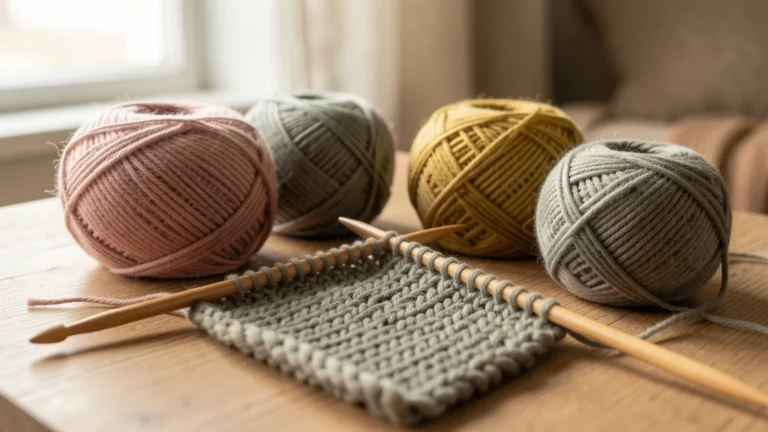
What does it take to knit a 40 by 60 inch blanket? In worsted yarn, our calculator says 3,036 yards, or 16 balls of 200 yards each. Pick lace yarn instead and the same blanket needs 6,900 yards.
That gap shows why yarn planning starts with the yarn weight, not the pattern photo. This guide walks through the estimate one step at a time. It also covers scaling a pattern, reading yards, meters and grams on a label, and buying enough extra.
- Yarn needed equals finished area times a yards-per-square-inch factor, plus a margin.
- Our calculator uses 1.1 yards per square inch for worsted, 2.5 for lace and 0.55 for super bulky.
- A 40 by 60 inch worsted blanket needs 2,640 yards, or 3,036 yards with a 15 percent margin.
- One yard is exactly 0.9144 meters, so always compare balls by length, not by grams.
Why Yarn Weight Drives the Yardage
Thin yarn covers less fabric per yard, so a project in fine yarn eats far more length. The finished size stays the same, but each stitch is smaller. You need more stitches and more rows to fill the same space.
The Craft Yarn Council sorts yarn into weight categories numbered 0 to 7, from lace to jumbo. Its chart lists a typical knit gauge for each one. Worsted runs 16 to 20 stitches per 4 inches, while fingering runs 27 to 32.
Our calculator turns each category into one number: yards per square inch of finished fabric. The table shows the factors it uses.
| Yarn weight | Yards per sq in | 40 x 60 in blanket, with 15% margin |
|---|---|---|
| Lace | 2.5 | 6,900 yd |
| Fingering | 2.0 | 5,520 yd |
| Sport | 1.6 | 4,416 yd |
| DK | 1.3 | 3,588 yd |
| Worsted | 1.1 | 3,036 yd |
| Bulky | 0.8 | 2,208 yd |
| Super bulky | 0.55 | 1,518 yd |
Not sure which weight you hold? The Craft Yarn Council also publishes a wraps-per-inch chart. You wrap the yarn around a ruler and count the wraps in one inch. Worsted, its category 4, shows 9 to 12 wraps.
How Is a Yarn Estimate Calculated?
Multiply width by length for the area, multiply by the factor for your yarn weight, then add a margin. Divide by the yards per ball and round up. Here is the calculator’s own blanket example, step by step.
- Measure the finished piece. Use the size after blocking. The blanket is 40 by 60 inches.
- Find the area. 40 x 60 = 2,400 square inches.
- Apply the weight factor. Worsted uses 1.1 yards per square inch, so 2,400 x 1.1 = 2,640 yards for the piece.
- Add the margin. Our calculator adds 15 percent: 2,640 x 1.15 = 3,036 yards.
- Divide by the ball size. 3,036 / 200 = 15.18 balls.
- Round up. You cannot buy 0.18 of a ball, so you buy 16.
The same steps work for smaller items. An 8 by 60 inch DK scarf covers 480 square inches. At 1.3 yards per square inch, that is 624 yards, or about 718 yards with the margin. With 200 yard balls you buy 4.
A 30 by 36 inch sport-weight baby blanket covers 1,080 square inches. It needs 1,728 yards bare, or about 1,987 yards with the margin. That comes to 10 balls of 200 yards.
The Knitting Yarn Calculator takes your finished size, yarn weight and ball size. It returns the balls to buy, with a 15 percent margin built in.
Can You Scale a Pattern’s Yardage to a New Size?
Yes. For flat pieces, yarn grows with area, so multiply the pattern’s yardage by the ratio of the new area to the old area. Width and length both count.
Say a pattern calls for 1,200 yards for a 36 by 48 inch blanket. You want it at 45 by 60 inches. The old area is 1,728 square inches and the new one is 2,700. The ratio is 1.5625, so you need about 1,875 yards.
A common slip is to scale by one side only. Here each side grew by 25 percent, but the area grew by 56.25 percent. Our guide to ratios and proportions shows why area ratios work this way.
Measure Your Own Factor From a Swatch
Your hands and stitch pattern may not match any chart. A swatch gives you a personal factor in a few minutes.
Knit a 6 by 6 inch swatch, which covers 36 square inches. Weigh it on a kitchen scale. Suppose your ball holds 200 yards in 100 grams, which is 2 yards per gram. An 18 gram swatch then used 36 yards, or 1.0 yard per square inch.
Plug that into the blanket: 2,400 x 1.0 = 2,400 yards, or 2,760 with the margin. That is 14 balls of 200 yards instead of 16.
The Craft Yarn Council makes the same point about swapping yarns. It says two yarns in one weight category are not automatically interchangeable, so knit a gauge swatch to be sure.
Yards, Meters, and Grams on the Label
A yarn label usually lists both length and weight. Length tells you how far the yarn goes. Weight in grams only tells you how heavy the ball is.
NIST defines the yard as exactly 0.9144 meters. So the 3,036 yard blanket needs about 2,776 meters. A ball labeled 200 meters holds about 218.7 yards, since 200 divided by 0.9144 is 218.72.
Mixed units cause real shortages. With 200 meter balls, the blanket needs 3,036 / 218.72 = 13.88 balls, so 14 is right. Read a 200 yard label as 200 meters by mistake, though, and you buy 14 balls when you need 16.
Grams Per Skein vs Yards Per Skein
Two 100 gram balls can hold very different lengths. A dense wool and a light, airy blend weigh the same yet run different distances. Always divide your yardage by the length on the label, never by the grams.
Grams still help in two ways. They let you weigh a swatch, as above. They also let you check a half-used ball: at 2 yards per gram, 40 grams left means about 80 yards left.
Some labels list ounces instead of grams. A 3.5 ounce ball is about 99.2 grams. Our guide to converting ounces to grams covers that math in detail.
Buying Extra, Dye Lots, and Estimate Traps
Our calculator adds 15 percent for swatches, seams and mistakes. It then rounds the ball count up. For the worsted blanket, the margin adds 396 yards, and rounding to 16 balls leaves another 164 yards spare.
Our calculator page also advises buying all the yarn for one project from the same dye lot. A dye lot is a batch dyed together, and balls from different lots can differ slightly in color. Buying enough at the start avoids hunting for a match later.
Its estimate suits flat, mostly solid pieces such as blankets, scarves and wraps. Cables, colorwork and garment shaping change the amount, so treat the figure as a planning number.
| Mistake | Better approach |
|---|---|
| Estimating by size alone | Include the weight factor. The same blanket needs 1,518 yards in super bulky but 6,900 in lace. |
| Rounding before adding the margin | Add 15 percent first, then round up. 2,640 yards is 14 balls bare but 16 with the margin. |
| Scaling a pattern by one side | Scale by area. Growing both sides by 25 percent raises the yarn by 56.25 percent. |
| Mixing meters and yards | Convert first. A 200 meter ball holds 218.72 yards, not 200. |
| Comparing balls by grams | Compare by length. Grams measure weight, not how far the yarn goes. |
| Skipping the swatch | Knit and weigh a swatch to find your own yards per square inch. |
Try it with your own project. Enter the size, weight and ball length in the yarn calculator and see how many balls to buy.
Yarn Estimates: Frequently Asked Questions
How Much Yarn Do I Need for a Blanket?
Our calculator puts a 40 by 60 inch worsted blanket at 2,640 yards for the piece. With a 15 percent margin that becomes 3,036 yards, or 16 balls of 200 yards.
How Do I Estimate Yarn Without a Pattern?
Multiply the finished width by the length for the area in square inches. Multiply by a yards-per-square-inch factor for your yarn weight, add a margin, then divide by the yards per ball.
Does Yarn Weight Change How Much I Need?
Yes, by a wide margin. In our calculator, lace uses 2.5 yards per square inch and super bulky uses 0.55, so lace needs about 4.5 times the yardage.
How Much Extra Yarn Should I Buy?
Our calculator adds 15 percent for swatches, seams and mistakes. Round the ball count up after adding that margin, never before.
How Many Meters Is 200 Yards of Yarn?
One yard is exactly 0.9144 meters, so 200 yards is 182.88 meters. Going the other way, a 200 meter ball holds about 218.7 yards.
Should I Compare Skeins by Grams or by Yards?
Compare by yards or meters. Grams tell you weight, not length, and two 100 gram balls can hold very different lengths of yarn.
Can I Swap a Pattern Yarn for Another in the Same Weight?
Not safely without testing. The Craft Yarn Council says its weight system is not an interchangeability chart, and it advises knitting a gauge swatch to be sure.
How Do I Scale Yarn for a Bigger Version of a Pattern?
Multiply the pattern yardage by the ratio of the two areas. A 1,200 yard, 36 by 48 inch blanket made at 45 by 60 inches needs about 1,875 yards.
Sources and Further Reading
References Used in This Article
This article explains yarn planning math for flat knitting and crochet projects. Real yarn use varies with gauge, stitch pattern and shaping. Reviewed for accuracy by Prof. Dr. Khalil Mudassar, PhD. Last updated September 27, 2026.
Author

Shakeel Muzaffar is the Founder and Editor-in-Chief of MultiCalculators.com, bringing over 15 years of experience in digital publishing, product strategy, and online tool development. He leads the platform's editorial vision, ensuring every calculator meets strict standards for accuracy, usability, and real-world value. Shakeel personally oversees content quality, formula verification workflows, and the platform's commitment to publishing tools that are genuinely useful for students, professionals, and everyday users worldwide.