How many meters is six feet? The answer depends on one number that has not changed since 1959: 0.3048. That single decimal is the entire secret behind every feet to meters conversion, whether you are checking a doorway, a football field, or your own height. Once you know it, you can convert any length in seconds, with no guesswork and no rounding errors.
To convert feet to meters, multiply the number of feet by 0.3048. One foot equals exactly 0.3048 meters, by international definition, not a rounded estimate. To go the other way, multiply meters by 3.28084 to get feet. A 6-foot height, for example, equals exactly 1.8288 meters.
The Exact Feet to Meters Conversion Factor
One foot equals exactly 0.3048 meters. This is not a rounded approximation used for convenience. It is a fixed, agreed definition, so the number never changes no matter which calculator or textbook you check.
That precision comes from a 1959 international agreement. The United States, the United Kingdom, Canada, Australia, and other countries agreed to define their foot and yard using the meter as the base unit. They set the international foot at exactly 0.3048 meters, and a yard, which is 3 feet, at exactly 0.9144 meters.
Because the factor is exact, you never lose accuracy converting feet to meters. Any rounding you see later comes only from how many decimal places you choose to keep.
How to Convert Feet to Meters
The formula is simple: meters equal feet multiplied by 0.3048. You do not need any other steps for a plain number of feet.
- Take your measurement in feet.
- Multiply that number by 0.3048.
- The result is your length in meters.
For example, a 10-foot ladder converts as 10 x 0.3048, which equals 3.048 meters. A small 2-foot shelf converts as 2 x 0.3048, which equals 0.6096 meters. The same formula works for any distance, from a few inches to a full mile.
Prefer not to do the math by hand? Our Feet to Meters Converter gives you the exact result instantly, in both directions.
Worked Example: Feet and Inches to Meters
Heights and room measurements are rarely a whole number of feet. To convert feet and inches, first turn the inches into a decimal fraction of a foot.
- Divide the inches by 12 to get a fraction of a foot.
- Add that fraction to the whole feet.
- Multiply the total by 0.3048.
Take a person who is 5 feet 10 inches tall. First, 10 divided by 12 equals 0.8333 feet. Add that to 5 feet for a total of 5.8333 feet.
Now multiply: 5.8333 x 0.3048 equals 1.7780 meters. That height is also commonly written as about 178 centimeters, a figure you will see on many international height charts.
You can also skip the fraction step by converting the whole height to inches first. Since 1 inch equals exactly 0.0254 meters, 70 inches x 0.0254 also equals 1.7780 meters, the same answer either way.
Meters to Feet: The Reverse Conversion
Sometimes you start with meters and need feet instead, such as reading a European product spec or a travel sign. The reverse formula is just as simple.
Multiply meters by 3.28084 to get feet, or divide the meters by 0.3048 for the same result. Both paths give the same answer, since dividing by 0.3048 is mathematically the same as multiplying by 3.28084.
For example, a 2-meter fence converts as 2 x 3.28084, which equals 6.56168 feet. That is about 6 feet 6.7 inches, since 0.56168 feet times 12 equals roughly 6.74 inches.
A 5-meter room wall converts as 5 x 3.28084, which equals 16.4042 feet. Rounding to whole feet, that is about 16 feet 5 inches.
A Quick Mental-Math Shortcut
You will not always have a calculator handy, and that is fine for a rough guess. To estimate meters to feet in your head, multiply by about 3.28 instead of 3.28084. To estimate feet to meters, multiply by about 0.3 instead of 0.3048.
These shortcuts are close enough for a quick check, like guessing whether a ceiling will clear your head or whether a rug will fit a room. They are approximations, not exact answers, so treat the small gap as normal.
For anything you measure, cut, order, or put on an official form, switch back to the exact factors of 0.3048 and 3.28084. Mount Everest shows why the difference matters. Its official height is 8848.86 meters. Using the exact factor, 8848.86 x 3.28084 equals about 29031.69 feet, the figure announced by China and Nepal in 2020. Using the rough shortcut instead, 8848.86 x 3.28 gives about 29024 feet, off by roughly 7 feet. That gap is harmless for a mental estimate but too much for a survey.
Quick Reference Chart: Feet to Meters
Some feet values come up again and again, in home projects, sports, and shopping. This table lets you skip the math for the most common ones.
| Feet | Meters |
|---|---|
| 1 ft | 0.3048 m |
| 5 ft | 1.524 m |
| 10 ft | 3.048 m |
| 50 ft | 15.24 m |
| 100 ft | 30.48 m |
Notice the pattern: every value is simply that number of feet multiplied by 0.3048. Multiply any feet figure by the same factor to fill in a value that is not on this list.
Comparing Feet and Meters Side by Side
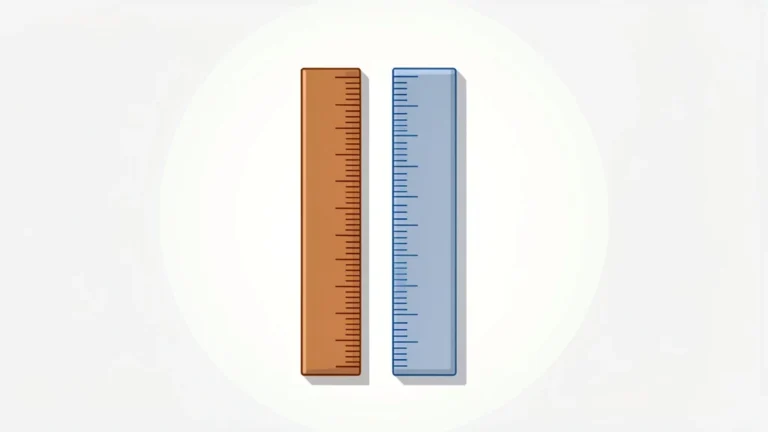
Numbers on a page are one thing, but seeing the two units side by side makes the conversion easier to picture. Here is the same height measured on a feet scale and a meter scale.
A person who stands 5 feet 10 inches tall is exactly 1.7780 meters tall. Both labels point to the same real height, just measured with different rulers.
Everyday Places You Will Use This Conversion
Feet to meters conversions show up more often than most people expect, well beyond the classroom.
- Checking your own height on a form that asks for centimeters or meters.
- Reading room dimensions when buying furniture from an international retailer.
- Understanding sports distances, since some tracks and fields mix feet and meters.
- Following building or DIY plans that use metric measurements.
- Comparing travel or hiking distances between countries that use different units.
A standard interior door in the United States is about 6 feet 8 inches tall. Converted, that is 80 inches x 0.0254, which equals exactly 2.032 meters.
A 100-foot stretch of open ground, like part of a park or a running path, equals 100 x 0.3048, or 30.48 meters. Keeping this factor handy makes both examples quick to check.
Where Feet Are Still Used vs Where Meters Take Over
Feet have not disappeared, even in a mostly metric world. In the United States, building heights, home square footage, and highway signs still use feet. Aviation keeps feet worldwide, since pilots report altitude in feet no matter which country they fly over.
Elevation on many US trail signs and maps also uses feet. Meters take over almost everywhere else. Most other countries measure height, distance, and land in meters, and science, engineering, and international shipping default to meters too.
Knowing both units helps when you compare a US building plan against an international spec sheet, or read a hiking sign abroad after growing up on feet.
Common Mistakes When Converting Feet to Meters
A few small errors cause most wrong answers. Knowing them ahead of time helps you avoid them.
- Forgetting to convert inches into a fraction of a foot before multiplying.
- Multiplying by 3.28084 instead of 0.3048, which reverses the conversion.
- Rounding too early, which can shift the final answer slightly.
- Assuming every country’s old “foot” was identical before 1959.
One more detail worth knowing: the United States once used a slightly different measure called the US survey foot. It was fractionally longer than the international foot. In 2022, the National Institute of Standards and Technology retired the survey foot, leaving 0.3048 meters as the single standard foot for all uses.
Related Unit Conversions
Feet to meters is a length conversion, but everyday life involves other units too. These sibling guides cover the ones we do not teach here.
- Converting volume between liters and gallons: see Liters to Gallons Explained.
- Converting land area between acres, hectares, and square feet: see Acres to Hectares and Square Feet.
Need an instant, exact answer instead of doing the math yourself? Our Feet to Meters Converter converts any length both ways in a second, down to as many decimal places as you need.
Frequently Asked Questions About Feet to Meters Conversion
What Is the Exact Feet to Meters Conversion Factor?
One foot equals exactly 0.3048 meters. This is not a rounded estimate. It has been the official international definition since 1959, agreed on by the United States, the United Kingdom, and other English-speaking countries.
How Do I Convert Feet to Meters?
Multiply the number of feet by 0.3048. For example, 10 feet times 0.3048 equals 3.048 meters. The same formula works for any number of feet, whole or fractional.
How Do I Convert Meters to Feet?
Multiply the number of meters by 3.28084, or divide by 0.3048. For example, 5 meters times 3.28084 equals about 16.4042 feet. Both methods give the same result.
How Do I Convert Feet and Inches to Meters?
First change the inches into a decimal fraction of a foot by dividing by 12. Add that to the whole feet, then multiply the total by 0.3048. For example, 5 feet 10 inches becomes 5.8333 feet, which equals 1.7780 meters.
Why Is 1 Foot Equal to Exactly 0.3048 Meters?
In 1959, the United States and several other countries signed an agreement that standardized the foot and yard using the meter. They defined the international foot as exactly 0.3048 meters, replacing older, slightly different national versions of the foot.
Is a Foot Always Exactly 0.3048 Meters?
For everyday and international use, yes. A separate measurement called the US survey foot was very slightly longer, but the United States officially retired it at the end of 2022. The international foot of 0.3048 meters is now the standard everywhere.
How Tall Is 6 Feet in Meters?
Six feet equals 6 x 0.3048, or 1.8288 meters. That is about 182.88 centimeters, a common height reference used in fitness, health, and clothing size charts around the world.
Sources
Authoritative Sources Used in This Article
This article is for general education only. Conversion factors are standard, but always double-check exact figures for critical uses like recipes, shipping, or legal documents. Reviewed for accuracy by Prof. Dr. Khalil Mudassar, PhD. Last updated September 13, 2026.
Author

Shakeel Muzaffar is the Founder and Editor-in-Chief of MultiCalculators.com, bringing over 15 years of experience in digital publishing, product strategy, and online tool development. He leads the platform's editorial vision, ensuring every calculator meets strict standards for accuracy, usability, and real-world value. Shakeel personally oversees content quality, formula verification workflows, and the platform's commitment to publishing tools that are genuinely useful for students, professionals, and everyday users worldwide.




1 thought on “Feet to Meters Conversion Guide”