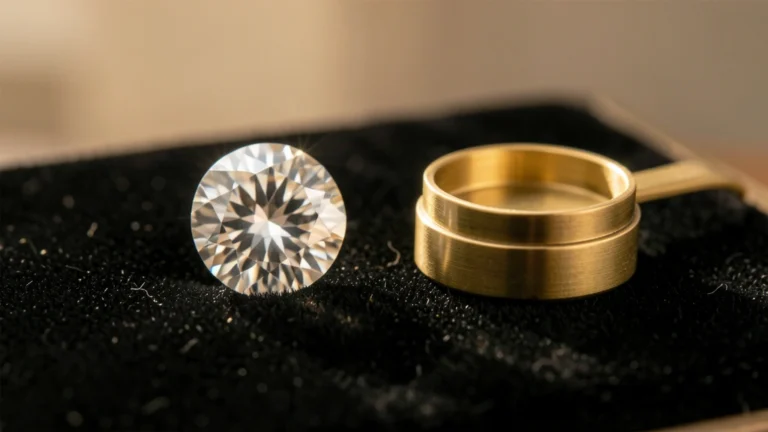
Did you know a one-carat stone weighs exactly 200 milligrams, or one fifth of a gram? That exact figure has been the rule for gems since 1913. This guide shows what a carat measures, how points work, and why carat is not the same as karat. You will also learn why weight alone never tells you how big a stone looks.
- One metric carat equals exactly 200 milligrams, or 0.2 grams.
- Each carat splits into 100 points, so one point weighs 2 milligrams.
- Carat measures the weight of a gemstone; karat measures the purity of gold.
- To convert, multiply carats by 0.2 for grams or by 0.0002 for kilograms.
- Two stones of equal carat weight can differ in size because their densities differ.
How Much Does One Carat Actually Weigh?
One metric carat weighs exactly 200 milligrams, which is 0.2 grams. The value is exact by definition, not a rounded estimate. Every carat figure on a gem label rests on this single number.
The unit has an old story behind it. The carat began with the carob seed, according to the national standards lab. It was later fixed at 1/444 of an ounce, and then at the modern 0.2 gram value.
The metric carat was recognized internationally on July 1, 1913, for diamonds and other precious stones. Weights are written as decimal fractions of a carat, such as 0.75 ct. A fixed 200 mg value makes gem weights comparable from one country to the next.
The formula is short. Grams equal carats times 0.2, and carats equal grams times 5. A 1.5 carat stone therefore weighs 0.3 grams. A 5 gram parcel of loose stones holds 25 carats in total.
Put that in everyday terms. One gram is 5 carats, so a pile of five one-carat stones weighs the same as a single gram. Carats let jewelers describe these small masses without long decimals.
What Are Points, and How Do Jewelers Use Them?
A point is one hundredth of a carat, so 100 points make one carat. Each point weighs exactly 2 milligrams. Jewelers use points to describe small stones without writing awkward decimals.
The math is simple. Move the decimal two places to turn carats into points. A 0.25 carat stone is 25 points, and a 0.75 carat stone is 75 points. That 75 point stone weighs 150 milligrams, or 0.15 grams.
Points matter most for small side stones and accents. A band set with tiny stones may list each at 2 or 3 points. The piece then shows the combined weight of all its stones as a single figure.
Points also make quick totals easy. Twenty accent stones of 3 points each add up to 60 points, or 0.60 carat. That total weighs 120 milligrams, a little more than one tenth of a gram. Adding points first and converting last avoids small rounding slips along the way.
Is a Carat the Same Thing as a Karat?
No. A carat measures the weight of a gemstone, while a karat measures the purity of gold. The two words sound alike but describe completely different things.
Karat works as a share out of 24 parts. Pure gold is 24 karat, which is soft, so makers mix it with other metals. A piece marked 18K holds 18 parts gold and 6 parts other metal. A 14K piece holds 14 parts gold and 10 parts other metal.
Turn karats into a percentage by dividing by 24. That gives 75 percent gold for 18K and about 58.3 percent for 14K. A 10K piece is about 41.7 percent gold.
A ring can carry both labels at once. A “1 carat 14K ring” means a stone of 200 mg set in metal that is 14 parts gold out of 24. Keep the two apart, and product labels become much easier to read.
Why Can Two One-Carat Stones Look Different in Size?
Carat measures mass, not size. A denser stone packs the same 200 mg into less space, so it looks smaller. A lighter mineral spreads the same weight over more volume.
Compare two common minerals. Diamond has a specific gravity of about 3.5, while quartz sits at 2.65. So one carat of diamond fills about 57 cubic millimeters, and one carat of quartz fills about 75.5. The quartz takes up roughly 32 percent more space.
The same idea drives floating, sinking, and packing in everyday life. Our guide to density explained with examples walks through mass divided by volume in more depth.
Here is a less obvious point. Doubling the carat weight does not double the width of a stone. Volume grows with the cube of width. So a 2 carat stone of the same shape is only about 26 percent wider than a 1 carat stone.
How Do You Turn Carats Into Grams, Kilograms, or Ounces?
Multiply carats by 0.2 for grams or by 0.0002 for kilograms. To go back, multiply grams by 5 or kilograms by 5,000. These factors are exact because the carat itself is exact.
| Carats | Points | Milligrams | Grams | Kilograms |
|---|---|---|---|---|
| 0.25 | 25 | 50 | 0.05 | 0.00005 |
| 1 | 100 | 200 | 0.2 | 0.0002 |
| 1.5 | 150 | 300 | 0.3 | 0.0003 |
| 5 | 500 | 1,000 | 1 | 0.001 |
Take the 1.5 carat stone again. The carat to kilogram converter returns 0.000300 kg, which is 0.3 grams. The tool shows kilograms to six decimal places, so a single point displays as 0.000002 kg.
Ounces need one more step. One avoirdupois ounce is about 28.35 grams, or roughly 141.7 carats. A troy ounce, used for precious metals, is about 31.10 grams, or about 155.5 carats. For kitchen and postal weights, see our guide to ounces to grams for cooking and shipping.
What Does a Fraction Like 1/2 Carat Really Promise?
A fraction on a label can stand for a range of weights, not one exact figure. Under federal guidance, a stone called 1/2 carat can weigh anywhere from 0.45 to 0.54 carat.
Decimal labels follow a stricter rule. A weight written as a decimal should be accurate to the last decimal place shown. So a stone listed at 0.50 carat should truly weigh 0.50 carat, not 0.46.
Sellers who use fractions should also say clearly that the weight is not exact. They should state the range or the tolerance they apply. That note tells you how much wiggle room sits behind a round number.
Jewelry with several stones often lists total weight. Three stones of 0.33 carat each add up to 0.99 carat total. That total can read as “1 carat,” yet no single stone comes close to one carat. Check whether a figure describes one stone or the whole piece.
The Carat to Kilogram Converter switches between carats and kilograms in one click, using the exact 0.2 gram carat.
FAQs About Carat Weight
How Many Grams Are in One Carat?
One metric carat equals exactly 0.2 grams, or 200 milligrams. That means one gram equals 5 carats, and a 1.5 carat stone weighs 0.3 grams.
How Many Points Are in a Carat?
There are 100 points in one carat. Each point equals 0.01 carat, which is 2 milligrams. A 50 point stone is half a carat and weighs 100 milligrams.
What Is the Difference Between Carat and Karat?
Carat is a unit of weight for gemstones, equal to 200 milligrams. Karat is a measure of gold purity out of 24 parts, so 18K gold is 18 parts gold and 6 parts other metal.
Does a Bigger Carat Weight Always Mean a Bigger Stone?
Not always. Carat measures mass, so a denser stone looks smaller at the same weight. One carat of quartz fills about 32 percent more volume than one carat of diamond.
How Many Carats Are in a Kilogram?
One kilogram equals exactly 5,000 carats. Going the other way, one carat equals 0.0002 kilograms. Multiply carats by 0.0002 to get kilograms.
What Does Total Carat Weight Mean on Jewelry?
Total carat weight is the combined weight of every stone in a piece. A pair of earrings with two 0.5 carat stones has a total of 1 carat, but each stone is only half a carat.
Can a Half Carat Stone Weigh Less Than 0.5 Carat?
Yes, when the weight is shown as a fraction. Federal guidance allows a stone called 1/2 carat to weigh from 0.45 to 0.54 carat, and the seller should disclose that range.
Sources
References Used in This Article
- NIST Handbook 44 (2026), Appendix C: General Tables of Units of Measurement
- NIST, Precious Metals Conversion Information
- FTC, In the Loupe: Advertising Diamonds, Gemstones and Pearls
- FTC Consumer Advice, Buying Platinum, Gold, and Silver Jewelry
- Mineralogy (Perkins et al.), 3.6: Density and Specific Gravity
This article explains carat weight as a unit of measurement. It is not buying, grading, or appraisal advice. Reviewed for accuracy by Prof. Dr. Khalil Mudassar, PhD. Last updated September 27, 2026.
Author

Shakeel Muzaffar is the Founder and Editor-in-Chief of MultiCalculators.com, bringing over 15 years of experience in digital publishing, product strategy, and online tool development. He leads the platform's editorial vision, ensuring every calculator meets strict standards for accuracy, usability, and real-world value. Shakeel personally oversees content quality, formula verification workflows, and the platform's commitment to publishing tools that are genuinely useful for students, professionals, and everyday users worldwide.