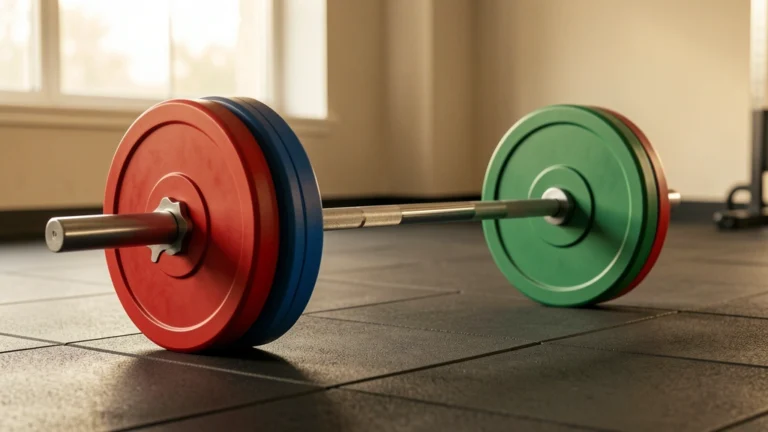
Is a 20 kilogram plate the same as a 45 pound plate? It looks that way on the rack, but the metric plate weighs 44.09 pounds. That gap is under one pound per plate. On a fully loaded bar, though, the small gaps stack up into several pounds. This guide shows the exact factor, the loading formula, and where rounding sneaks in.
- One pound equals exactly 0.45359237 kilograms, so one kilogram is about 2.20462 pounds.
- A 20 kg plate weighs 44.09 lb, and a 45 lb plate weighs 20.41 kg.
- Loaded weight equals the bar, plus collars, plus two times the plates on one side.
- A 20 kg bar with one 20 kg plate per side totals 60 kg, or 132.28 lb.
- Convert the final total once, and round only at the end.
Why Is a 20 Kg Plate Lighter Than a 45 Lb Plate?
A 20 kg plate weighs 44.0925 pounds, while a 45 lb plate weighs 45 pounds. So the metric plate is 0.91 pounds lighter. The two systems simply picked different round numbers.
Metric plates come in steps of kilograms, such as 25, 20, 15, and 10. Pound plates come in steps of pounds, such as 45, 35, 25, and 10. Neither set lines up neatly with the other.
Flip the view and the gap looks the same. A 45 lb plate converts to 20.4117 kg, which is 0.41 kg more than a 20 kg plate. Both numbers describe one small difference from two sides. Pick one unit for your log and stay with it.
One plate hardly matters for a single set. The trouble starts when a lifter logs a metric bar as a pound bar, or the reverse. Each plate adds its own small error, and the log slowly drifts from reality.
Which Exact Factor Turns Kilograms Into Pounds?
One pound equals exactly 0.45359237 kilograms by definition. Divide 1 by that number and you get 2.20462262185 pounds per kilogram. Those two figures handle every plate conversion.
The pound is fixed to the kilogram, so the first number never changes. The federal weights handbook lists the avoirdupois pound as 0.453 592 37 kg. The same table rounds the reverse factor to 2.204 623 pounds per kilogram.
Use the factors this way. Multiply kilograms by 2.20462262185 to get pounds. Multiply pounds by 0.45359237 to get kilograms. For quick mental math, 2.2 gets you close, but it runs about 0.2 percent low.
That small shortfall matters on heavy totals. Take 200 kg as a test. The exact factor gives 440.92 lb, while the shortcut gives 440 lb. The shortcut drops almost a full pound.
Keep full precision until the last step. Our calculator stores every value in kilograms, then shows pounds with two decimals. Rounding in the middle of a sum adds error that the final answer cannot remove.
How Do the Bar, Plates, and Collars Add Up?
Loaded weight equals the bar, plus the collars, plus two times the plates on one side. Count the bar once. Count every plate twice, because a balanced bar carries the same load on both sleeves.
Here is the example from our calculator page. A 20 kg bar carries one 20 kg plate on each side. The plates add 2 x 20 = 40 kg, and the bar adds 20 kg, for 60 kg total.
Now convert the total once. Multiply 60 kg by 2.20462262185 and you get 132.28 lb. That total is not 40 kg, which forgets the bar. It is not 80 kg either, which counts the bar twice.
The pound version works the same way. A 45 lb bar with one 45 lb plate per side totals 135 lb. In kilograms, that is 61.23 kg, which sits 1.23 kg above the metric 60 kg setup.
How Much Weight Do the Bar and Collars Add?
The bar is often the single heaviest item on the lift. Our calculator offers a 20 kg bar, a 15 kg bar, a 45 lb bar, and a 35 lb bar. A custom option covers any other bar.
| Bar option | Kilograms | Pounds |
|---|---|---|
| 20 kg bar | 20.00 | 44.09 |
| 15 kg bar | 15.00 | 33.07 |
| 45 lb bar | 20.41 | 45.00 |
| 35 lb bar | 15.88 | 35.00 |
Collars are easy to forget. Our calculator lists a competition pair at 5 kg total, or 2.5 kg each. It also offers a 2.5 kg pair and a 1 kg pair.
Add the competition collars to the 60 kg example. The total becomes 65 kg, which is 143.30 lb. Those 5 kg are about 11 pounds, so leaving them out of a log changes the record.
Printed numbers are nominal, so only a scale shows the true mass of a bar or plate.
The gym plate kg to lb converter adds the bar once and doubles the plates for you. It shows the loaded total in both units side by side.
When Does Rounding Change Your Total?
Rounding shifts a total whenever you swap each item for the nearest round number in the other unit. The error grows with every plate. Convert the exact total instead, and round once at the end.
Picture a common mix-up. A lifter logs a 20 kg bar with two 20 kg plates per side as “225 lb.” Yet the true total is 100 kg, which is 220.46 lb. The label overstates the load by 4.54 lb.
The gap climbs as the bar fills up. Each extra pair of 20 kg plates adds another 1.82 lb of error compared with 45 lb plates. With four plates per side, the gap reaches 8.17 lb.
Exact records matter most when you track a max over months. For that side of lifting, see our guide on finding your one rep max safely.
How Do You Work Backward From a Target Weight?
Subtract the bar and collars from the target, then split what remains in half. That half is the plate weight for each side. Convert the target first so every number shares one unit.
Try a 100 kg target in a pound gym. The target is 220.46 lb. Take away a 45 lb bar and 175.46 lb remains, or 87.73 lb per side.
The closest stack is 45 + 25 + 10 + 5 + 2.5 = 87.5 lb per side. That loads the bar to 220 lb, or 99.79 kg, just 0.21 kg under target.
Small plates set how close you can get. A 2.5 lb plate weighs 1.13 kg, and a 1.25 kg plate weighs 2.76 lb. Our guide to progressive overload covers how lifters use those small jumps over time.
One limit is worth knowing. The calculator loads one matching plate size per side. For a mixed stack like the one above, add up the plates by hand and convert the final total once.
The Gym Plate Kg to Lb Calculator converts one plate, a pair, and the whole loaded bar. It also shows the gap to your target.
FAQs About Barbell Plate Math
How Many Pounds Is a 20 Kg Plate?
One 20 kg plate weighs 44.0925 lb, which rounds to 44.09 lb. A pair of 20 kg plates weighs 88.18 lb before you add the bar.
How Many Kilograms Is a 45 Lb Plate?
One 45 lb plate weighs 20.4117 kg, which rounds to 20.41 kg. That makes it 0.41 kg heavier than a 20 kg plate.
Do You Count Both Sides of the Bar?
Yes. Multiply the plates on one side by two, then add the bar once. A 20 kg bar with one 20 kg plate per side totals 60 kg.
Is 2.2 Close Enough for Converting Plates?
It works for a rough guess but runs about 0.2 percent low. On 200 kg, the shortcut gives 440 lb instead of the exact 440.92 lb.
Should Collars Count in the Total Weight?
Count them when you want the true load. A competition pair adds 5 kg, so a 60 kg bar becomes 65 kg, or 143.30 lb.
Why Does My Converted Total Have Decimals?
Metric and pound plates use different round steps, so exact conversions rarely land on whole numbers. Keep the decimals for records and round only for quick talk.
Is a 225 Lb Bar the Same as 100 Kg?
No. A true 225 lb load equals 102.06 kg, while 100 kg equals 220.46 lb. The two setups differ by 4.54 lb.
Sources
References Used in This Article
This article explains unit arithmetic for barbell loads. It does not recommend any training weight or program. Reviewed for accuracy by Prof. Dr. Khalil Mudassar, PhD. Last updated September 27, 2026.
Author

Shakeel Muzaffar is the Founder and Editor-in-Chief of MultiCalculators.com, bringing over 15 years of experience in digital publishing, product strategy, and online tool development. He leads the platform's editorial vision, ensuring every calculator meets strict standards for accuracy, usability, and real-world value. Shakeel personally oversees content quality, formula verification workflows, and the platform's commitment to publishing tools that are genuinely useful for students, professionals, and everyday users worldwide.