A 15 kilogram pack is 25 percent of a 60 kilogram hiker, but only 16.7 percent of a 90 kilogram hiker. Same bag, very different load. That is why pack weight makes the most sense as a share of your own body weight.
This guide shows how to work out that percentage with a bathroom scale and simple division. It covers the school backpack guidance from pediatric groups and the 20 percent hiking limit our calculator uses. It also lists the load errors that push a pack too high.
- Pack percentage equals pack weight divided by body weight, times 100.
- The American Academy of Pediatrics says a school backpack should stay at or under 15 percent of body weight.
- Our calculator uses 20 percent of body weight as its hiking limit and flags anything over 25 percent.
- A child who leans forward to carry a backpack is carrying too much, according to the same AAP guidance.
Pack Weight as a Share of Your Body
Backpack weight percentage compares the load on your back with the weight of the person carrying it. A 12 kilogram pack on a 75 kilogram adult is 16 percent. The same pack on a 40 kilogram child would be 30 percent.
A fixed limit, such as “no more than 10 kilograms,” treats every body the same. A percentage scales with the carrier instead. That makes it a fairer rule for a family, a scout troop, or a mixed hiking group.
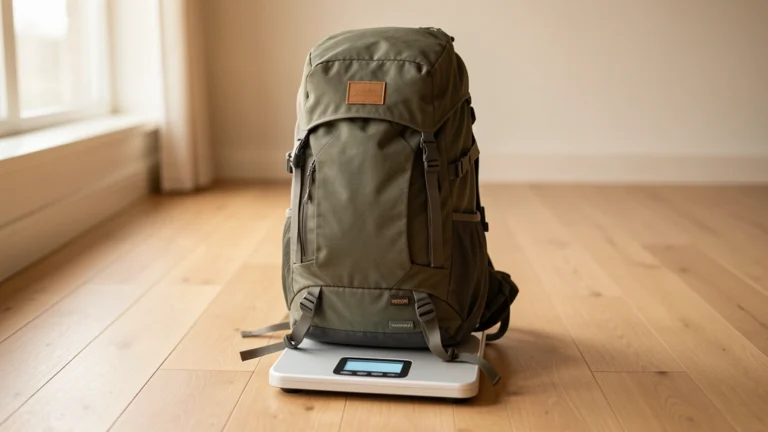
The math only needs two numbers, and both come from a bathroom scale. Weigh the pack exactly as you will carry it, with water, food, books, and laptop inside. Weigh yourself on the same scale so both readings share the same error.
Percent limits also work in either unit. A 15 percent limit is 15 pounds for a 100 pound child and 6 kilograms for a 40 kilogram child. The ratio stays the same, so there is nothing to convert.
How Do You Work Out Your Pack Percentage?
Divide the loaded pack weight by your body weight, then multiply by 100. The formula is percentage = pack weight / body weight x 100.
- Weigh yourself. Stand on a bathroom scale without the pack and note the number. Our example hiker weighs 75 kilograms.
- Weigh the loaded pack. Pack it as you will carry it, water included. A pack too big for the scale works too: weigh yourself holding it and subtract your body weight.
- Divide and multiply. 12 kilograms divided by 75 kilograms is 0.16. Times 100, that is 16 percent.
- Find your limit. Multiply your body weight by your chosen guide. At 20 percent, a 75 kilogram hiker has a 15 kilogram limit.
- Check the headroom. Subtract the pack from the limit. Here, 15 minus 12 leaves 3 kilograms for extra food or water.
This is the same worked example the calculator page uses. It goes on to add a heavy tent, which pushes the pack to 18 kilograms. That is 24 percent, 3 kilograms over the 20 percent limit, and inside the heavy band.
The tool’s quick presets show how body size shifts the answer. A 7 kilogram day pack on a 75 kilogram hiker is 9.3 percent. A 12 kilogram weekend load on a 70 kilogram hiker is 17.1 percent. An 18 kilogram trek pack on an 80 kilogram hiker is 22.5 percent.
The Backpack Weight Percentage Calculator turns your pack and body weight into a percentage, a 20 percent limit, your headroom, and a load label.
How Heavy Should a School Backpack Be?
The American Academy of Pediatrics says a school backpack should not weigh more than 15 percent of the child’s body weight. For a 100 pound child, that is 15 pounds.
Other children’s health guidance gives a range of 10 to 20 percent of body weight. By that range, an 80 pound child should carry no more than 8 to 16 pounds. The AAP figure of 15 percent sits inside that range.
The AAP also gives a simple visual test. A child who needs to lean forward to support the backpack is carrying too much. It adds that backpacks have not been shown to cause scoliosis or other long-term spine problems.
How Should the Pack Sit?
The AAP advice favors two broad, padded shoulder straps worn on both shoulders. The pack should sit close to the body and rest in the curve of the lower back. It should never hang more than 4 inches below the waistline.
Heavy items such as textbooks and laptops go closest to the back. A waist or chest strap helps spread the load. Cleaning out the pack weekly and using a locker both cut the daily weight.
The guidance says not to ignore back pain in a child that happens at times other than wearing a backpack. It advises asking a pediatrician in that case.
Where Hiking Loads Land on the Scale
Our calculator treats 20 percent of body weight as the top of a comfortable hiking load. It labels 15 percent or less as light, 20 to 25 percent as heavy, and anything above 25 percent as too heavy.
These bands are the calculator’s own rule of thumb, not a medical limit. Research behind hiking load limits is limited. A 2026 study of long-distance hikers noted that quantitative evidence behind backpack weight advice is still scarce.
That same study measured foot pressure in hikers carrying loads of 10 and 20 percent of body weight. Static forefoot pressure rose 5.41 percent at the 10 percent load and 8.73 percent at the 20 percent load. The authors concluded their results support keeping hiking loads around 10 percent to reduce foot stress.
Water Moves the Number Fast
One liter of water weighs about 1 kilogram. Adding 2 liters to the 12 kilogram example pack makes it 14 kilograms, or 18.7 percent. The hiker’s 3 kilograms of headroom shrinks to 1 kilogram.
Your drinking needs set how much water you start with. Our guide on how much water to drink based on your weight covers that side. Gear is the part you control before the trip starts. Our explainer on backpacking base weight shows how to separate gear from food and water.
Load Errors and Smarter Fixes
The errors below come from weighing the wrong thing or using the wrong limit. The table pairs each error with a better habit.
| Mistake | Better approach |
|---|---|
| Weighing the pack before filling the water bottles | Weigh it trail-ready. Two liters of water adds about 2 kilograms and 2.7 points on a 75 kilogram hiker. |
| Using the 20 percent hiking figure for a school bag | Use the AAP school guide of 15 percent. For a 40 kilogram child, that is 6 kilograms, not 8. |
| Setting one weight limit for a whole group | Give each person a limit from their own body weight. A 15 kilogram pack is 25 percent on 60 kilograms but 16.7 percent on 90. |
| Carrying a school bag on one shoulder | Use both straps, as the AAP advises, and keep the pack close to the back. |
| Treating a percentage as a safe zone | Watch the carrier too. The AAP says leaning forward means the pack is too heavy. |
Research on school loads also leaves open questions. A 2009 systematic review found that weight recommendations and carrying habits were not consistently supported by the studies it examined. That is a good reason to treat any percentage as a starting guide and to watch how the child actually moves.
Try it with your next load. Enter your pack and body weight in the backpack percentage calculator to see your headroom before you leave.
Backpack Weight: Frequently Asked Questions
How Do You Calculate Backpack Weight Percentage?
Divide the loaded pack weight by your body weight and multiply by 100. A 12 kilogram pack on a 75 kilogram hiker is 16 percent.
How Heavy Should a Child’s School Backpack Be?
The American Academy of Pediatrics says no more than 15 percent of the child’s body weight. A 100 pound child should carry no more than 15 pounds.
Is 10 Percent or 20 Percent the Right Limit?
Children’s health guidance gives a range of 10 to 20 percent for school bags, and the AAP uses 15 percent. Our calculator uses 20 percent as a hiking limit for adults.
What Is the 20 Percent Rule for Hiking?
It is the rule of thumb our calculator uses: keep a hiking pack at or under 20 percent of body weight. For a 75 kilogram hiker, that is 15 kilograms.
How Can You Tell a Backpack Is Too Heavy?
The AAP says a child who needs to lean forward to support the backpack is carrying too much. A high percentage on the calculator is a second warning sign.
Should Water Count in the Pack Weight?
Yes. One liter of water weighs about 1 kilogram. Two liters lift a 12 kilogram pack to 14 kilograms, or 18.7 percent for a 75 kilogram hiker.
Do Heavy Backpacks Cause Scoliosis?
The AAP says backpacks have not been shown to cause scoliosis or other long-term spine problems. Poorly worn packs can still cause back, neck, and shoulder pain.
How Do You Weigh a Pack That Is Too Big for the Scale?
Weigh yourself holding the pack, then weigh yourself without it. The difference is the pack weight. At 87 and 75 kilograms, the pack weighs 12 kilograms.
Sources and Further Reading
References Used in This Article
- American Academy of Pediatrics (HealthyChildren.org), School Backpack Safety: Proper Fit, Smart Packing and Preventing Back Pain
- Nemours KidsHealth, Backpack Safety
- PubMed (NIH), Moya-Cuenca C et al., Plantar Pressure Responses to Backpack Load in Long-Distance Hikers, 2026
- PubMed (NIH), Lindstrom-Hazel D, The Backpack Problem Is Evident but the Solution Is Less Obvious, 2009
This article is for general education only, not medical advice. The AAP advises asking a pediatrician about a child’s back pain that happens when no backpack is worn. Reviewed for accuracy by Dr. Abdullah Khalil, MBBS. Last updated September 27, 2026.
Author

Shakeel Muzaffar is the Founder and Editor-in-Chief of MultiCalculators.com, bringing over 15 years of experience in digital publishing, product strategy, and online tool development. He leads the platform's editorial vision, ensuring every calculator meets strict standards for accuracy, usability, and real-world value. Shakeel personally oversees content quality, formula verification workflows, and the platform's commitment to publishing tools that are genuinely useful for students, professionals, and everyday users worldwide.