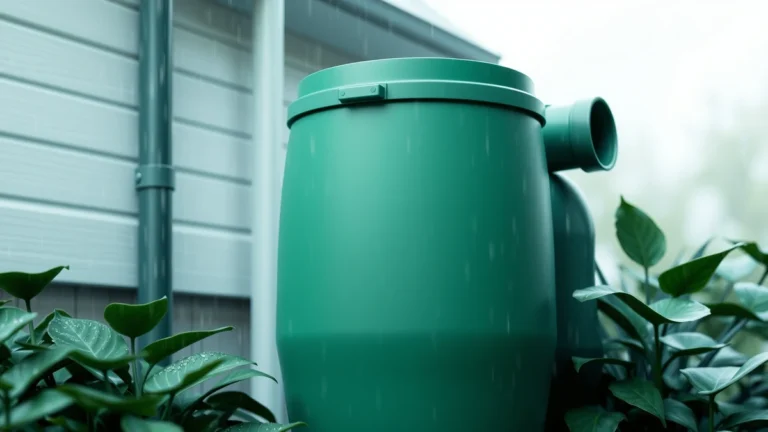
How many rain barrels does one inch of rain fill? On a roof with a 1,500 square foot footprint, the answer is about 14. The math behind that number is simple enough to do with a pencil.
To estimate rainwater from a roof, multiply rainfall depth in inches by the roof footprint in square feet and by 0.623 gallons. Then multiply by an efficiency factor, such as 85 percent, to allow for losses. One inch of rain on a 1,500 square foot footprint gives about 794 gallons.
The Rainwater Formula in One Line
The formula is gallons = rain depth in inches × roof footprint in square feet × 0.623 × efficiency. Each part has a job. Depth tells you how hard it rained, and area tells you how much roof caught it. Efficiency tells you how much of that water reached your barrel.
The number 0.623 comes from unit math. One inch of rain over one square foot is 144 cubic inches of water. A US gallon holds 231 cubic inches, so 144 divided by 231 gives 0.623 gallons per square foot per inch.
Metric is even easier. One millimeter of rain on one square meter is exactly one liter. Our gallons to liters converter switches the final answer either way. To skip the arithmetic, the rainfall water volume calculator applies this same formula.
Measure the Footprint, Not the Roof Surface
Use the footprint of the roof as your area. Texas A&M AgriLife Extension says the catchment area is the building area plus the area of the roof overhang. It also says differences in roof slope do not change the catchment area.
- Find the building area. Take the area of the building that sits under the roof.
- Add the overhang. Include the area of the eaves that stick out past the walls.
- Use the total. Enter that sum as the area in the formula.
A steep roof has more surface than a flat one with the same footprint. That extra surface does not add to the catchment. So a sloped surface figure, such as one from our roof area calculator, answers a different question than the footprint does.
Some homes have a garage, porch, or shed with its own roof. Treat each roof as its own catchment, measure each footprint with its overhang, and add the areas together. Then you only run the formula once.
Why You Never Collect Every Drop
Real roofs lose some water, so the formula includes an efficiency factor. The rainfall calculator uses 85 percent as a typical roof runoff efficiency. That is a planning estimate for gutter, splash, and evaporation losses, not a published standard, and you can adjust it.
Because it is an assumption, test it. Try a lower value if your gutters are old or often overflow. Try a higher one if they are well kept and the roof is smooth. The point is to see a sensible range, not a single exact number.
Here is the worked example for one inch of rain on a 1,500 square foot footprint.
- Multiply depth by area. 1 inch times 1,500 square feet gives 1,500.
- Apply the constant. 1,500 times 0.623 gives 934.5 gallons before losses.
- Apply efficiency. 934.5 times 0.85 gives 794.3, so about 794 gallons, or about 3,000 liters.
- Count the barrels. A common rain barrel holds about 55 gallons. 794 divided by 55 is 14.4, so about 14 barrels.
If you are planning the gutters that feed your barrels, our gutter calculator covers that side of the job.
How Storm Size Changes the Total
Collected water rises in a straight line with rain depth. Double the rain and you double the water. On the same roof at 85 percent efficiency, a quarter inch gives about 199 gallons, and a two inch storm gives about 1,589.
That dashed line matters. Even a quarter inch of rain gives about 3.6 barrels of water on this roof. A single barrel overflows in a modest storm.
Where does the depth number come from? Weather reports and rain gauges give rainfall in inches or millimeters. Use the depth from a storm you measured, or pick a depth you want to plan for. We do not quote local totals here, because they vary by place.
Roof Size and Rain Barrel Count
Roof footprint scales the answer in the same straight way. Twice the area gives twice the water. The table uses one inch of rain and the 85 percent efficiency allowance, with a 55 gallon barrel, which holds about 208 liters.
| Roof footprint | Before losses | At 85 percent | 55 gallon barrels |
|---|---|---|---|
| 500 sq ft | 311.5 gal | 265 gal | 4.8 |
| 1,000 sq ft | 623 gal | 530 gal | 9.6 |
| 1,500 sq ft | 934.5 gal | 794 gal | 14.4 |
| 2,500 sq ft | 1,557.5 gal | 1,324 gal | 24.1 |
Most households will not store a whole storm, and that is fine. The numbers just show what the roof offers. If you want a tank instead of barrels, a volume calculator turns tank dimensions into capacity.
Putting the Numbers to Work
Use the formula to plan before you buy anything. Start with the storm you care about, then work through the same short list each time. It takes a few minutes with a calculator.
- Pick a rain depth. Choose a storm size you want to plan for, such as one inch.
- Find the footprint. Add the building area and the overhang for every roof that drains to your gutters.
- Set the efficiency. Start with 85 percent, then test a lower and a higher value.
- Divide by barrel size. Divide the collected gallons by 55 and round up to whole barrels.
The result is a ceiling, not a promise. Real storms vary, and barrels that are already full catch nothing more.
Common Mistakes and What the Estimate Leaves Out
The biggest errors come from the inputs, not the math. Watch for these.
- Using the sloped roof surface. The footprint is what counts, not the surface.
- Skipping the overhang. Texas A&M includes it in the catchment area.
- Assuming 100 percent. Allow for losses with an efficiency factor.
- Mixing units. Keep inches with square feet, or millimeters with square meters.
This article estimates volume only. First flush, filtration, treatment, local rainfall totals, and legal rules are outside its scope, and we make no claims about them. Rainwater rules and water quality vary by place, so check your adopted edition and local office.
Enter your rainfall depth and roof footprint in the rainfall water volume calculator to see gallons, liters, and barrels in seconds.
FAQs About Rainwater Collection From a Roof
How many gallons of rain fall on a roof per inch of rain?
About 0.623 gallons for every square foot of footprint, for each inch of rain. A 1,000 square foot footprint gets about 623 gallons from one inch, before any losses.
Does roof slope change how much water I can collect?
No. Texas A&M AgriLife Extension says the catchment area is based on the roof footprint, and differences in slope do not change it. Use the building area plus the overhang.
Why does the calculator use 85 percent efficiency?
It is a planning estimate for gutter, splash, and evaporation losses on a typical roof. It is not a published standard, so you can raise or lower it for your own setup.
How many rain barrels do I need for one inch of rain?
On a 1,500 square foot footprint at 85 percent efficiency, one inch of rain gives about 794 gallons. That fills about 14 barrels of 55 gallons each.
How many liters is one millimeter of rain on a square meter?
Exactly one liter. One millimeter of rain over one square meter is 0.001 cubic meter, and a cubic meter holds 1,000 liters. Multiply by your efficiency factor for the collected amount.
Is one rain barrel enough?
Rarely. A barrel holds about 55 gallons, and even a quarter inch of rain on a 1,500 square foot footprint gives about 199 gallons. Expect the barrel to overflow in a modest storm.
Is collected rainwater safe to use?
This article does not cover water quality or treatment. Safety depends on how you collect, store, and use the water. Check local rules and treatment advice before you use it.
Sources and Further Reading
References Used in This Article
- Texas A&M AgriLife Extension, Rainwater Harvesting, Catchment Area, read 2026-10-13.
- NIST Special Publication 811, Appendix B.9, liter and gallon units, read 2026-10-13.
- Wikipedia, Rainwater harvesting (background), read 2026-10-13.
This article is general education. Rainwater rules and water quality vary by place, so check local rules and treatment advice before you use collected water. Reviewed for accuracy by Prof. Dr. Khalil Mudassar, PhD. Last updated 2026-10-13.
Author

Shakeel Muzaffar is the Founder and Editor-in-Chief of MultiCalculators.com, bringing over 15 years of experience in digital publishing, product strategy, and online tool development. He leads the platform's editorial vision, ensuring every calculator meets strict standards for accuracy, usability, and real-world value. Shakeel personally oversees content quality, formula verification workflows, and the platform's commitment to publishing tools that are genuinely useful for students, professionals, and everyday users worldwide.



