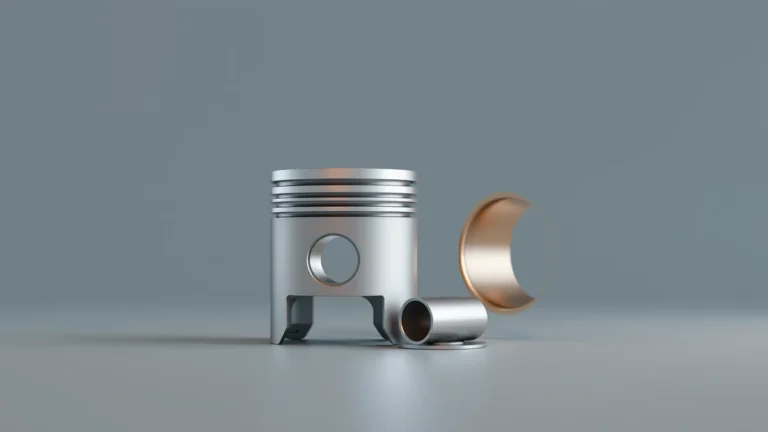
How does a pair of measurements on a spec sheet turn into a badge that reads 2.0? You need only bore, stroke, and the number of cylinders. Here is the formula, the units, and four real-size examples worked by hand.
Engine displacement equals pi divided by 4, times bore squared, times stroke, times the number of cylinders. Use centimeters to get cubic centimeters (cc). Divide cc by 1,000 for liters, or by 16.387064 for cubic inches. An 86 mm by 86 mm four-cylinder sweeps about 1,998 cc, or 2.0 L.
The Displacement Formula in One Line
Engine displacement is the volume the pistons sweep as they travel from the top of the cylinder to the bottom. The formula is (π / 4) × bore² × stroke × number of cylinders. The answer comes out in cubic units.
Bore is the width of the cylinder. Stroke is how far the piston travels. Together they describe one cylinder as a short, wide column, and the cylinder count scales it up to the whole engine.
Think of it as a slice of air. The bore circle is the floor, the stroke is the height, and the piston sweeps that whole space on every trip. Engine size and swept volume are other names for the same number.
You can skip the arithmetic with our engine displacement calculator. Knowing the pieces still helps you spot a typo in a spec.
Getting the Units Right: Millimeters, CC, Liters, Cubic Inches
Convert bore and stroke to centimeters first, and the formula returns cubic centimeters (cc) directly. One cubic centimeter is one cc, and 1,000 cc equals one liter. Skip this step and the answer will be off by a factor of 1,000 or more.
For inches, the NIST guide defines the inch as exactly 2.54 cm. That makes one cubic inch equal to 2.54 cubed, or 16.387064 cm³.
| You have | You want | Do this | Example |
|---|---|---|---|
| Millimeters | Centimeters | Divide by 10 | 86 mm = 8.6 cm |
| Inches | Centimeters | Multiply by 2.54 | 4.00 in = 10.16 cm |
| cc | Liters | Divide by 1,000 | 1,998.2 cc = 1.998 L |
| cc | Cubic inches | Divide by 16.387064 | 1,998.2 cc = about 121.9 cu in |
Going the other way, multiply cubic inches by 16.387064 to get cc.
Two quick checks catch most slips. A result near 2,000 cc should read about 2.0 L when you convert it. If you see 2,000,000, millimeters slipped into the formula, because one cc holds 1,000 cubic millimeters.
Worked Example: An 86 mm by 86 mm Four-Cylinder
Take an engine with an 86 mm bore, an 86 mm stroke, and four cylinders. Here is each step, with the numbers you should see on your own calculator.
- Convert to centimeters. 86 mm becomes 8.6 cm for both bore and stroke.
- Find the circle area. Square the bore: 8.6 × 8.6 = 73.96. Multiply by π / 4 (about 0.7854) to get roughly 58.09 cm².
- Multiply by the stroke. 58.09 × 8.6 gives about 499.56 cc for one cylinder.
- Multiply by four cylinders. 499.56 × 4 = 1,998.2 cc in total.
- Convert the units. 1,998.2 cc is about 2.0 L. Divide by 16.387064 and you get 121.9, or about 122 cubic inches.
Check your work by running it backward. Dividing 1,998.2 cc by four cylinders returns about the 499.56 cc from step three. The same five steps work for any engine.
The bore and stroke are equal, so the bore-to-stroke ratio is exactly 1.000. That is what engineers call a square engine.
Bore-to-Stroke Ratio: Square, Oversquare, Undersquare
Divide the bore by the stroke to get the ratio. A ratio above 1 means the bore is wider than the stroke (oversquare). A ratio of 1 is square, and a ratio below 1 means a long stroke (undersquare).
A commonly cited trade-off says oversquare designs suit high revs, while long-stroke designs favor low-rpm torque. Treat that as a general tendency, not a rule. For what torque actually means, read our torque explained guide, or compute a value with the torque calculator.
Why does the ratio appear on spec sheets at all? It gives a quick picture of the cylinder’s shape without the formula. Two engines can sweep the same volume with very different shapes. A ratio of 1.149 describes a wide cylinder, and a ratio of 0.877 describes a tall one.
| Type | Ratio | Shape | General tendency | Example here |
|---|---|---|---|---|
| Oversquare | Above 1 | Bore wider than stroke | Suits high revs | 350 V8: 1.149 |
| Square | 1.000 | Bore equals stroke | Neither wider nor longer | 86 x 86 four: 1.000 |
| Undersquare | Below 1 | Stroke longer than bore | Favors low-rpm torque | Three-cylinder: 0.877 |
Four Engines Side by Side
The same steps work for any engine size. The classic Chevrolet small-block 350 lists a 4.00 in bore, a 3.48 in stroke, and eight cylinders. In centimeters that is 10.16 and 8.8392, giving 716.6 cc (43.73 cubic inches) per cylinder.
Multiply by eight and you get 5,733 cc, or about 5.7 L. That is 349.8 cubic inches, which rounds to the famous 350. Its ratio is 4.00 / 3.48 = 1.149, so it is oversquare.
A small three-cylinder with a 71.9 mm bore and 82.0 mm stroke sweeps 332.9 cc per cylinder. That totals 998.8 cc, about 1.0 L or 61.0 cubic inches, with a ratio of 0.877. A six-cylinder at 92 mm by 86 mm sweeps 571.7 cc per cylinder, or 3,430.2 cc (3.43 L), with a ratio of 1.070.
Notice how the 350 gets its size. Each cylinder sweeps about 717 cc, which is more than the four-cylinder’s 500 cc, and there are twice as many of them.
Why Your Result May Not Match the Badge
Your hand result is a nominal number. Real engines list bore and stroke with rounding, so a tiny change in either value shifts the total a little.
Marketing names round too. A 3.43 L engine may be sold under a different round label, so trust the exact figure when you compare engines.
The formula also leaves out other engine numbers. Head gasket thickness, deck height, and compression ratio are separate measurements, and the calculator does not use them.
Before you rely on any figure, check it against the engine maker’s published specifications. Use your own calculation to understand the number, not to replace the official one.
Displacement is only a size. It does not tell you power or fuel use on its own. To compare power units, read horsepower vs watts. To price a drive, try the fuel cost calculator.
Enter them with the cylinder count in the engine displacement calculator to get cc, liters, cubic inches, and the bore/stroke ratio at once.
FAQs About Engine Displacement
What is the formula for engine displacement?
Displacement equals (pi / 4) x bore squared x stroke x number of cylinders. Work in centimeters and the answer comes out in cc, which you can then convert to liters or cubic inches.
How many cc are in a liter?
There are 1,000 cc in one liter. So an engine of 1,998.2 cc is about 2.0 L, and a 998.8 cc engine is about 1.0 L.
How do I convert cc to cubic inches?
Divide the cc by 16.387064, because one cubic inch is exactly 2.54 cubed cubic centimeters. For example, 1,998.2 cc divided by 16.387064 is about 121.9 cubic inches.
What does oversquare mean?
An oversquare engine has a bore wider than its stroke, so the bore-to-stroke ratio is above 1. The Chevrolet small-block 350 is an example, at a ratio of about 1.149.
What is a long-stroke engine?
A long-stroke, or undersquare, engine has a stroke longer than its bore, so the ratio is below 1. A 71.9 mm bore with an 82.0 mm stroke gives a ratio of about 0.877.
Does compression ratio change displacement?
No. Compression ratio is a different number. The displacement formula uses only bore, stroke, and cylinder count, and it leaves out head gasket thickness and deck height as well.
Why is my result different from the advertised engine size?
Listed bore and stroke are rounded, and marketing names round the total too. A 3.43 L engine may carry a different round label, so your exact figure is the better guide.
Sources and Further Reading
References Used in This Article
- National Institute of Standards and Technology, NIST Special Publication 811, Appendix B.9, conversion factors for the inch and cubic inch, accessed 2026-10-13.
- Wikipedia, Engine displacement, accessed 2026-10-13.
- Wikipedia, Stroke ratio, accessed 2026-10-13.
This article is general education, not engineering or repair advice. Always use the engine maker’s published specifications for real work. Reviewed for accuracy by Prof. Dr. Khalil Mudassar, PhD. Last updated 2026-10-13.
Author

Shakeel Muzaffar is the Founder and Editor-in-Chief of MultiCalculators.com, bringing over 15 years of experience in digital publishing, product strategy, and online tool development. He leads the platform's editorial vision, ensuring every calculator meets strict standards for accuracy, usability, and real-world value. Shakeel personally oversees content quality, formula verification workflows, and the platform's commitment to publishing tools that are genuinely useful for students, professionals, and everyday users worldwide.