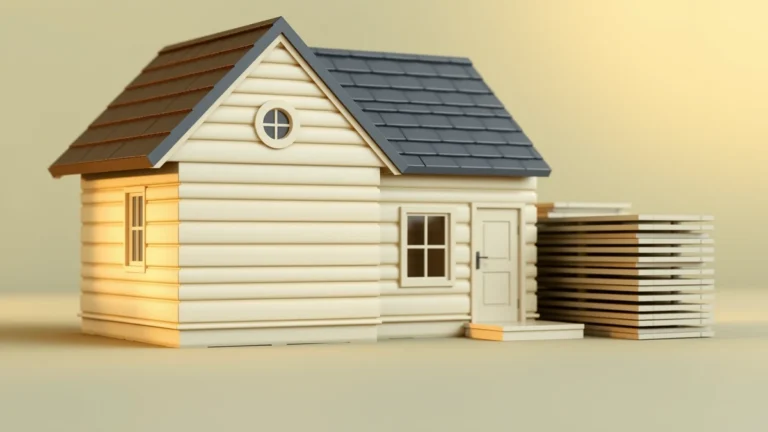
How many boxes of siding does a house with two gables, six windows and two doors really need? Guess low and the job stops halfway; guess high and you pay for a pile of leftovers.
Siding is sold by the square, and one square covers 100 square feet. Multiply your wall perimeter by the wall height, then add each gable as a triangle. Add about 10 percent for waste, divide by 100, and round up to whole squares.
What One Square of Siding Means
Siding is priced and ordered in squares. One square equals 100 square feet of wall. The Polymeric Exterior Products Association (PEPA) uses this same unit for ordering vinyl siding.
Wall area is not the same as floor area. Floor area counts the rooms inside, while siding covers the outside walls and gables. If you need the interior number, see our guide on how to calculate square footage of a house.
Roofers also count in squares, but that is a separate job with its own rules. Our article on roofing squares and shingles covers it. To skip the hand math, the siding calculator follows the same steps below.
A house with 1,000 square feet of wall needs 10 squares before waste. Thinking in squares keeps your order, your quote and your price per square all in the same unit.
Measure the Walls and Count the Openings
Start with the walls. PEPA says to multiply the height by the width of each wall, and to include the windows in that measure. For a simple box-shaped house, you can walk the outside, add up the wall lengths, and multiply by the wall height.
- Perimeter: add the length of every outside wall in feet.
- Height: measure from the base of the siding to the top of the wall.
- Wall area: perimeter times height. A 120 foot perimeter at 9 feet high is 1,080 square feet.
Rectangles are easy to check with a square footage calculator. Count your doors and windows too. Our calculator uses planning figures of 21 square feet per door and 12 square feet per window. Those are estimates, not standard sizes, so measure your own if they look off.
PEPA notes that windows and doors are not usually deducted, because including them gives an allowance for waste. Very large openings, such as garage doors and sliding glass doors, may be deducted.
How to Figure the Gables
A gable is the triangle of wall under the peak of the roof. Its area is 0.5 times the base times the height. A gable 24 feet wide and 6 feet high is 0.5 x 24 x 6, which is 72 square feet. Two of them make 144.
Gables are the biggest source of waste. The ends of each siding strip are cut at an angle to follow the roofline. A common rule of thumb is width times height times 0.75, which builds in cutting waste. For a 12 foot by 12 foot gable, that is 108 square feet instead of the 72 square feet geometry gives. Treat it as a rule of thumb, not a code figure.
Roof pitch changes how tall the gable is. If you also need the roof surface itself, use a roof area calculator. The diagram below shows how all the pieces fit together.
How Much Waste to Add
Add waste after you finish the net area. PEPA says the right amount depends on roof pitch and other house factors. The table shows the common planning habits.
| House type | Waste to add | Why |
|---|---|---|
| Simple house | About 10 percent | Few corners and mostly straight cuts |
| Typical guide range | 5 to 15 percent | Depends on cuts, skill and layout |
| Many corners, dormers or angled walls | 12 to 15 percent | More cuts and more offcuts |
To apply the percentage, multiply by one plus the waste. At 10 percent, that means multiplying by 1.10. If you skipped the opening deductions, you already have a small cushion built in.
Pick the higher end when the layout is complicated. Every corner, dormer and angled wall adds cuts, and cuts create offcuts. A little extra costs less than running short in the middle of the job.
A Worked Example for a 120-Foot House
Take a house with a 120 foot perimeter, 9 foot walls, two gables, two doors and six windows. Each gable is 24 feet wide and 6 feet high. The waste is 10 percent, and siding costs $300 per square.
- Walls. 120 x 9 = 1,080 square feet.
- Gables. 2 x 0.5 x 24 x 6 = 144 square feet.
- Openings. Doors are 2 x 21 = 42. Windows are 6 x 12 = 72. Together that is 114 square feet.
- Net area. 1,080 + 144 – 114 = 1,110 square feet.
- Add waste. 1,110 x 1.10 = 1,221 square feet.
- Convert to squares. 1,221 / 100 = 12.21, so order 13 squares.
- Price it. 13 x $300 = $3,900.
If your cartons hold two squares, or 200 square feet, 13 squares is about 7 cartons. Coverage varies by profile, so read the label first.
Cross-Check the Number and Add the Extras
Many pros use a shortcut: do not deduct openings, and add no extra waste. For our house that is 1,080 + 144 = 1,224 square feet, or 12.24 squares. That also rounds up to 13 squares, so the two methods agree.
| Method | Area used | Squares | Order |
|---|---|---|---|
| Deduct openings, add 10 percent | 1,221 sq ft | 12.21 | 13 squares |
| Pro habit: no deductions, no waste | 1,224 sq ft | 12.24 | 13 squares |
| Deduct openings, no waste (risky) | 1,110 sq ft | 11.10 | 12 squares |
If two methods differ by more than a square, recheck your measurements. Then add the extras. A starter strip is measured in linear feet around the base of the house. For fasteners, PEPA says to multiply total siding square feet by a pound factor. Use 0.005 pound for aluminum nails, or 0.01 pound for roofing nails, staples and screws. On 1,110 square feet, that is 5.55 or 11.1 pounds.
Common Counting Mistakes to Avoid
Most ordering errors come from a few small slips. Check this list before you place the order.
- Forgetting the gables. They add real area and the most cutting waste.
- Mixing units. Convert inches to feet first, and remember that one square is 100 square feet, not one.
- Deducting everything and adding no waste. The third row in the table shows how that leaves you a square short.
- Rounding down. A result of 12.21 squares means you need 13, because partial squares are not sold.
- Skipping the label. Carton coverage varies by profile, so read it before you divide.
Finally, remember that these numbers are a planning estimate. Your installer or supplier may use a different waste habit, so ask before you buy.
Enter your perimeter, wall height, gables, openings and waste in the siding calculator to get squares and cost in seconds.
FAQs About Calculating House Siding
How many square feet are in one square of siding?
One square of siding covers 100 square feet. Siding is ordered by this unit. For example, 1,221 square feet is 12.21 squares, which you round up to 13.
Should I subtract windows and doors when I measure for siding?
Usually not. PEPA says windows and doors are not normally deducted, and leaving them in adds a built-in waste allowance. Very large openings, like garage doors or sliding glass doors, may be deducted.
How do I find the area of a gable end?
Treat it as a triangle: 0.5 times the base times the height. A gable 24 feet wide and 6 feet high is 72 square feet. Some builders use width times height times 0.75 to cover cutting waste.
How much extra siding should I order?
About 10 percent is common for a simple house, and many guides cite 5 to 15 percent. Use 12 to 15 percent when the house has many corners, dormers or angled walls.
How many cartons of siding make up 13 squares?
Many cartons hold two squares, or 200 square feet, so 13 squares is about 7 cartons. Coverage varies by profile, so read the label on your carton before you order.
Why are gables the biggest source of siding waste?
The ends of each strip are cut at an angle to follow the roofline. That extra cutting means gables create more waste than flat, rectangular walls.
How many nails or fasteners should I buy for siding?
PEPA suggests multiplying siding square feet by 0.005 pound for aluminum nails, or 0.01 pound for roofing nails, staples and screws. For 1,110 square feet, that is 5.55 or 11.1 pounds.
Sources and Further Reading
References Used in This Article
- Polymeric Exterior Products Association (PEPA), vinyl siding installation: measuring, squares, waste, starter strip and fasteners, accessed 2026-10-13.
- Hunker, how much coverage does one box of vinyl siding cover (carton coverage and gable rule of thumb), accessed 2026-10-13.
- Wikipedia, Area (formulas for rectangles and triangles), accessed 2026-10-13.
This article is general education, not engineering, construction or building-code advice. Codes, products and prices vary by place, so confirm with your local building office and the product instructions before you build or buy. Reviewed for accuracy by Prof. Dr. Khalil Mudassar, PhD. Last updated 2026-10-13.
Author

Shakeel Muzaffar is the Founder and Editor-in-Chief of MultiCalculators.com, bringing over 15 years of experience in digital publishing, product strategy, and online tool development. He leads the platform's editorial vision, ensuring every calculator meets strict standards for accuracy, usability, and real-world value. Shakeel personally oversees content quality, formula verification workflows, and the platform's commitment to publishing tools that are genuinely useful for students, professionals, and everyday users worldwide.



