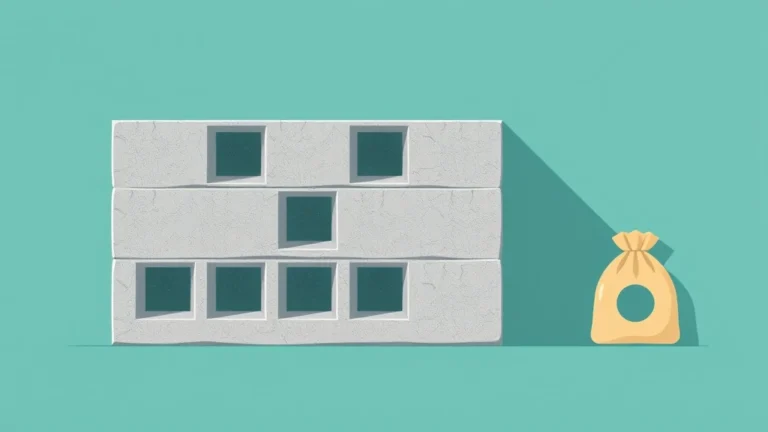
To fill the cores of a hollow concrete block wall, estimate grout by wall width and core spacing. Per CMHA TEK 04-02A, a solid-grouted 8 inch wall needs about 36.1 cubic feet per 100 square feet, which is roughly 1.34 cubic yards once you divide by 27.
- Core-fill grout fills the hollow cells of a block wall. It is a volume job, not the joint grout used between tiles.
- Volume depends on two things: the wall width (6, 8, 10, 12, or 14 inch block) and how far apart the grouted cores sit.
- CMHA Table 3 gives cubic feet of grout per 100 square feet of wall, with 3% waste already added. Four inch units are not grouted.
- An 80 lb bag of preblended grout yields roughly 0.66 to 0.68 cubic feet and fills about 3 standard 8x8x16 blocks solid.
- Small jobs favor 80 lb bags; large pours favor ready-mix measured in cubic yards. Always follow the project engineer’s specs.
Is Core-Fill Grout the Same as Tile Grout?
No. Core-fill grout and tile grout solve different problems. Tile grout fills the thin joints between tiles, so you estimate it by joint width and depth. Core-fill grout is a fluid concrete mix poured into the hollow cells of a concrete masonry unit, or CMU, to add strength and weight.
Because you are filling open cavities, this is a straight volume calculation. You are not computing a thin seam. You are figuring out how many cubic feet of grout it takes to pack the vertical cores of a wall, sometimes every cell and sometimes only the cells that hold reinforcing steel.
That difference changes the math entirely. If you came here for tile joints instead, our guide on how much grout you need for tile covers that case and the joint-volume math.
What Drives the Grout Volume in a Block Wall?
Two factors set the volume: the block width and the grout spacing. Wider block has deeper cores, so a 12 inch wall holds far more grout than a 6 inch wall over the same area. Spacing then decides how many of those cores you actually fill.
A wall grouted solid fills every cell. A partially grouted wall fills cores only at a set spacing, such as every 16, 24, or 48 inches on center, with the empty cells left hollow. The farther apart the filled cores, the less grout you buy.
The table below comes from CMHA TEK 04-02A, Table 3. It lists cubic feet of grout per 100 square feet of wall for common widths and spacings, and it already includes 3% waste. Note that 4 inch units are left out, since CMHA does not recommend grouting them.
| Grout spacing | 6 in wall | 8 in wall | 10 in wall | 12 in wall |
|---|---|---|---|---|
| Solid (every cell) | 25.6 | 36.1 | 47.0 | 58.9 |
| 16 in on center | 12.8 | 18.1 | 23.5 | 29.5 |
| 24 in on center | 8.6 | 12.1 | 15.7 | 19.7 |
| 48 in on center | 4.3 | 6.1 | 7.9 | 9.9 |
To turn any figure into cubic yards for ready-mix, divide by 27. A solid 12 inch wall at 58.9 cubic feet per 100 square feet works out to about 2.18 cubic yards per 100 square feet.
How Do You Estimate Core-Fill Grout Step by Step?
The method is short. You find the wall area, pick your width and spacing, read the table, then scale it to your wall. Here is the full process.
- Measure the net wall area. Multiply wall length by height, then subtract openings like doors and windows. Keep the result in square feet.
- Confirm the block width. Use the nominal width: 6, 8, 10, or 12 inch. Four inch units are not grouted.
- Set the grout spacing. Solid fills every cell. Otherwise use the reinforced spacing the drawings call for, such as 24 or 48 inches on center.
- Read the table rate. Find the cubic feet per 100 square feet for your width and spacing.
- Scale to your wall. Multiply the rate by your area, then divide by 100. Divide that total by 27 for cubic yards.
You can skip the arithmetic and let the CMU grout fill calculator read the table and convert to bags or cubic yards for you.
Enter your wall size, block width, and core spacing in the CMU Grout Fill Calculator to get grout volume in cubic feet, 80 lb bags, and cubic yards in one step.
Solid Fill Versus Grout at Spacing
Solid fill uses the most grout because every cell is packed. Spacing the grouted cores apart leaves hollow cells between them, which cuts volume sharply. The cutaway below shows the same wall grouted three ways.
Should You Buy Bags or Ready-Mix?
Match the delivery method to the pour size. Small walls and repairs favor 80 lb bags of preblended core-fill grout. Large jobs favor ready-mix grout delivered by the cubic yard, which saves mixing hundreds of bags by hand.
For bag counts, each 80 lb bag yields roughly 0.66 to 0.68 cubic feet. Quikrete Core-Fill Grout Fine (product 1585-08) yields about 0.68 cubic feet per bag, the Coarse version (1585-07) yields about 0.65, and CMHA cites about 0.66 for generic preblended grout. All three fill the cores of roughly 3 standard 8x8x16 blocks.
CMHA also lists cores filled per bag by block size, which is handy for spot repairs. The decision guide below shows when each option makes sense.
| Block size | Cores filled per 80 lb bag |
|---|---|
| 6 in | 3.6 cores |
| 8 in | 2.7 cores |
| 10 in | 2.2 cores |
| 12 in | 1.8 cores |
A quick caution on round numbers. Some sites quote “0.89 cubic yards per 100 blocks” as a fixed rule, but no manufacturer or CMHA document states it. If you want a per-100-block figure, derive it and show the source. Quikrete’s rate of 3 blocks per 0.68 cubic foot bag works out to about 0.84 cubic yards per 100 solid-filled 8 inch blocks, while CMHA’s Table 3 solid-fill figure implies closer to 1.19. Treat both as derived estimates, not published constants.
A Worked Example for One Wall
Say you have an 8 foot tall by 20 foot long garden wall in 8 inch block, grouted solid, with no openings. That is 160 square feet of net wall area.
- Area: 8 ft x 20 ft = 160 square feet.
- Table rate: an 8 inch wall grouted solid uses 36.1 cubic feet per 100 square feet.
- Total volume: 36.1 x 160 / 100 = about 57.8 cubic feet.
- Cubic yards: 57.8 / 27 = about 2.14 cubic yards for ready-mix.
- Bags: at 0.66 cubic feet per bag, 57.8 / 0.66 = about 88 bags of 80 lb grout.
That bag count is high, so this wall sits near the line where ready-mix starts to make sense. Add a small extra for pump loss or over-pour, since the table waste figure is modest. You can also size the blocks themselves with the concrete block calculator and check footing concrete with the concrete calculator.
Common Core-Fill Estimating Mistakes
Most overages trace back to a few habits. The table pairs each slip with a cleaner approach.
| Mistake | Better approach |
|---|---|
| Treating core fill like tile grout | Estimate by cavity volume, not joint width and depth. |
| Grouting 4 inch units | CMHA does not recommend it; the table starts at 6 inch block. |
| Assuming solid fill everywhere | Read the drawings; reinforced spacing like 48 inches uses far less grout. |
| Using a block count instead of area | Use net wall area in square feet with the CMHA rate for accuracy. |
| Forgetting bond beams | Add horizontal bond-beam grout separately, by the linear foot. |
If you are estimating a mixed masonry project, the bricks per square foot guide and the full construction calculators hub cover the companion materials.
Concrete Block Grout Fill: Frequently Asked Questions
How much grout fills one standard concrete block?
About a third of an 80 lb bag. Quikrete states one 80 lb bag fills the cores of roughly 3 standard 8x8x16 blocks solid, so each block takes close to 0.23 cubic feet of grout.
Do you have to fill every core in a block wall?
No. Many walls are grouted only at reinforced cores, such as every 24 or 48 inches on center. The structural drawings set the spacing. Partial fill uses much less grout than solid fill.
How many 80 lb bags of grout per 100 square feet?
For a solid 8 inch wall, about 55 bags. That is 36.1 cubic feet per 100 square feet from CMHA, divided by roughly 0.66 cubic feet per bag. Wider block and solid fill raise the count.
Can you use regular concrete to fill block cores?
Not as a substitute for grout. Masonry grout is mixed fluid so it flows into the cells and bonds to the steel. Follow the engineer’s specified grout and slump, not a stiff concrete mix.
How do you convert grout cubic feet to cubic yards?
Divide the cubic feet by 27. For example, 57.8 cubic feet of grout divided by 27 is about 2.14 cubic yards, which is the figure you give a ready-mix supplier.
Are 4 inch blocks ever grouted?
CMHA does not recommend grouting 4 inch units, so its Table 3 begins at 6 inch block. Core-fill estimates in this guide cover 6, 8, 10, and 12 inch walls.
What is the difference between fine and coarse core-fill grout?
Aggregate size. Fine grout suits narrow cells and small cores; coarse grout has larger aggregate for wider cavities. Quikrete lists about 0.68 cubic feet per bag for Fine and 0.65 for Coarse.
Sources and Further Reading
References Used in This Article
Educational estimate, not professional construction advice; follow the manufacturer’s current data sheet, and follow the project engineer’s specs and your local building code. Coverage varies with block size, core geometry, grout spacing, and mixing. Not affiliated with any brand; trademarks belong to their owners. Reviewed for accuracy by Prof. Dr. Khalil Mudassar, PhD. Last updated October 4, 2026.
Author

Shakeel Muzaffar is the Founder and Editor-in-Chief of MultiCalculators.com, bringing over 15 years of experience in digital publishing, product strategy, and online tool development. He leads the platform's editorial vision, ensuring every calculator meets strict standards for accuracy, usability, and real-world value. Shakeel personally oversees content quality, formula verification workflows, and the platform's commitment to publishing tools that are genuinely useful for students, professionals, and everyday users worldwide.