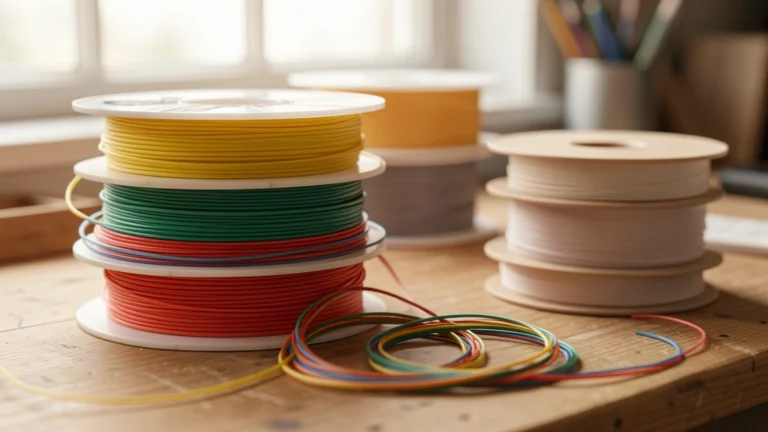
A 1 kg spool of 1.75 mm PLA holds about 335 metres of plastic thread. That is more than a third of a kilometre on one reel. Yet the same weight in 2.85 mm filament runs only about 126 metres. This guide shows where those numbers come from and how to check your own spool.
| Formula | Length = weight / (density x pi x r^2) |
|---|---|
| 1 kg of 1.75 mm PLA | About 335 metres |
| 1 kg of 2.85 mm PLA | About 126 metres |
| 1.75 mm PLA per metre | About 2.98 grams |
| PLA density used | 1.24 g/cm3 |
Spool Lengths for Seven Filament Materials
Each material has its own density, so a kilogram of each one gives a different length. The table uses the densities our calculator applies. All lengths are for a full 1 kg spool of plain, unfilled filament.
| Material | Density (g/cm3) | 1.75 mm spool | 2.85 mm spool |
|---|---|---|---|
| ABS | 1.04 | 399.8 m | 150.7 m |
| ASA | 1.07 | 388.6 m | 146.5 m |
| Nylon | 1.14 | 364.7 m | 137.5 m |
| Polycarbonate | 1.20 | 346.5 m | 130.6 m |
| TPU (flexible) | 1.21 | 343.6 m | 129.5 m |
| PLA | 1.24 | 335.3 m | 126.4 m |
| PETG | 1.27 | 327.4 m | 123.4 m |
The spread is worth knowing before you buy. A kilogram of ABS runs about 19 percent longer than a kilogram of PLA. That gap comes purely from density, since both strands share the same width.
The difference shows up on part-used spools too. Take 750 grams left on two 1.75 mm reels. The PETG reel holds about 245.5 metres, while the ABS reel holds about 299.8 metres.
Five terms appear throughout this guide. Here is what each one means in plain words.
- Density
- The mass packed into each cubic centimetre of plastic, written in g/cm3.
- Nominal diameter
- The labeled width of the strand, such as 1.75 mm or 2.85 mm.
- Cross-section area
- The area of the round end of the strand, equal to pi times the radius squared.
- Grams per metre
- The weight of one metre of filament, which links weight and length directly.
- Net weight
- The weight of the filament alone, without the empty spool it is wound on.
How Does Weight Turn Into Length?
Divide the weight by the density to get volume, then divide the volume by the strand’s cross-section area. The result is length. Filament is just a very long, thin cylinder of plastic.
Density is mass divided by volume, and textbooks give it in grams per cubic centimetre for solids. Our guide on density explained with examples covers that idea in more depth. Here we only need to run it backward.
The Tool Page Example, Worked by Hand
Take 1 kilogram of 1.75 mm PLA at 1.24 g/cm3. First, 1,000 grams divided by 1.24 gives about 806 cubic centimetres of plastic. That equals about 806,452 cubic millimetres.
Next, find the end area of the strand. The radius is 0.875 mm, so pi times 0.875 squared is about 2.41 square millimetres. Dividing 806,452 by 2.405 gives about 335,300 mm, or 335.3 metres.
The same steps work for any weight. A half spool of 500 grams gives exactly half the length, about 167.6 metres. The filament length calculator runs these steps for seven materials and both common diameters.
Why Is a 2.85 mm Spool So Much Shorter?
A 2.85 mm strand has about 2.65 times the cross-section of a 1.75 mm strand. Each metre therefore uses 2.65 times more plastic. So the same kilogram stretches only about 38 percent as far.
Area grows with the square of the diameter, not in step with it. The wider strand is only 1.63 times thicker, yet its end area is 6.38 square millimetres instead of 2.41. That squared effect is what makes the gap so large.
Printers are built for one size or the other, so the choice is not yours to make per job. A university library 3D printing guide notes that the larger size may be listed as either 2.85 mm or 3 mm. Enter 2.85 mm for those spools to keep the math close to the real strand.
How Much Filament Is Left on a Part-Used Spool?
Weigh the spool, subtract the empty spool weight, then convert the net grams to metres. Our calculator lists a forgotten empty spool as a classic mistake. The empty reel adds weight that is not filament at all.
Here is a clear example. Suppose your scale reads 450 grams, and you weighed a matching empty spool at 250 grams. That leaves 200 grams of 1.75 mm PLA, or about 67.1 metres.
Will This Print Finish?
Your slicer reports that the next print needs 80 grams. At 2.98 grams per metre, that is about 26.8 metres. The 200 grams on the spool covers it, with 120 grams, or about 40.2 metres, to spare.
Always compare like with like. Grams against grams is the simplest check, because slicers report the weight of each print. Convert to metres only when you want to compare against a length printed on a label.
Why Do Real Spools Run Longer or Shorter Than the Math?
Real filament differs slightly from its label in both density and diameter. The formula is exact for the numbers you enter. The spool in your hand may not match those numbers perfectly.
Fillers Change the Density
A study of carbon-fibre PLA found pure PLA at 1.24 g/cm3. Adding 10 percent carbon fibre by weight raised the measured density to 1.28 g/cm3. At that density, 1 kg of 1.75 mm filament runs about 324.8 metres, or 10.5 metres less.
Small Diameter Errors Add Up
Diameter matters even more, because it is squared. A lab study that extruded 1.75 mm PLA measured average diameters from 1.63 to 1.69 mm. At 1.66 mm, a kilogram would stretch to about 372.6 metres, roughly 11 percent more than the label math.
The lesson is simple. Treat any computed length as a close estimate, and keep a small safety margin before a long print.
Grams per Metre: The Shortcut Worth Memorizing
Grams per metre equals density times the cross-section area in square millimetres. The units line up neatly, so no extra conversion is needed. For 1.75 mm PLA, 1.24 times 2.405 gives about 2.98 grams per metre.
| Material | 1.75 mm | 2.85 mm |
|---|---|---|
| ABS | 2.50 g/m | 6.63 g/m |
| Nylon | 2.74 g/m | 7.27 g/m |
| PLA | 2.98 g/m | 7.91 g/m |
| PETG | 3.05 g/m | 8.10 g/m |
Once you know this one number, weight and length become two views of the same spool. Multiply metres by grams per metre for weight. Divide grams by it for metres.
The thicker strand needs its own figure. At 7.91 grams per metre for 2.85 mm PLA, the same 80 gram print uses only about 10.1 metres. The weight is identical, but the length drops sharply.
The same number also helps with budgeting. A print’s filament cost follows from its grams and the spool price. Our guide to how much a 3D print costs covers that side, including power and failed prints.
The Filament Length Calculator turns any weight into length, volume and grams per metre for seven materials at 1.75 mm or 2.85 mm.
Questions People Ask About Filament Length
How Many Metres Are in a 1 kg Spool of PLA?
About 335 metres for 1.75 mm PLA at 1.24 g/cm3. The same kilogram in 2.85 mm PLA runs about 126 metres, because the thicker strand uses more plastic per metre.
How Do You Convert Filament Weight to Length?
Divide the weight by the density to get volume. Then divide that volume by the strand’s end area, pi times the radius squared. Keep grams, cubic centimetres and millimetres consistent.
Why Does ABS Give More Metres Than PLA?
ABS is lighter, at about 1.04 g/cm3 versus 1.24 for PLA. A kilogram of ABS fills more volume, so a 1.75 mm spool runs about 400 metres instead of 335.
How Can I Tell How Much Filament Is Left?
Weigh the spool and subtract the empty spool weight. Then divide the net grams by grams per metre. For 1.75 mm PLA, 200 grams is about 67 metres.
Is 3 mm Filament the Same as 2.85 mm?
In practice, the larger filament size is often sold under either label. Use 2.85 mm in length math, which gives about 126 metres for 1 kg of PLA.
Where These Numbers Come From
References Used in This Article
- OpenStax Chemistry 2e, 1.4 Measurements (density as mass over volume, g/cm3 for solids)
- NIST, SI Units (metre and kilogram base units)
- Carbon Fiber-Reinforced PLA Composite for Fused Deposition Modeling 3D Printing, PMC (PLA density 1.24 g/cm3; filled PLA densities)
- Optimization of Process Parameters for Fabricating Polylactic Acid Filaments, PMC (measured filament diameters)
- Purdue University Libraries, 3D Printing Filament Guide (1.75 mm and 2.85 mm or 3 mm sizes)
Lengths assume a perfectly round strand at the stated diameter and the densities listed above. Real spools vary slightly, so weigh part-used spools for the best estimate. Reviewed for accuracy by Prof. Dr. Khalil Mudassar, PhD. Last updated September 27, 2026.
Author

Shakeel Muzaffar is the Founder and Editor-in-Chief of MultiCalculators.com, bringing over 15 years of experience in digital publishing, product strategy, and online tool development. He leads the platform's editorial vision, ensuring every calculator meets strict standards for accuracy, usability, and real-world value. Shakeel personally oversees content quality, formula verification workflows, and the platform's commitment to publishing tools that are genuinely useful for students, professionals, and everyday users worldwide.