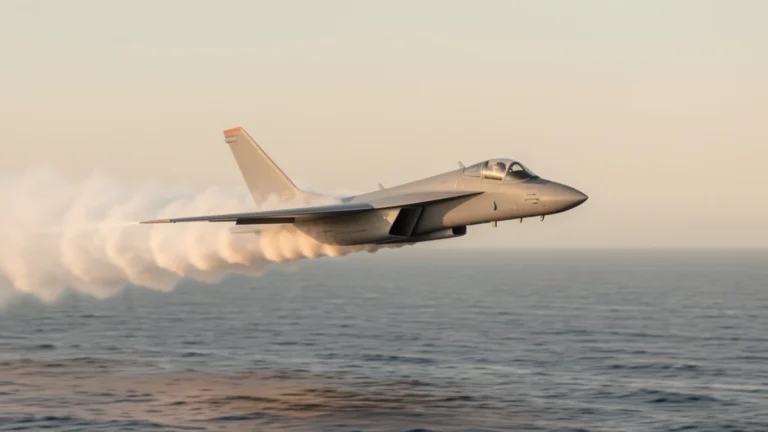
Why can a jet flying at 660 mph be at Mach 1 high up but only Mach 0.87 near the ground? A Mach number compares your speed with the local speed of sound, and that speed shifts with air temperature. This guide gives you the table, the formula, and the flight bands behind every Mach reading.
| Definition | Flow speed divided by the local speed of sound |
|---|---|
| Formula | M = v / a, with a = sqrt(gamma x R x T) |
| Mach 1 at 15 C | About 340.3 m/s, or 761 mph |
| Mach 1 at -56.5 C | About 295 m/s, or 660 mph |
| Hypersonic starts at | Mach 5, per NASA Glenn |
Mach 1 in Meters, Miles and Knots at Five Air Temperatures
The table below turns Mach 1 into everyday units for dry air. Each row uses the same formula with gamma 1.4 and R 287 J/kg K. Only the temperature changes from row to row.
| Air temperature | Kelvin | m/s | mph | knots |
|---|---|---|---|---|
| 30 C (hot day) | 303.15 K | 349.0 | 781 | 678 |
| 15 C (standard sea level) | 288.15 K | 340.3 | 761 | 661 |
| 0 C (freezing) | 273.15 K | 331.3 | 741 | 644 |
| -20 C | 253.15 K | 318.9 | 713 | 620 |
| -56.5 C (11 to 25 km up) | 216.65 K | 295.0 | 660 | 574 |
Notice the spread. Mach 1 is about 101 mph slower in the cold air of the lower stratosphere than on a standard day at sea level. The number on the gauge stays at 1.0 in both places.
Five terms appear in almost every Mach problem. Here is what each one means in plain words.
- Mach number (M)
- The ratio of flow speed to the local speed of sound. It has no units.
- Speed of sound (a)
- How fast a small pressure disturbance travels through a gas at a given temperature.
- Specific heat ratio (gamma)
- A gas property equal to cp divided by cv. Air uses 1.4, and helium uses 1.66.
- Stagnation (total) value
- The pressure or temperature the gas would reach if brought smoothly to rest.
- Static value
- The pressure or temperature measured in the moving gas itself.
What Does a Mach Number Actually Measure?
A Mach number measures how fast something moves compared with sound in the same air. NASA Glenn defines it as M = v / a, where v is the speed and a is the speed of sound.
Because both speeds share the same units, the units cancel. Mach 2 means twice the local speed of sound, whether you measure in meters per second, miles per hour or knots. Pilots and sailors often think in knots, and our guide on converting knots to mph covers that unit switch.
The ratio matters more than raw speed for one reason. NASA Glenn explains that the Mach number sets the size of many compressibility effects on an aircraft. Two planes at Mach 0.8 feel similar air physics, even when their true speeds differ.
A Quick Worked Conversion
Take a plane moving at 250 m/s. Near the ground at 15 C, it flies at 250 / 340.3, or about Mach 0.73. At -56.5 C high up, the same 250 m/s gives 250 / 295.0, or about Mach 0.85.
The plane did not speed up at all. The air around it got colder, so sound got slower, and the ratio climbed.
Why Does the Speed of Sound Depend on Temperature?
Sound travels through collisions between gas molecules, and warmer molecules move faster. NASA Glenn gives the speed of sound as a = sqrt(gamma x R x T), with T on an absolute scale.
That last detail trips people up. The temperature must be in kelvin, not Celsius. Add 273.15 to a Celsius reading first, so 15 C becomes 288.15 K.
Now run the numbers for standard sea-level air. Multiply 1.4 by 287 by 288.15, and the product is about 115,780. Its square root is 340.3 m/s, which is Mach 1 on a standard day.
Temperature changes with height, so Mach 1 changes too. The NASA Glenn atmosphere model starts at about 15 C at sea level. It then drops by about 6.5 C per 1,000 meters, until it holds near -56.5 C from 11,000 to 25,000 meters.
Speed of sound is not the same as loudness. A whisper and a shout travel at the same speed through the same air. Loudness is a separate scale, covered in our guide to what decibels measure.
Where Do Subsonic, Transonic, Supersonic and Hypersonic Begin?
NASA Glenn sets the bands by Mach number: subsonic below 1, transonic near 1, supersonic above 1, and hypersonic above 5. It also flags speeds above Mach 3 as high supersonic.
| Regime | Mach range | What changes | Speed at 15 C |
|---|---|---|---|
| Subsonic | Below 1 | At the lowest speeds, compressibility can be ignored | Under 761 mph |
| Transonic | Near 1 | Local flow passes sound speed; drag rises sharply | About 761 mph |
| Supersonic | Above 1 | Shock waves form on the surface | Mach 2 = 1,522 mph |
| High supersonic | Above 3 | Aerodynamic heating shapes the design | Mach 3 = 2,283 mph |
| Hypersonic | Above 5 | Air chemistry itself changes | Mach 5 = 3,806 mph |
The transonic band is where the old idea of a sound barrier came from. NASA Glenn notes that the barrier was really a steep rise in drag near Mach 1. For that reason, aircraft do not cruise right at Mach 1.
At the top end, NASA Glenn describes the Space Shuttle reentering at about Mach 25. At those speeds, the heated air becomes an ionized plasma.
Our calculator uses a simpler split: subsonic, sonic at exactly 1, supersonic from 1 to 5, and hypersonic from 5 up. It also treats flow below Mach 0.3 as nearly incompressible. At Mach 0.3, density drops only about 4.4 percent from its rest value.
What Happens to Pressure and Temperature at Mach 2?
As a gas speeds up smoothly, its static pressure and temperature fall. At Mach 2 in air, static temperature is 0.5556 of the stagnation value, and static pressure is 0.1278 of it.
These are the isentropic ratios, and NASA Glenn lists them in one set of equations. Each ratio depends only on the Mach number and gamma. Let f = 1 + 0.2 x M^2 for air. Then T / T0 = 1 / f, and p / p0 = f^-3.5.
The Nozzle Example From Our Calculator
The tool page works a nozzle problem with air at Mach 2, a stagnation pressure of 500 kPa and 300 K. Here f = 1 + 0.2 x 4 = 1.8.
- Static temperature: 300 / 1.8 = 166.7 K, a drop of 133.3 K.
- Static pressure: 500 x 0.1278 = 63.9 kPa.
- Density ratio: 1.8^-2.5 = 0.2300.
- Local speed of sound: sqrt(1.4 x 287 x 166.7) = 258.8 m/s.
- Flow speed: 2 x 258.8 = 517.6 m/s, with an area ratio of 1.6875.
Look at the speed of sound there. The cold, fast gas has a lower a than the 340.3 m/s of standard air. So Mach 2 in this nozzle is only 517.6 m/s, not 680.6 m/s.
At Mach 1, the same equations give the critical ratios. For air, p* / p0 is 0.528 and T* / T0 is 0.833. You can test other speeds and gases with the compressible flow and Mach ratio calculator.
How Do You Turn Any Speed Into a Mach Number?
Find the air temperature, compute the local speed of sound, then divide the speed by it. Keep both speeds in the same units before you divide.
- Convert the temperature to kelvin by adding 273.15.
- Compute a = sqrt(1.4 x 287 x T) for air, in m/s.
- Convert your speed to m/s, or convert a to your speed unit.
- Divide: M = v / a.
Try a slower example. A speed of 170 m/s at 15 C gives 170 / 340.3, or Mach 0.50. At 0 C, the same speed gives 170 / 331.3, or Mach 0.51.
Three Slips That Skew the Answer
The first slip is using Celsius inside the square root. At 15 C, that would give a speed of sound near 78 m/s, which is far too low.
The second is using the sea-level 761 mph at every height. At -56.5 C, Mach 1 is 660 mph, so a sea-level figure understates the Mach number by about 13 percent.
The third is mixing gases. Helium uses gamma 1.66 and R 2077, so sound moves far faster in it. At 15 C, helium carries sound at about 997 m/s, nearly three times the speed in air.
The Compressible Flow Calculator takes a Mach number, gas and stagnation conditions, then returns static values, speed of sound, velocity and area ratio.
Questions People Ask About Mach Number
How Fast Is Mach 1 in Mph?
Mach 1 is about 761 mph in standard sea-level air at 15 C. In the colder air between 11 and 25 km up, at about -56.5 C, it drops to about 660 mph.
Is the Speed of Sound the Same Everywhere?
No. It depends on the gas and its absolute temperature, through a = sqrt(gamma x R x T). Warmer air carries sound faster, so Mach 1 is a different speed at different heights.
What Mach Number Counts as Hypersonic?
NASA Glenn calls flow hypersonic above Mach 5. At those speeds, some of the energy goes into the air molecules themselves, so air chemistry affects the forces.
Does Mach Number Have Units?
No. It is a ratio of two speeds, so the units cancel. Mach 2 means twice the local speed of sound in any unit system.
Why Does Temperature Drop in Fast Gas Flow?
As gas speeds up smoothly, it trades heat energy for motion. In air at Mach 2, the static temperature is 0.5556 of the stagnation value, so 300 K falls to 166.7 K.
Where These Numbers Come From
References Used in This Article
- NASA Glenn Research Center, Mach Number (definition and flight regimes)
- NASA Glenn Research Center, Speed of Sound (a = sqrt(gamma R T), absolute temperature)
- NASA Glenn Research Center, Isentropic Flow Equations (pressure, temperature and density ratios)
- NASA Glenn Research Center, Earth Atmosphere Model, Metric Units (temperature by altitude)
This article explains Mach number for general science and engineering education. Speeds assume dry air as an ideal gas with gamma 1.4 and R 287 J/kg K. Reviewed for accuracy by Prof. Dr. Khalil Mudassar, PhD. Last updated September 27, 2026.
Author

Shakeel Muzaffar is the Founder and Editor-in-Chief of MultiCalculators.com, bringing over 15 years of experience in digital publishing, product strategy, and online tool development. He leads the platform's editorial vision, ensuring every calculator meets strict standards for accuracy, usability, and real-world value. Shakeel personally oversees content quality, formula verification workflows, and the platform's commitment to publishing tools that are genuinely useful for students, professionals, and everyday users worldwide.