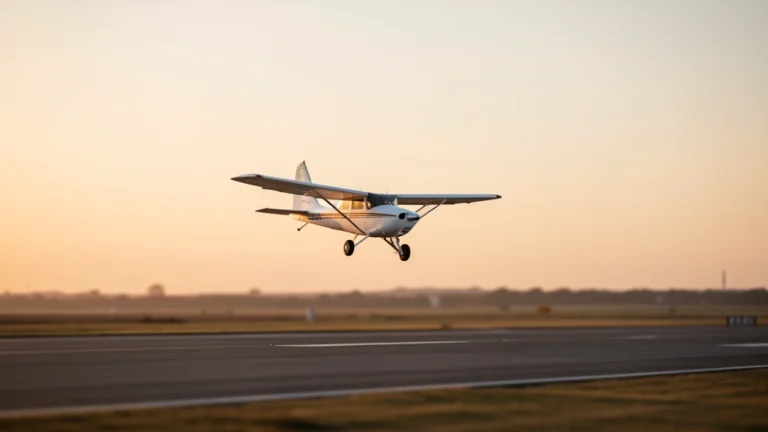
What do a hiker gaining 400 meters in an hour and an airplane sinking 600 feet a minute share? Both are moving at a vertical speed. It is the rate of height change over time, and it ignores how far you travel sideways.
This guide shows how to work out vertical speed from a climb and its time. It also covers the aviation side: how descent angle and ground speed set a descent rate, and how the FAA handbooks plan a descent. It is for learning only, not for flying an aircraft.
- Vertical speed is height gained or lost divided by time, such as 600 m in 1.5 hours = 400 m per hour.
- Pilots use feet per minute. One knot of ground speed covers about 101.27 feet each minute.
- On a 3-degree path, the rate is ground speed x 101.27 x tan(3), so 120 knots needs about 637 fpm.
- Time to descend is height to lose divided by the rate, so 10,000 ft at 500 fpm takes 20 minutes.
Height Per Hour, Height Per Minute
Vertical speed measures only the up or down part of your motion. A hiker on a switchback trail may walk 3 km to gain 600 m. The walking distance does not matter here, only the 600 m of height and the time it took.
Hikers and hill runners usually quote meters per hour. Pilots quote feet per minute, often shortened to fpm. The FAA’s Pilot’s Handbook of Aeronautical Knowledge says the vertical speed indicator shows the rate of climb or descent in feet per minute.
The two worlds sit far apart on the same scale. A hiker at 400 m per hour climbs about 21.9 feet per minute. An airplane at 120 knots on a 3-degree path descends about 637 fpm, roughly 29 times faster.
Direction also matters. Climbing gives a positive number, and descending gives a negative one. A descent rate is simply a vertical speed with the sign dropped.
How Do You Calculate Vertical Speed?
Divide the height change by the time it took. The formula is vertical speed = height change / time, with time in the unit you want per.
- Measure the height change. Use the start and end elevation, not the trail distance. Our calculator’s example uses a 600 m climb.
- Convert the time. Turn hours and minutes into one number. For 1 hour 30 minutes, that is 1.5 hours.
- Divide. 600 m / 1.5 hours = 400 m per hour. This is the vertical speed for that section.
- Change units when needed. One foot is exactly 0.3048 m, so 400 m per hour is about 1,312 feet per hour. Divide by 60 for about 21.9 fpm.
- Flip it for pacing. Divide 6,000 by the rate in m per hour. At 400 m per hour, each 100 m of height takes 15 minutes.
The same math plans a bigger climb. At 400 m per hour, a 1,000 m climb takes 2.5 hours. At 500 m per hour, it takes 2 hours.
Vertical speed is not the same as trail pace. Pace tracks how fast you cover ground, as our guide to converting pace to speed in mph explains. On steep ground, the height number tells you more about effort.
The Vertical Speed Calculator turns your ascent and time into meters per hour, feet per hour, and minutes per 100 m of height.
How Does Descent Angle Set the Descent Rate?
The descent rate equals ground speed times the tangent of the descent angle. Faster ground speed on the same angle needs a faster descent rate.
Picture a right triangle. The ground track is the long flat side, and the height lost is the short side. The tangent of the angle is height over distance, which our guide to using tan and inverse tan on a calculator covers step by step.
Units need care here. One nautical mile is exactly 1,852 m, or about 6,076 ft. So one knot covers about 101.27 ft per minute of ground track.
Now take 120 knots on a 3-degree path. The math is 120 x 101.27 x tan(3), and tan(3) is about 0.0524. The result is about 637 fpm.
The Times-Five Shortcut
The FAA Instrument Procedures Handbook gives a quick rule for a 3-degree path: multiply ground speed by 5. At 120 knots, that gives 600 fpm. The shortcut runs about 5.8 percent below the exact figure at every speed.
| Ground speed | Exact (fpm) | Times five (fpm) | Gap (fpm) |
|---|---|---|---|
| 90 kt | 478 | 450 | 28 |
| 120 kt | 637 | 600 | 37 |
| 150 kt | 796 | 750 | 46 |
| 180 kt | 955 | 900 | 55 |
Flying the times-five number traces a path of about 2.83 degrees, a little shallower than 3. The shortcut is easy to do in your head, which is its main value.
Time and Distance for a Planned Descent
Time to descend equals the height to lose divided by the descent rate. Losing 10,000 ft at 500 fpm takes 20 minutes. Losing 3,000 ft at 600 fpm takes 5 minutes.
Distance comes next. Multiply the descent time by the ground covered each minute. At 120 knots, the aircraft covers 2 NM per minute, so a 10-minute descent spans 20 NM.
The 3 to 1 Rule and the Divide-by-300 Rule
The FAA Instrument Procedures Handbook calls the 3 to 1 formula a rule of thumb for initial IFR descent planning in jets. It means 3 NM of distance for every 1,000 ft of descent. In its example, a jet at FL 310 must lose 25,000 ft, so descent begins 75 NM out.
That handbook example assumes a vertical speed of 1,800 to 2,200 fpm. At 2,000 fpm, the 25,000 ft takes 12.5 minutes. The handbook also adds 2 NM for each 10 knots of tailwind.
For a slower airplane, the same handbook divides the height to lose by 300. Dropping from 7,000 ft to 1,000 ft means 6,000 ft, so descent starts 20 NM out. At 120 knots and 600 fpm, that 10-minute descent loses exactly 6,000 ft.
An exact 3-degree path loses about 318 ft per NM, so 6,000 ft needs 18.84 NM. The 3 to 1 rule works out to a path near 3.14 degrees. The divide-by-300 rule works out to about 2.83 degrees.
Vertical Speed Errors and Better Habits
Most errors come from mixed units or from timing the wrong stretch. The table pairs each trap with a better habit.
| Mistake | Better approach |
|---|---|
| Dividing by minutes when you want a rate per hour | Convert the time first. 90 minutes is 1.5 hours, which gives 400 m per hour for a 600 m climb. |
| Using trail distance instead of height gained | Use only the elevation change. A 3 km trail with 600 m of gain still counts as 600 m. |
| Timing a section with flat or downhill parts | Our calculator’s page advises timing a clean climbing section, or the rate gets diluted. |
| Using airspeed in the descent formula | Use ground speed, because the path angle is measured over the ground. Wind changes the rate you need. |
| Treating the times-five rule as exact | Expect the exact 3-degree rate to be about 5.8 percent higher, such as 637 fpm instead of 600. |
| Reading an instant VSI jump as final | The FAA notes the standard VSI has lag. Wait for the needle to settle on a steady rate. |
The FAA Airplane Flying Handbook says a descent rate of generally 500 to 1,000 fpm suits light aircraft on a stabilized approach. It also calls a sink rate above 800 to 1,000 fpm excessive near the ground. These figures are background for learning, not flight guidance.
Try it with your own hike. Enter your climb and time in the vertical speed tool to see your rate in meters and feet per hour.
Vertical Speed: Frequently Asked Questions
What Is Vertical Speed?
Vertical speed is the rate of height change over time. It ignores sideways travel. Climbing 600 m in 1.5 hours is a vertical speed of 400 m per hour.
Is Descent Rate the Same as Vertical Speed?
Yes, a descent rate is a vertical speed while losing height. Pilots usually state it in feet per minute, such as a 600 fpm descent.
How Do You Convert Meters Per Hour to Feet Per Minute?
Divide meters per hour by 0.3048 to get feet per hour, then divide by 60. So 400 m per hour is about 1,312 feet per hour, or 21.9 fpm.
What Descent Rate Gives a 3-Degree Path?
Multiply ground speed in knots by about 5.31 for the exact figure. At 120 knots, that is about 637 fpm. The times-five shortcut gives 600 fpm.
How Long Does It Take to Descend 10,000 Feet?
Divide the height by the descent rate. At 500 fpm, 10,000 ft takes 20 minutes. At 2,000 fpm, it takes 5 minutes.
What Is the 3 to 1 Descent Rule?
The FAA Instrument Procedures Handbook describes it as 3 NM of distance for each 1,000 ft to lose. A jet losing 25,000 ft would start down 75 NM out.
Why Use Ground Speed Instead of Airspeed?
The descent angle is measured against the ground. A headwind slows ground speed, so the same path needs a lower descent rate.
How Long Does a 1,000 Meter Climb Take on Foot?
Divide 1,000 by your vertical speed. At 400 m per hour, it takes 2.5 hours. At 500 m per hour, it takes 2 hours.
Sources and Further Reading
References Used in This Article
- FAA, Pilot’s Handbook of Aeronautical Knowledge, Chapter 8: Flight Instruments
- FAA, Instrument Procedures Handbook (FAA-H-8083-16B), Chapter 3: Arrivals
- FAA, Airplane Flying Handbook (FAA-H-8083-3C), Chapter 9: Approaches and Landings
- NIST, Guide to the SI, Appendix B.8: Factors for Units Listed Alphabetically
This article explains vertical speed math for learning, hiking and flight study. It is not flight instruction; follow your aircraft manual, your instructor and air traffic control. Reviewed for accuracy by Prof. Dr. Khalil Mudassar, PhD. Last updated September 27, 2026.
Author

Shakeel Muzaffar is the Founder and Editor-in-Chief of MultiCalculators.com, bringing over 15 years of experience in digital publishing, product strategy, and online tool development. He leads the platform's editorial vision, ensuring every calculator meets strict standards for accuracy, usability, and real-world value. Shakeel personally oversees content quality, formula verification workflows, and the platform's commitment to publishing tools that are genuinely useful for students, professionals, and everyday users worldwide.