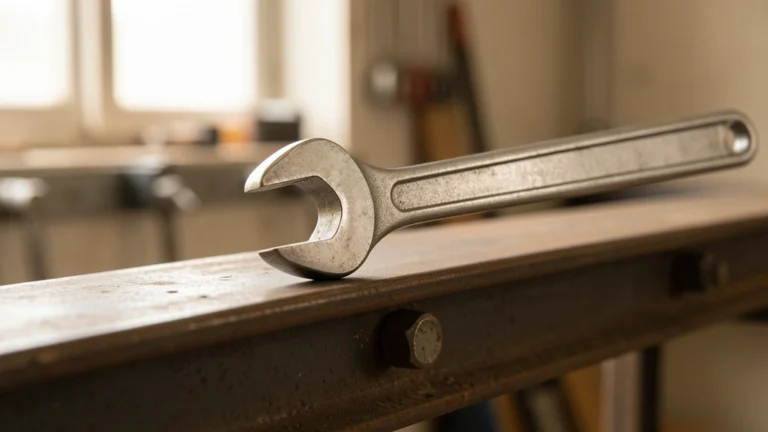
Why does a stuck bolt give way when you slide a longer handle onto your wrench? The answer is torque. A 50 newton push on a 0.3 meter handle makes 15 newton meters of turning effect. Push the same way at a 30 degree slant, and you get only half of that. This guide shows where those numbers come from and how to use them.
| What it is | The turning effect of a force about a pivot |
|---|---|
| Formula | T = F x r x sin(angle) |
| SI unit | Newton meter (N m) |
| Best angle | 90 degrees, where sin(angle) = 1 |
| Classic example | 50 N on a 0.3 m arm at 90 degrees = 15 N m |
| US unit | 1 pound-force foot = 1.356 N m |
Torque Quick Reference Table
The table below keeps the force at 50 newtons and the lever arm at 0.3 meters. Only the angle between the force and the arm changes. Watch how the torque grows as the push gets closer to square.
| Angle | sin(angle) | Torque | Share of maximum |
|---|---|---|---|
| 0 degrees | 0 | 0 N m | 0% |
| 30 degrees | 0.5 | 7.5 N m | 50% |
| 45 degrees | 0.707 | 10.61 N m | 70.7% |
| 60 degrees | 0.866 | 12.99 N m | 86.6% |
| 90 degrees | 1 | 15 N m | 100% |
Units trip people up just as often as angles do. These are the conversions you will reach for most.
| From | To | Multiply by |
|---|---|---|
| Pound-force foot (lbf ft) | Newton meter (N m) | 1.356 |
| Pound-force inch (lbf in) | Newton meter (N m) | 0.113 |
| Newton meter (N m) | Pound-force foot (lbf ft) | 0.7376 |
What Is Torque, in Plain Words?
Torque is the turning effect of a force about a pivot point. It tells you how strongly a push or pull tends to rotate an object, not just how hard the push is.
A door shows the idea well. Push with 20 newtons at the handle, 0.8 meters from the hinge, and you make 16 N m. Push with the same 20 newtons just 0.1 meters from the hinge, and you get only 2 N m. To match the handle, you would need 160 newtons near the hinge.
Five terms come up again and again in torque problems. Here is what each one means.
- Pivot (Axis of Rotation)
- The fixed point or line an object turns around, such as a hinge, a bolt, or an axle.
- Lever Arm
- The perpendicular distance from the pivot to the line along which the force acts.
- Line of Action
- The straight line that runs through the force arrow in the direction it points.
- Net Torque
- The sum of all torques on an object about one axis, with clockwise and counterclockwise given opposite signs.
- Moment of Inertia
- How strongly an object resists changes to its spin, based on its mass and how far that mass sits from the axis.
How Do Force, Lever Arm, and Angle Combine?
Torque equals force times lever arm times the sine of the angle between them: T = F x r x sin(angle). All three parts multiply, so doubling any one of them doubles the torque.
The sine term measures how much of the push actually turns the object. At 90 degrees the sine is 1, so every newton counts. At 0 degrees the force points straight along the arm, toward or away from the pivot. That push only squeezes or stretches the arm, and the torque is zero.
The same 50 N force at 30 degrees shows the effect. The sine of 30 degrees is 0.5, so only 25 N of the push acts at a right angle. The torque drops to 50 x 0.3 x 0.5 = 7.5 N m.
The chart below plots every row of the reference table. The gain slows as you near 90 degrees, so a small tilt near square costs very little.
How Much Force Does a Wrench Need?
Divide the torque you need by the handle length: F = T / r, when you push at a right angle. A longer handle lowers the force in exact proportion.
Say a bolt calls for 40 N m. On a 0.25 meter wrench, you need 40 / 0.25 = 160 newtons. Switch to a 0.5 meter breaker bar, and the force falls to 80 newtons. Double the handle, and you halve the push.
Measure the lever arm from the center of the bolt to the center of your hand. Gripping the handle halfway along cuts your lever arm in half and doubles the force you need. Pushing at a slant has the same kind of cost, since the sine term shrinks the torque.
To solve for force or handle length without the algebra, the torque calculator for force, lever arm, and angle finds the blank value from the other two. Its own example shows 20 N m on a 0.5 meter arm needs 40 newtons.
Why Is Torque in Newton Meters, Not Joules?
Torque and energy share the same base units, but they measure different things. The SI system names torque’s unit the newton meter so readers never confuse it with the joule.
Energy, or work, uses a force along a distance the object moves. Torque uses a force across a lever arm, and nothing has to move at all. A bolt you strain against without turning still feels full torque, yet no work is done.
The two do connect once rotation happens. Work equals torque times the angle turned, measured in radians. A steady 15 N m turned through one full turn, or 2 x pi radians, does about 94.25 joules of work.
In the US, torque often appears in pound-force feet. One lbf ft equals 1.356 N m, so 100 N m is about 73.76 lbf ft. Small fasteners use pound-force inches, where 12 lbf in makes 1 lbf ft.
How Does Torque Make Things Spin or Balance?
Net torque sets how fast an object’s spin changes, and zero net torque means balance. This is the rotational version of force causing straight-line acceleration.
For rotation, the rule reads net torque = I x alpha, where I is the moment of inertia and alpha is the angular acceleration. A 15 N m net torque on a wheel with I = 0.5 kg m^2 gives 30 radians per second squared. It mirrors the second law in Newton’s laws of motion and force, with torque in place of force.
Balance works through signs. Counterclockwise torques count as positive and clockwise ones as negative. A seesaw balances when both sides cancel.
With gravity at 9.8 m/s^2, the 30 kg child weighs 294 N, and 294 x 2.0 = 588 N m. The 40 kg child weighs 392 N, and 392 x 1.5 = 588 N m. The torques match, so the seesaw holds still. Spinning objects also carry angular momentum, the turning cousin of the quantity covered in our guide to momentum.
The Torque Calculator solves T = F x r x sin(angle) for whichever value you leave blank.
Questions People Ask About Torque
What Is Torque in Simple Terms?
Torque is the turning effect of a force about a pivot. It depends on how hard you push, how far from the pivot you push, and the angle of the push. A 50 N push on a 0.3 m arm at a right angle gives 15 N m.
Why Does a Longer Wrench Make a Bolt Easier to Turn?
A longer handle increases the lever arm, so the same torque needs less force. For 40 N m, a 0.25 m wrench needs 160 N, while a 0.5 m bar needs only 80 N.
What Angle Gives the Most Torque?
A push at 90 degrees to the lever arm gives the most torque, because sin(90) = 1. At 30 degrees you get half as much, and a push straight along the arm gives zero.
Is a Newton Meter of Torque the Same as a Joule?
No. They share base units, but torque is a turning effect and a joule measures energy or work. The SI system writes torque in newton meters to keep the two apart.
How Do You Convert Pound-Force Feet to Newton Meters?
Multiply pound-force feet by 1.356 to get newton meters. Going the other way, multiply newton meters by 0.7376. For example, 100 N m equals about 73.76 lbf ft.
Where These Numbers Come From
References Used in This Article
- HyperPhysics, Georgia State University: Torque and the lever arm
- OpenStax, University Physics Volume 1, Section 10.6: Torque
- OpenStax, University Physics Volume 1, Section 10.7: Newton’s Second Law for Rotation
- NIST Guide to the SI, Chapter 4: Moment of force in newton meters
- NIST Guide to the SI, Appendix B.9: Torque conversion factors
This article is general physics education. Always follow the torque value a manufacturer specifies for a real fastener. Reviewed for accuracy by Prof. Dr. Khalil Mudassar, PhD. Last updated September 27, 2026.
Author

Shakeel Muzaffar is the Founder and Editor-in-Chief of MultiCalculators.com, bringing over 15 years of experience in digital publishing, product strategy, and online tool development. He leads the platform's editorial vision, ensuring every calculator meets strict standards for accuracy, usability, and real-world value. Shakeel personally oversees content quality, formula verification workflows, and the platform's commitment to publishing tools that are genuinely useful for students, professionals, and everyday users worldwide.