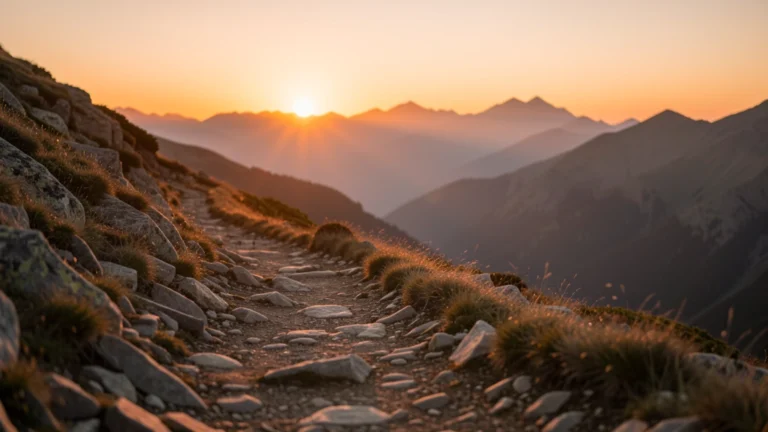
How late is too late to keep climbing toward the top? The safe answer is a clock time you choose at the trailhead, not a feeling you get near the summit. That clock time is your turnaround time, and it protects the walk back, where tired hikers get caught by darkness.
This guide shows how to work it out from three numbers: daylight, a safety buffer, and your return time. You will also see why the return leg often runs slower than planned, and how weather and group pace pull the deadline earlier.
- Your turnaround time is the latest moment to head back and still finish in daylight with a buffer to spare.
- Usable time equals daylight minus buffer, and you turn around at usable time minus return time.
- With 8 hours of daylight, a 1 hour buffer, and 3 hours back, turn around 4 hours after starting.
- Fix the time before you start, and turn back when it arrives, even with the goal in sight.
What a Turnaround Time Really Means
A turnaround time is a fixed moment when you stop moving forward and start heading back. It applies whether or not you have reached the summit, the lake, or the viewpoint. The light and the length of your return set the time, not the goal.
Think of it as a deadline for leaving your farthest point. Reach the goal early, and the gap becomes spare time for food, rest, or photos. Reach it late, and the goal waits for another day.
Why decide it in advance? At the trailhead you are rested, and the numbers are easy to read. Near the top you are tired, and the wish to finish is strong. That pull is often called summit fever, and a written time is the simplest cure.
The stakes are real. Grand Canyon National Park reports that more than 300 people are rescued from the canyon each year. The park adds that your safety depends on choices made before and during the hike.
A turnaround time also gives a group one shared rule. Nobody has to argue on the trail or feel like the person who ended the day. The clock makes the call for everyone.
How Do You Work Out Your Turnaround Time?
Subtract a safety buffer from the daylight you have left, then subtract your return time. The result is how many hours after starting you must turn back.
Usable time = daylight left at start – safety buffer
Turnaround = usable time – return time
Here is the standard example. You start with 8 hours of daylight and keep a 1 hour buffer, so 7 hours are usable. The walk back takes 3 hours, so you turn around 4 hours after starting.
Now check the goal. The summit is 3 hours away, so you arrive at hour 3 and hold 1 hour of spare time. A summit 4 hours away would not fit, because your deadline arrives an hour before you do.
Turning Hours Into a Clock Time
Say you start at 8:00 AM and sunset is at 6:30 PM, which gives 10.5 hours of daylight. A 1.5 hour buffer leaves 9 usable hours. With 4 hours back, you turn around 5 hours after starting, at 1:00 PM.
Measure daylight to sunset, not to full dark. The National Weather Service defines evening civil twilight as ending when the sun’s center sits 6 degrees below the horizon. Treat that fading light as part of your buffer, not as extra hiking time.
The Hiking Turnaround Time Calculator takes your daylight, one-way time, and buffer, then shows your latest turnaround and whether the goal fits.
Why Is the Return Leg Rarely a Mirror of the Way Out?
The return happens on tired legs, often in fading light, and sometimes uphill. The simple formula assumes the walk back matches the walk out, so adjust that number when the route is uneven.
A gentle descent on smooth trail is often quicker than the climb. Steep, loose, or rocky descents are the opposite, because every step needs care. Knees and ankles slow down late in the day, too.
Canyon hikes flip the usual pattern. You descend first and climb out at the end, when heat and fatigue peak. The Grand Canyon park warns that hikers “lured by initially easy downhill hiking” suffer illness and injury every year.
Estimate the Return on Its Own
Change only the return time and watch the deadline move. Keep the same 8 hours of daylight, 1 hour buffer, and 3 hour climb.
- A 3.5 hour return moves the turnaround to 3.5 hours after starting, leaving only 30 minutes at the goal.
- A 2.5 hour return on easy downhill trail moves it to 4.5 hours, leaving 1.5 hours at the goal.
To estimate each leg from distance and climb, see our guide on how long a hike will take using Naismith’s rule. Then plug the return figure into the turnaround formula.
How Daylight, Weather, and Group Pace Shift the Deadline
Three outside factors pull a turnaround earlier: shorter days, afternoon storms, and slower groups. Each one shrinks the usable window or stretches the time you need.
Season and Daylight
| Daylight at start | Usable time | Latest turnaround | Goal fits? |
|---|---|---|---|
| 14 h (summer) | 13 h | 10 h after start | Yes, 7 h spare |
| 10 h (spring) | 9 h | 6 h after start | Yes, 3 h spare |
| 8 h (autumn) | 7 h | 4 h after start | Yes, 1 h spare |
| 6 h (winter) | 5 h | 2 h after start | No, 1 h short |
Afternoon Storms
The National Weather Service notes that mountain thunderstorms typically build in the early afternoon. Its advice is to hike early and be down the mountain by noon. On those days the storm clock, not sunset, sets your turnaround.
Group Pace
A group moves at the speed of its slowest member. Take a group that runs 20 percent slower than the plan: the 3 hour climb becomes 3 hours 36 minutes. With a matching return, the turnaround drops to 3 hours 24 minutes, and the goal misses by 12 minutes. A slower pace also means more hours between water stops, so check how much water to carry on a hike.
Setting a Hard Turnaround Before You Leave
A turnaround works best as a written clock time that everyone knows before the first step. These five steps take about five minutes at home.
- Check the sunset. Look up the sunset for your date and location, then count the hours from your planned start.
- Pick a buffer. One hour is a common starting point. Add more for winter, new routes, groups, or bad weather.
- Estimate the return separately. Judge the walk back on its own terrain, climbs, and your likely fatigue.
- Do the subtraction. Take the buffer and return time from the daylight, then convert the answer to a clock time.
- Share it and set an alarm. Tell every partner the time and set a phone alarm. When it rings, turn around.
| Mistake | Better approach |
|---|---|
| Planning to finish right at sunset | Keep a buffer at the end for slow sections, a wrong turn, or a twisted ankle. |
| Reusing the outbound time for a steep or canyon return | Estimate the return on its own, and round it up when the last leg climbs. |
| Moving the deadline once the summit is in sight | Treat the time as fixed. The goal will still be there next weekend. |
| Keeping the same plan after a late start | Redo the math. One hour late on an 8 hour day leaves zero spare time at a 3 hour goal. |
| Leaving the headlamp home on a short day | Pack a headlamp and extra batteries, as the park service’s Ten Essentials list advises. |
Try it with your own route in the hiking turnaround calculator, then write the clock time on your map.
Hike Turnaround Times: Frequently Asked Questions
What Is a Turnaround Time on a Hike?
It is a set moment when you stop going forward and head back, whether or not you reached the goal. You choose it before the hike so you finish in daylight with a safety buffer.
How Do I Calculate My Turnaround Time?
Subtract your safety buffer from the daylight left at the start, then subtract your return time. With 8 hours of daylight, a 1 hour buffer, and 3 hours back, you turn around 4 hours after starting.
How Big Should My Safety Buffer Be?
No single standard exists, and 1 hour is a common starting point. Use a bigger buffer in winter, on unfamiliar routes, with a group, or when the forecast looks unsettled.
Should I Assume the Hike Back Takes the Same Time as the Hike Out?
Only as a first guess. Easy downhill trail is often faster, while steep descents, canyon climbs, and tired legs make the return slower. Estimate the return on its own terrain.
What Should I Do When I Reach My Turnaround Time Before the Goal?
Turn around. The deadline exists for exactly this moment, and pushing on eats into your buffer. Note where you stopped, and plan an earlier start or a shorter goal next time.
Does Twilight Count as Hiking Time?
Plan to the sunset, not to full dark. Civil twilight ends when the sun’s center is 6 degrees below the horizon, and that fading light works best as part of your buffer.
How Does a Late Start Change My Turnaround Time?
Every hour you start late removes an hour of daylight. With sunset fixed, an 8 hour day becomes 7 hours. A 3 hour goal with a 1 hour buffer then leaves no spare time.
How Do Afternoon Thunderstorms Affect When I Turn Around?
They pull it earlier. The National Weather Service says mountain storms typically form in the early afternoon and advises being down by noon. Use whichever deadline comes first.
Sources and Further Reading
References Used in This Article
This article is general outdoor-planning education. Check local conditions and ranger advice before any hike. Reviewed for accuracy by Prof. Dr. Khalil Mudassar, PhD. Last updated September 27, 2026.
Author

Shakeel Muzaffar is the Founder and Editor-in-Chief of MultiCalculators.com, bringing over 15 years of experience in digital publishing, product strategy, and online tool development. He leads the platform's editorial vision, ensuring every calculator meets strict standards for accuracy, usability, and real-world value. Shakeel personally oversees content quality, formula verification workflows, and the platform's commitment to publishing tools that are genuinely useful for students, professionals, and everyday users worldwide.