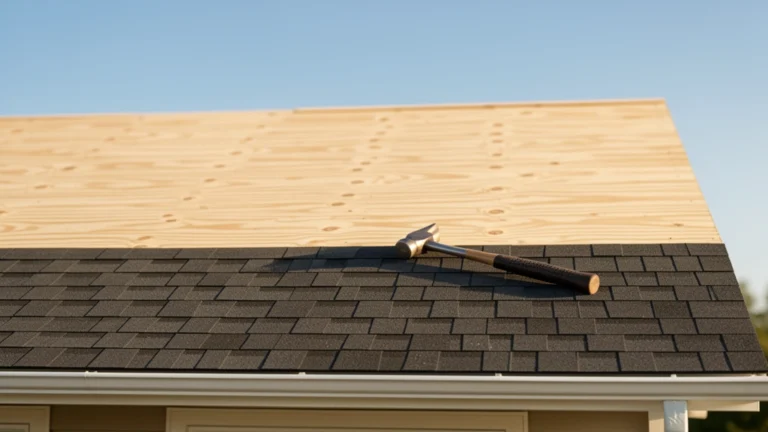
How many shingles does a 40 by 50 foot house really need? With a 6/12 pitch and a gable roof, the answer is 81 bundles. You get there in five steps, and you never have to climb onto the roof to do it. This guide walks through each step with one house, from the tape measure to the order sheet.
- One roofing square covers 100 square feet of roof surface.
- Measure the house footprint, then add the overhang on every side.
- Multiply that plan area by the pitch multiplier to get the true roof area.
- Divide by 100, then add 10 percent waste for a gable or 15 percent for a hip.
- Multiply squares by bundles per square, usually 3, and round up.
What Is a Roofing Square?
A roofing square is the amount of roofing that covers 100 square feet of roof surface. Roofers price labor, tear-off, and shingles by the square, so every estimate ends in this unit.
The square counts covered area, not the paper area of the shingles. Each course overlaps the one below it, so a square of shingles holds more than 100 square feet of material. That overlap is already built into the package, so you never add it yourself.
Converting from square feet to squares is simple division by 100. A roof with 2,442 square feet of surface holds 24.42 squares. Keep the decimals until the last step, because early rounding adds error to every later number.
Squares also make contractor quotes easy to compare side by side. Two bids for the same house should list nearly the same number of squares. A bid that is three or four squares higher deserves a question about how the roof was measured.
How Do You Measure the Roof Footprint?
Measure the outside walls of the house at ground level, then add the eave and rake overhang on every side. That gives the plan area, which is the shadow the roof casts straight down.
Start with the wall lengths. A simple rectangle of 40 by 50 feet covers 2,000 square feet. Our guide on how to calculate the square footage of a house covers L-shapes and other odd footprints in detail.
Next, find the overhang on each edge of the roof. Look under the eaves and measure from the wall to the outer edge of the fascia. A 1 foot overhang adds 2 feet to each dimension, since it sits on both sides.
That turns 40 by 50 into 42 by 52 feet, or 2,184 square feet of plan area. The overhang alone adds 184 square feet, which is almost two full squares. Skipping it is the most common reason a roof order runs short.
How Does Roof Pitch Change the Area?
A sloped roof has more surface than its flat plan area, so you multiply the plan area by a pitch multiplier. The multiplier equals the square root of 1 plus the rise over 12, squared.
A 6/12 roof rises 6 inches for every 12 inches of run. Its multiplier is 1.1180, so each plan foot becomes about 1.12 feet of sloped surface. A 4/12 roof uses 1.0541, an 8/12 roof uses 1.2019, and a 12/12 roof uses 1.4142.
For the example house, 2,184 times 1.1180 gives 2,441.8 square feet of roof. That is 24.42 squares before any waste. Measuring the pitch itself is a separate job, usually done with a level and a tape from the attic or a ladder.
Here is a useful shortcut. The plan-area method works for gable and hip roofs alike, as long as every plane shares one pitch. A hip roof on the same footprint has the same surface area, just more cutting.
How Much Waste Should You Add?
Add about 10 percent waste for a simple gable roof and about 15 percent for a hip roof. The extra covers cut shingles at edges, hips, and valleys that cannot be reused elsewhere.
Roof shape drives the number. A gable roof has two long rectangles and straight rake edges, so most cuts are short. A hip roof has angled cuts along every hip line, and each angled cut leaves a triangle of scrap.
Dormers, valleys, skylights, and chimneys push waste higher still. Each one adds cuts and flashing laps. Our guide on how to calculate material waste and overage explains how to size an allowance for any cut-up job.
Apply waste to the squares, not to the bundles. The gable example becomes 24.42 times 1.10, or 26.86 squares. As a hip roof, the same house needs 24.42 times 1.15, or 28.08 squares.
How Many Bundles of Shingles Do You Need?
Multiply the squares, including waste, by the bundles per square, then round up to a whole bundle. Most shingles pack 3 bundles per square, while some heavier lines pack 4.
Read the bundle wrapper before you do this step. It lists the coverage per bundle and the bundles per square. A bundle rated at about 33.3 square feet means 3 bundles per square.
For the gable example, 26.86 squares times 3 gives 80.6 bundles, so order 81. The hip version needs 28.08 times 3, or 84.2, so order 85. At 4 bundles per square, the gable roof would need 108 bundles.
The roofing calculator for squares, bundles, and underlayment runs these steps for any footprint and pitch. It also handles the waste choice and the rounding for you.
Buy every bundle from the same production lot when you can. Shingle color shifts slightly between runs, and a mixed lot can show as a patch on the finished roof. Keeping one leftover bundle also gives you matching shingles for a future repair.
What Else Goes on the Order Besides Shingles?
Starter strip, ridge cap, drip edge, and underlayment are separate line items measured on their own. None of them comes out of the field shingle bundles.
Edges and Ridges Are Linear Feet
Starter strip runs along the eaves, so measure eave length. The gable example has two 52 foot eaves, or 104 feet. Ridge cap covers the ridge and every hip, so add those lengths and check the linear feet printed on the cap bundle.
Drip edge goes on both eaves and rakes under the building code. Each rake on the example is 23.48 feet, so the total is 104 plus 93.9, or 197.9 feet. That is 21 ten-foot pieces once you allow 2 inch overlaps.
Underlayment Is Sold by Area
Divide the roof area by the coverage on the roll label, then round up. A roll rated at 10 squares covers the 24.42 square example in 3 rolls. Slopes from 2/12 up to 4/12 need a double layer under the code.
The Roofing Calculator turns your footprint or plan area and pitch into roof area, squares, bundles, and underlayment rolls.
FAQs About Roofing Squares
How Many Square Feet Are in a Roofing Square?
One roofing square covers 100 square feet of roof surface. Divide the total roof area in square feet by 100 to get squares, and keep the decimals until you round the final bundle count.
How Many Bundles of Shingles Are in a Square?
Most shingles pack 3 bundles per square, so each bundle covers about 33.3 square feet. Some heavier shingle lines pack 4 bundles per square, so always read the wrapper before you order.
How Many Squares Is a 2,000 Square Foot Roof?
A 2,000 square foot plan area at a 6/12 pitch holds 2,236.1 square feet of roof, or 22.36 squares. With 10 percent waste that becomes 24.60 squares, or 74 bundles at 3 per square.
Do I Use the House Square Footage or the Footprint?
Use the footprint of the outside walls plus the overhang, not the living area. A two-story house has double the living area but the same roof, so floor area overstates the order badly.
Why Does a Hip Roof Need More Waste Than a Gable Roof?
A hip roof has angled cuts along every hip line, and each cut leaves scrap that cannot be reused. Plan about 15 percent waste for a hip roof and about 10 percent for a simple gable.
Does a Steeper Roof Need More Shingles?
Yes. A steeper roof has more sloped surface over the same footprint. A 12/12 roof has a multiplier of 1.4142, so it needs about 41 percent more shingles than a flat plan area suggests.
Are Starter Strips and Ridge Caps Included in the Bundle Count?
No. Starter strip and ridge cap are ordered separately by linear feet. Measure the eaves for starter strip, then add the ridge and all hips for ridge cap, and check each product label for coverage.
Sources
References Used in This Article
This article is general home-improvement estimating education. Local codes and the shingle maker’s instructions control the final order and installation. Reviewed for accuracy by Prof. Dr. Khalil Mudassar, PhD. Last updated September 27, 2026.
Author

Shakeel Muzaffar is the Founder and Editor-in-Chief of MultiCalculators.com, bringing over 15 years of experience in digital publishing, product strategy, and online tool development. He leads the platform's editorial vision, ensuring every calculator meets strict standards for accuracy, usability, and real-world value. Shakeel personally oversees content quality, formula verification workflows, and the platform's commitment to publishing tools that are genuinely useful for students, professionals, and everyday users worldwide.