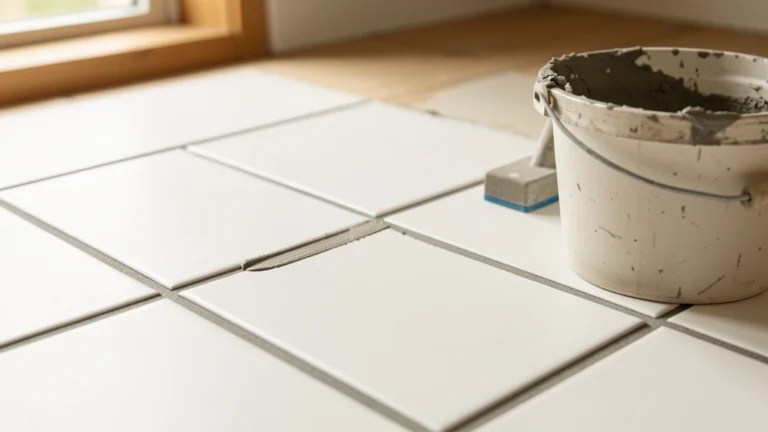
Can a 30 square foot mosaic backsplash use more grout than a 100 square foot tile floor? It can, and the reason is simple. Grout fills only the joints between tiles, so the joint grid sets the amount. This guide shows how tile size, thickness, and joint width turn into pounds of grout you can buy with confidence.
- Grout volume equals joint width times joint depth times the total length of joints.
- Smaller tiles make more joints per square foot, so they need far more grout.
- A 12 x 12 inch floor with 1/8 inch joints needs about 7.7 pounds per 100 square feet.
- For cement grout, joints under 1/8 inch take unsanded grout, and wider joints take sanded.
- Add about 10 percent for waste, and trust the bag’s coverage chart over any estimate.
Why Does Tile Size Change How Much Grout You Need?
Smaller tiles create more joints in every square foot, and grout fills only those joints. The total length of joint on your floor or wall sets how much grout you buy.
Picture the surface as a grid of repeating cells. Each cell holds one tile plus a joint along two of its edges. A 12 x 12 inch tile with a 1/8 inch joint makes a cell 12.125 inches on each side.
One square foot of that layout holds about 23.6 inches of joint. One square foot of 2 x 2 inch mosaic with the same joint holds about 131.5 inches. That is more than five times the joint length in the same space.
Tile count comes from the same grid. Our guide on how to calculate flooring and tile quantities covers tiles and boxes. This article stays focused on the grout that fills the gaps between them.
How Do You Calculate Grout Volume for a Tile Job?
Multiply joint width by joint depth by joint length. For one tile cell, that is J x T x (L + W + J). Here L and W are the tile sides, T is the thickness, and J is the joint width.
To get volume per square foot, multiply the cell volume by 144. Then divide by the cell area, which is (L + J) x (W + J). Multiply that result by the square footage of the job.
A Worked Example With 12 x 12 Tile
Take 12 x 12 inch tile that is 3/8 inch thick, set with a 1/8 inch joint. One cell holds 1/8 x 3/8 x 24.125, or about 1.13 cubic inches of grout. Each cell covers 147.0 square inches, so 100 square feet holds about 98 cells.
That adds up to 110.8 cubic inches, or about 0.064 cubic feet. To turn volume into weight, we assume a cured grout density of 120 pounds per cubic foot. That figure is our assumption, and the chart on your bag always wins over it.
At that density, the 100 square foot floor needs about 7.69 pounds of grout before waste. The grout calculator for any tile size and joint width runs this joint-grid math and rounds the result to bags.
Use the real joint depth, which is not always the full tile thickness. The Tile Council of North America says grout should stay off beveled tile edges, and a deep bevel leaves a shallower joint.
How Much Grout Do Common Tile Layouts Need?
Common layouts range from under 6 pounds to nearly 29 pounds per 100 square feet at our assumed density. Large tiles with narrow joints need the least, and small mosaics need the most.
A 12 x 24 inch plank, 3/8 inch thick with a 1/8 inch joint, needs 83.4 cubic inches for 100 square feet. That is about 5.79 pounds. The longer tile cuts joint length per square foot by about one quarter.
A 4 x 4 inch wall tile, 1/4 inch thick with a 1/16 inch joint, needs 55.0 cubic inches for 50 square feet. That is about 3.82 pounds. Thin joints and thin tile offset the extra joint length of the small tile.
A 2 x 2 inch mosaic, 1/4 inch thick with a 1/8 inch joint, needs 123.3 cubic inches for just 30 square feet. That is about 8.56 pounds. The small backsplash needs more grout than the 7.69 pounds for the 100 square foot floor of 12 x 12 tile.
Per square foot, the mosaic uses about 3.7 times as much grout as the 12 x 12 floor. Small tiles make up for thinner bodies with sheer joint length.
How Do You Choose Joint Width and Grout Type?
Pick joint width from your tile’s size variation and the look you want, then match grout type to that width. Joint width also scales grout almost directly, so it matters for the budget.
The Tile Council of North America notes there is no single standard joint size. Joints smaller than three times the average tile-to-tile variation tend to look irregular. Doubling a 12 x 12 joint from 1/8 to 1/4 inch raises grout from 7.69 to 15.15 pounds per 100 square feet.
Sanded or Unsanded Grout?
For cement grout, joints under 1/8 inch take unsanded grout, and joints 1/8 inch and wider take sanded grout. That is the TCNA guidance, and a federal tiling specification uses the same 1/8 inch split.
Joints wider than 3/8 inch usually need a more heavily sanded mix. TCNA also warns against sanded grout on marble and other surfaces the sand can scratch.
When Does Epoxy Grout Make Sense?
Epoxy grout is a two-part resin system with its own standard, ANSI A118.3, which covers chemical-resistant grouting epoxies. The joint volume math stays the same. Epoxy weighs differently, so use the kit’s own coverage chart for pounds.
How Do You Read the Coverage Chart on a Grout Bag?
Find the row for your tile size and the column for your joint width, then read square feet per bag. Divide your job area by that number and round up to whole bags.
Each chart row assumes a tile thickness, so check that it matches your tile. Grout scales with depth. The same 12 x 12 layout needs 5.13 pounds per 100 square feet at 1/4 inch thick, against 7.69 at 3/8 inch.
Your tile size will not always appear on the chart. Use the next smaller tile size listed, since smaller tile means more joint and a safer estimate. For a 16 x 16 tile, read the 12 x 12 row.
Use the joint-grid math as a cross-check. At our assumed density, a 25 pound bag covers about 325 square feet of 12 x 12 x 3/8 tile at a 1/8 inch joint. When the chart and your math disagree, follow the chart, since it reflects the real product.
How Much Extra Grout Should You Buy and Mix?
A common allowance is 10 percent extra, rising to about 15 percent for mosaics and rough tile. Grout is lost to the bucket, the float, the sponge, and uneven joints.
The 12 x 12 floor needs 7.69 pounds, so 10 percent extra brings it to about 8.46 pounds. The 30 square foot mosaic at 15 percent extra needs about 9.84 pounds. Our guide on how to calculate material waste and overage explains how to set that percentage.
Mix in Small Batches
Mix only what you can spread and tool within the working time printed on the bag. Start with a small batch for your first 20 to 30 square feet. That test shows how fast you really work.
Common guidance says never to add water to grout that has started to stiffen. Buy all bags at once in the same color and lot, and keep a small sealed amount for future repairs.
The Grout Calculator turns your tile size, thickness, joint width, and area into pounds of grout and a bag count with waste included.
FAQs About Grout Quantity
How Much Grout Do I Need for 100 Square Feet of Tile?
For 12 x 12 inch tile that is 3/8 inch thick with a 1/8 inch joint, plan on about 7.7 pounds. That figure assumes cured grout at 120 pounds per cubic foot. Add 10 percent for waste, which brings it to about 8.5 pounds.
Why Do Mosaic Tiles Need So Much More Grout?
Small tiles pack far more joint into each square foot. A square foot of 2 x 2 mosaic holds about 131.5 inches of joint, against about 23.6 inches for 12 x 12 tile. More joint length means more grout.
Should I Use Sanded or Unsanded Grout for a 1/8 Inch Joint?
Use sanded grout for a 1/8 inch joint with cement grout. TCNA guidance puts joints of 1/8 inch and wider in the sanded group. Unsanded grout is for joints narrower than 1/8 inch and for surfaces sand can scratch.
Does Tile Thickness Change the Amount of Grout?
Yes. Grout fills the joint to its depth, so thicker tile needs more grout. The same 12 x 12 layout needs about 5.13 pounds per 100 square feet at 1/4 inch thick, and 7.69 pounds at 3/8 inch thick.
How Many Square Feet Does a Bag of Grout Cover?
It depends on tile size, thickness, and joint width, so read the chart on the bag. At our assumed density, a 25 pound bag covers about 325 square feet of 12 x 12 x 3/8 tile. That assumes a 1/8 inch joint.
Is Epoxy Grout Calculated the Same Way as Cement Grout?
The joint volume math is the same for both. Epoxy has a different weight per volume and comes in kits, so convert volume to kits with the chart that comes with the epoxy product.
How Much Extra Grout Should I Buy?
A common allowance is about 10 percent extra for standard tile. Use about 15 percent for mosaics and rough or uneven tile. Buy every bag from the same color and lot, and keep a little for repairs.
Sources
References Used in This Article
This article is general home-improvement estimating education, not a substitute for the grout maker’s instructions. Pound figures assume a cured density of 120 pounds per cubic foot, so always confirm with the bag’s coverage chart. Reviewed for accuracy by Prof. Dr. Khalil Mudassar, PhD. Last updated September 27, 2026.
Author

Shakeel Muzaffar is the Founder and Editor-in-Chief of MultiCalculators.com, bringing over 15 years of experience in digital publishing, product strategy, and online tool development. He leads the platform's editorial vision, ensuring every calculator meets strict standards for accuracy, usability, and real-world value. Shakeel personally oversees content quality, formula verification workflows, and the platform's commitment to publishing tools that are genuinely useful for students, professionals, and everyday users worldwide.