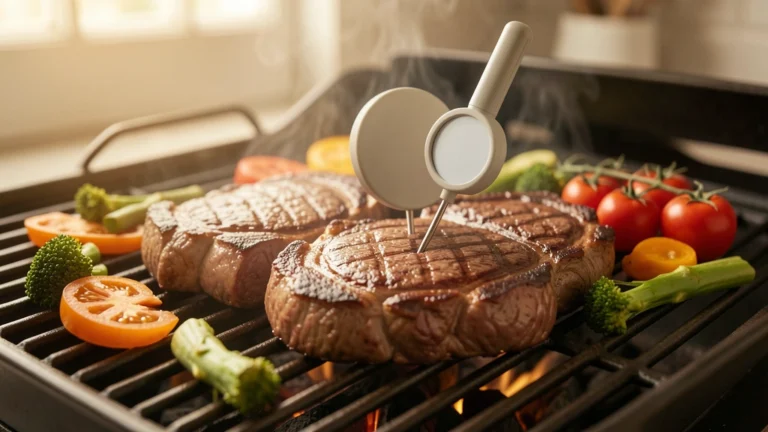
The most useful tool at any grill is not the tongs. It is a thermometer. A timer tells you how long the food has been over the fire, but only the internal temperature tells you whether it is actually done. Master a short list of target temperatures and you can grill any cut to the doneness you want and the safety you need, no guessing and no cutting it open to peek.
- Internal temperature, not time, tells you when meat is truly done.
- Poultry needs 165F, ground meat 160F, and whole pork or fish 145F for safety.
- Steak doneness runs from about 125F rare to 160F well done.
- Thicker cuts take longer, so timing scales with thickness, not weight alone.
- Rest meat a few minutes after grilling, and it keeps rising a few degrees.
Why Temperature Beats the Timer
Grill times you read online are only estimates. They assume a certain heat, a certain thickness, and a certain starting temperature, and your grill matches none of them exactly. A cold, thick steak and a thin, room-temperature one need very different times, even side by side on the same grate.
Internal temperature cuts through all of it. It is the one measurement that reflects what is actually happening in the center of the food. Slide a probe into the thickest part, away from bone, and the number tells you the truth that a timer only guesses at.
The Safe Temperatures That Matter
Some temperatures are about taste. Others are about safety, and those are not negotiable. The USDA sets minimum internal temperatures that kill harmful bacteria, and hitting them is the line between a good cookout and a sick guest.
| Food | Safe temperature |
|---|---|
| Chicken and turkey | 165F |
| Ground beef, pork, lamb | 160F |
| Whole pork, beef, lamb cuts | 145F, then rest 3 min |
| Fish and seafood | 145F |
Whole muscle steaks are the one flexible case. Because bacteria live on the surface, which the grill sears, the inside can safely be cooked to your preferred doneness below 145F. Ground meat and poultry get no such leeway.
Steak Doneness by Temperature
For steak, temperature is how you dial in doneness precisely. Each stage sits in a narrow band, and a few degrees is the difference between a rosy medium-rare and a gray medium.
| Doneness | Pull at about |
|---|---|
| Rare | 125F |
| Medium-rare | 132F |
| Medium | 145F |
| Medium-well | 152F |
| Well done | 160F |
To turn a specific food, thickness, and doneness into an estimated grill time and target temperature, the Grilling Time Calculator works it out for you.
How Thickness and Doneness Change Timing
Weight is a poor guide to grill time. Thickness is what matters, because heat travels in from both surfaces toward the center. A one-inch steak and a two-inch steak of the same weight cook at completely different speeds, since the thicker one has a deeper center to heat.
Doneness stretches the time too. Pushing a steak from medium-rare to well done means holding it over the fire longer to drive the center hotter. Thicker plus more done means more time, and a thermometer keeps you honest about when you have arrived.
The Grilling Time Calculator takes the food, thickness, and doneness and gives you a target temperature and estimated grill time.
FAQs About Grilling Times and Temperatures
Should I Grill by Time or Temperature?
Temperature. A timer only estimates, because it cannot account for thickness, grill heat, and starting temperature. An internal thermometer reads the actual center of the food, which is the only reliable sign it is done.
What Temperature Is Chicken Safe to Eat?
Chicken and other poultry are safe at an internal temperature of 165F. Unlike steak, poultry has no lower safe option, so always grill it to at least 165F in the thickest part.
What Internal Temperature Is Medium-Rare Steak?
About 132F. Rare is around 125F, medium is 145F, and well done is about 160F. Because searing kills surface bacteria, whole steaks can safely be cooked to these lower temperatures.
Why Does Thickness Matter More Than Weight?
Heat travels inward from the surfaces, so the distance to the center sets the cook time. A thick cut has a deeper center to heat, so it takes longer than a thin cut of the same weight.
What Is Carryover Cooking?
It is the continued rise in internal temperature after you remove meat from the heat. The center keeps climbing a few degrees, so pull the meat slightly before your target and let it rest.
What Temperature Should Ground Beef Reach?
Ground beef should reach 160F. Grinding spreads any surface bacteria throughout the meat, so unlike a whole steak it cannot be safely cooked to a lower, rarer temperature.
Sources
References Used in This Article
This article includes food-safety temperatures from the USDA and is general cooking education. Reviewed for accuracy by Chef Marco, culinary reviewer. Last updated September 26, 2026.
Author

Shakeel Muzaffar is the Founder and Editor-in-Chief of MultiCalculators.com, bringing over 15 years of experience in digital publishing, product strategy, and online tool development. He leads the platform's editorial vision, ensuring every calculator meets strict standards for accuracy, usability, and real-world value. Shakeel personally oversees content quality, formula verification workflows, and the platform's commitment to publishing tools that are genuinely useful for students, professionals, and everyday users worldwide.