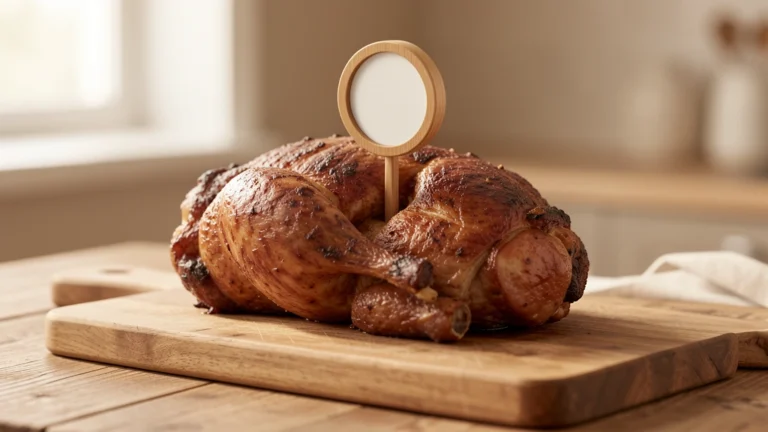
A safe piece of meat is not defined by its color, its juices, or how long it sat on the heat. It is defined by one number: the internal temperature at its thickest point. The United States Department of Agriculture, through its Food Safety and Inspection Service, sets safe minimum internal temperatures for every major meat category, and hitting that number is the only reliable way to know a cut is done. This guide lays out those temperatures plainly, explains how to check them correctly, and gives typical cooking-time ranges you can use as a starting point.
Cook whole poultry to 165F/74C, ground meats to 160F/71C, whole cuts of beef, pork, and lamb to 145F/63C with a 3-minute rest, and fish to 145F/63C. These figures come from USDA/FSIS safe minimum internal temperature guidance. A food thermometer inserted into the thickest part of the meat, away from bone, is the only accurate way to confirm doneness. Time and color are helpful clues but neither one replaces a thermometer reading.
What Is the Safe Minimum Internal Temperature for Each Meat?
USDA/FSIS publishes a small set of safe minimum internal temperatures that cover almost every meat cooked at home. These numbers represent the point at which harmful bacteria common to each type of meat are reduced to a safe level, and they apply regardless of the cooking method used.
Whole poultry, including whole chicken, whole turkey, chicken parts, and ground poultry, needs to reach 165F/74C in the thickest part. Ground meats made from beef, pork, veal, or lamb need to reach 160F/71C, since grinding mixes any surface bacteria throughout the meat rather than leaving it on the outside. Whole cuts of beef, pork, veal, and lamb, meaning steaks, chops, and roasts, need to reach 145F/63C followed by a 3-minute rest before carving or eating. Fish needs to reach 145F/63C as well, checked at the thickest part of the fillet or steak.
| Meat Category | Safe Minimum Temperature | Rest Time |
|---|---|---|
| Whole poultry (chicken, turkey, ground poultry) | 165F / 74C | None required |
| Ground meats (beef, pork, veal, lamb) | 160F / 71C | None required |
| Beef, pork, veal, lamb (steaks, chops, roasts) | 145F / 63C | 3 minutes |
| Fish | 145F / 63C | None required |
These numbers are general reference guidance from USDA/FSIS, not a substitute for your local health authority’s advice or a food safety professional’s judgment on a specific situation. Anyone converting a recipe written in Celsius, or checking a number against a chart printed in the other unit, can run the figure through the Celsius to Fahrenheit Converter. No dedicated meat-doneness tool exists on this site, so this converter fills the gap by translating a temperature between the two scales quickly.
Why Does Internal Temperature Matter More Than Time or Color?
Internal temperature matters more than time or color because it is the only measurement directly tied to food safety. A steak can look perfectly cooked on the outside while its center still sits well below a safe temperature, especially with a thick cut or an oddly shaped roast.
Color misleads in both directions. Ground beef can turn brown before it reaches 160F/71C, and it can also stay slightly pink after it clears that mark, depending on the cut, the grind, and even the pan used. Chicken can look fully white at the surface while the area near the bone stays undercooked.
Cooking time varies too much between kitchens to serve as a safety measure on its own. Oven calibration, starting meat temperature, pan material, and altitude all shift how long a piece of meat actually needs. A recipe’s stated time works as a rough guide for planning a meal, but the thermometer reading is what confirms the meat is actually safe to eat.
How Do You Use a Food Thermometer Correctly?
Insert the thermometer probe into the thickest part of the meat, since this is the last spot to reach a safe temperature. For a whole chicken or turkey, that spot sits in the innermost part of the thigh, avoiding contact with the bone, which conducts heat differently than muscle and can produce a false high reading.
For a steak, chop, or roast, insert the probe through the side into the center of the thickest section. For a thin cut like a burger patty or a fish fillet, insert the probe sideways so the tip sits in the middle of the thickness rather than near a surface.
Wait for the reading to stabilize before recording it, since digital instant-read thermometers usually settle within a few seconds while older dial models can take up to 15 to 20 seconds. Clean the probe with hot soapy water between uses, especially when moving from raw poultry to another food, to avoid cross-contamination.
Check more than one spot on an irregular cut such as a whole turkey or a large roast. A thick roast can cook unevenly, so a single reading near the edge can miss a cooler pocket closer to the bone or the center of the cut.
What Is Carryover Cooking and Why Does Resting Matter?
Carryover cooking describes how meat keeps cooking after it leaves the heat source, since heat stored near the surface keeps moving toward the center for several minutes. This is why the 3-minute rest for whole cuts of beef, pork, veal, and lamb is part of the actual USDA/FSIS safety guidance, not an optional finishing touch.
A pork chop pulled from the pan at exactly 145F/63C commonly keeps climbing a few more degrees during that rest, which helps the safe temperature hold steady throughout the cut rather than only at the surface where the probe was inserted. Skipping the rest skips part of the safety step, even if the thermometer showed 145F/63C at the moment the meat came off the heat.
Resting also improves texture and juiciness, since juices that pooled toward the center during cooking redistribute through the meat once it sits undisturbed. A rested roast slices cleaner and loses less liquid onto the cutting board than one carved immediately.
Larger roasts and whole turkeys benefit from a longer rest than the minimum 3 minutes required for food safety, often 15 to 30 minutes depending on size, mainly for texture rather than an additional safety requirement. A full breakdown of turkey-specific timing and resting lives in the sibling article on turkey cooking time by weight.
How Long Does Meat Typically Take to Cook by Cut and Method?
Cooking time depends on the cut’s thickness, its starting temperature, and the exact heat used, so any chart offers a typical range rather than a guarantee. Treat every figure below as a starting point, then confirm doneness with a thermometer every time.
| Cut / Method | Typical Oven or Pan Temp | Typical Time |
|---|---|---|
| Whole chicken, roasted (unstuffed) | 350F / 177C | About 20 min per pound |
| Boneless chicken breast, baked | 375F / 190C | About 20 to 30 minutes |
| Ground beef patties, pan-seared | Medium-high stovetop heat | About 8 to 10 minutes total |
| Pork chops, 1 inch thick, pan-seared | Medium-high stovetop heat | About 8 to 12 minutes total |
| Beef roast, oven-roasted | 325F / 163C | About 20 min per pound |
| Salmon fillet, baked | 400F / 204C | About 12 to 15 minutes |
Consider a boneless chicken breast about 1 inch thick baked at 375F/190C. It typically reaches 165F/74C in roughly 22 to 25 minutes, though a thicker piece or a cold-from-the-fridge start can push that time longer. The only way to know it actually hit 165F/74C is to check the thickest part with a thermometer once the estimated time has passed.
A 3-pound beef roast at 325F/163C, following the roughly 20-minutes-per-pound guideline, lands near 60 minutes before checking, then needs the thermometer to confirm 145F/63C followed by its 3-minute rest. Oven-specific behavior, including fan settings and dial accuracy, is covered in the sibling article on oven temperature conversions.
Working from a recipe written in Celsius, or matching a printed chart against a different scale? Use the Celsius to Fahrenheit Converter to translate any of these safe temperatures between F and C in a few seconds.
How Do These Temperatures Kill Harmful Bacteria?
Each safe minimum temperature marks the point where heat destroys common harmful bacteria fast enough to make the food safe, according to USDA/FSIS guidance. Salmonella and Campylobacter, two bacteria often associated with raw poultry, do not survive sustained exposure to 165F/74C.
Grinding meat spreads any surface bacteria through the entire batch, which is exactly why ground meats need a higher safe temperature, 160F/71C, than a whole muscle cut of the same animal needs. A whole steak or roast only carries surface bacteria, and 145F/63C plus the 3-minute rest clears that risk for the cut as a whole.
This article covers general reference guidance only, citing USDA/FSIS figures, and does not offer personal medical advice about diagnosing or treating foodborne illness. Anyone with specific health concerns about food safety should consult a doctor or a local health authority directly.
Recipe scaling changes ingredient amounts, not safe internal temperatures, so a recipe scaled up or down still needs the same thermometer check. The full method for adjusting a recipe’s serving size lives in the sibling article on scaling a recipe up or down.
FAQs About Meat Cooking Times and Temperatures
Does Meat Have to Be Well Done to Be Safe?
No. Safety depends on reaching the correct safe minimum internal temperature for that meat category, not on cooking it until it looks fully browned throughout. A pork chop at 145F/63C plus its 3-minute rest is safe, even though it can still show a hint of pink near the center.
Is Checking Color the Same as Checking Temperature?
No. Color is not a reliable safety test. Ground beef can brown before reaching 160F/71C, and poultry can look white at the surface while the area near the bone stays under 165F/74C. A food thermometer is the only accurate way to confirm a safe temperature.
Why Do Ground Meats Need a Higher Temperature Than Whole Cuts of the Same Animal?
Grinding mixes any surface bacteria throughout the entire batch of meat, instead of leaving it only on the outside. Ground beef, pork, veal, and lamb need 160F/71C, while a whole steak or roast from the same animal only needs 145F/63C plus a 3-minute rest.
What Happens if I Skip the 3-Minute Rest After Cooking a Steak or Roast?
Skipping the rest skips part of the actual USDA/FSIS safety step for whole cuts of beef, pork, veal, and lamb, even after the thermometer shows 145F/63C. The rest lets carryover cooking finish and lets juices redistribute, which also improves texture.
How Do I Check the Temperature of an Oddly Shaped Cut Like a Whole Turkey?
Insert the thermometer into the innermost part of the thigh, avoiding the bone, and check a second spot on a large or irregular cut. Bone conducts heat differently than muscle and can produce a misleading reading if the probe touches it.
Do Cooking Times Change if My Recipe Uses Celsius Instead of Fahrenheit?
The safe temperature stays the same; only the number written down changes with the scale. Convert a Celsius figure to Fahrenheit, or the reverse, with the Celsius to Fahrenheit Converter, then confirm the meat hits that number with a thermometer regardless of which scale the recipe used.
My Chicken Breast Recipe Says 25 Minutes, But It Is Still Not at 165F. What Do I Do?
Keep cooking until the thickest part reaches 165F/74C, since printed times are typical ranges, not guarantees. Thickness, starting temperature, and oven accuracy all shift real cooking time, so treat 25 minutes as an estimate and the thermometer reading as the actual finish line.
Sources
Reference Sources Used in This Article
This article is general cooking education, not food-safety or professional culinary advice. Always use a food thermometer and follow your local health authority’s guidance for safe minimum cooking temperatures. Reviewed for accuracy by Prof. Dr. Khalil Mudassar, PhD. Last updated September 23, 2026.
Author

Shakeel Muzaffar is the Founder and Editor-in-Chief of MultiCalculators.com, bringing over 15 years of experience in digital publishing, product strategy, and online tool development. He leads the platform's editorial vision, ensuring every calculator meets strict standards for accuracy, usability, and real-world value. Shakeel personally oversees content quality, formula verification workflows, and the platform's commitment to publishing tools that are genuinely useful for students, professionals, and everyday users worldwide.




1 thought on “Meat Cooking Times and Temperatures”