A fish tank that looks roomy on the showroom floor can hold far less water than you think. Knowing the real volume of your aquarium is the first step to picking a filter, dosing water treatments, and choosing how many fish it can safely hold. This guide walks through the math for rectangular and round tanks, gallons versus liters, and the stocking ideas that matter beyond a simple number.
For a rectangular tank, multiply length by width by height in inches, then divide by 231 to get US gallons. For a cylindrical tank, multiply pi by the radius squared, then by the height, then divide by 231. One US gallon equals about 3.785 liters. The old “one inch of fish per gallon” rule is only a rough starting point for small, calm freshwater fish, and it breaks down for larger, messy, or territorial species. Real stocking limits depend on filtration strength, live plants, fish temperament, and adult size, not raw gallons alone. Bigger tanks are generally more forgiving for beginners because a larger volume of water changes more slowly.
Why Volume Is the Foundation of Good Stocking
Every stocking decision starts with knowing how much water you actually have. Fish waste, oxygen levels, and temperature swings all behave differently depending on total volume.
Two tanks that look similar in a store can hold very different amounts of water. Shape, glass thickness, and how high you fill the water line all change the real number.
Once you know your exact volume, you can size a filter correctly and calculate a realistic stocking plan. Skipping this step means every later decision rests on a guess instead of a number.
How to Calculate Volume for a Rectangular Tank
Most home aquariums are rectangular, so this is the calculation you will use most often. Measure the inside of the tank in inches: length, width, and the height of the water line.
Multiply length by width by height to get the volume in cubic inches. Then divide that number by 231, since one US gallon equals 231 cubic inches.
As an illustrative example only, a tank measuring 24 by 12 by 16 inches comes to 4,608 cubic inches, or about 20 gallons. Always measure your own tank rather than trusting a nameplate size, since real dimensions can vary slightly.
Keep in mind the true water volume is always a bit less than this number. Substrate, decorations, and equipment all take up space, so many aquarists plan around 90 percent of the calculated figure to stay realistic.
How to Calculate Volume for a Cylindrical Tank
Round or bowl-style tanks need a different formula, since they do not have a simple length and width. Measure the inside diameter of the tank in inches, then divide by two to get the radius.
Volume equals pi, about 3.14, times the radius squared, times the height of the water line in inches. Divide the result by 231 to convert to gallons.
As an illustrative example only, a cylinder with a 10 inch radius and a 20 inch water height works out to roughly 6,280 cubic inches, or about 27 gallons. Always measure your own tank rather than assuming a listed size is exact.
Gallons vs Liters: Quick Conversions
Fish stores and product packaging do not always use the same unit. Knowing how to switch between gallons and liters helps you compare tanks, filters, and treatment doses correctly.
One US gallon equals about 3.785 liters. One liter equals about 0.264 US gallons. To go from gallons to liters, multiply by 3.785, and to go the other way, divide by 3.785.
A UK imperial gallon is larger, at about 4.546 liters, so double check which gallon a product label means if you shop from a UK source. When in doubt, convert everything to liters first, since a liter is the same unit worldwide.
Common Tank Sizes and Approximate Volume
Standard tank sizes are a useful reference point, though your own measurements always take priority. The table below lists common sizes and their typical dimensions.
| Nominal Size | Typical Dimensions (L x W x H, inches) | Approx. Liters |
|---|---|---|
| 10 gallon | 20 x 10 x 12 | about 38 L |
| 20 gallon long | 30 x 12 x 12 | about 76 L |
| 29 gallon | 30 x 12 x 18 | about 110 L |
| 55 gallon | 48 x 13 x 20 | about 208 L |
These figures are nominal and rounded, so a “20 gallon” tank may hold a bit less once filled to a normal working level. Use your own measurements for anything you plan to stock or dose precisely.
The Inch-Per-Gallon Rule and Why It Breaks Down
The “one inch of fish per gallon” rule is a popular shortcut for beginners. It says to add up the adult length of your fish in inches and keep that total under your tank’s gallon count.
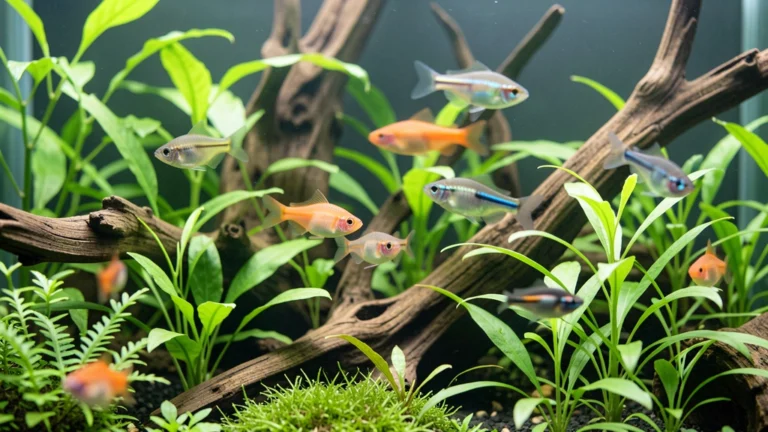
This rule can work as a rough starting point for small, calm, freshwater fish like neon tetras or guppies. These fish stay small, produce modest waste, and rarely fight over space.
The rule breaks down quickly for larger or more active fish. A single ten inch fish is not the same bioload as ten one inch fish, since a bigger fish eats more, produces more waste, and needs more room to turn and swim.
It also ignores body shape, since a slim fish and a deep-bodied fish of equal length are not equal in bulk or waste output. Because of these gaps, treat the rule as a loose starting point, never a hard stocking limit.
Bioload: What Matters Beyond Raw Volume
Bioload is the total waste and oxygen demand your fish place on the tank. Raw gallons alone do not capture this, so several other factors matter just as much.
Filtration capacity comes first. A filter rated for a larger tank than you own processes waste faster and can support a heavier stocking level than a weak or undersized filter.
Live plants help too, since they absorb some waste compounds and add oxygen during daylight hours. A well-planted tank can often support slightly more fish than a bare tank of the same size.
Fish temperament and territory needs matter as much as headcount. A territorial species needs more swimming room per fish than a calm schooling species, even at the same body length.
Finally, always plan around adult size, not the size a fish was when you bought it. A one inch juvenile that grows into a twelve inch adult changes your bioload completely within a year.
Why Bigger Tanks Are More Forgiving for Beginners
Larger tanks are generally easier for beginners to keep stable. A bigger volume of water dilutes waste and temperature swings more slowly than a small one.
In a small tank, a missed water change or a failed heater can cause dangerous swings within hours. The same mistake in a large tank gives you more time to notice and fix the problem.
Bigger tanks also tolerate small stocking or feeding mistakes better, since the margin for error is wider. This is why many experienced aquarists suggest starting with the largest tank your space and budget allow, rather than the smallest.
Use the Tank Volume Calculator to Get Your Exact Number
Doing this math by hand works, but small errors creep in easily, especially with cylindrical tanks. A dedicated tool checks the arithmetic for you and saves time.
The Tank Volume Calculator lets you enter your tank’s shape and measurements and returns the volume in both gallons and liters instantly. Use that number as the foundation for your filtration and stocking plan.
Ready to get your exact tank volume? Plug in your measurements with our Tank Volume Calculator and use the result to plan filtration, water changes, and stocking with real numbers.
Frequently Asked Questions About Aquarium Volume and Stocking
How Do I Calculate the Volume of a Rectangular Fish Tank?
Measure the inside length, width, and water height in inches, then multiply the three numbers together. Divide the result by 231 to get US gallons. The true water volume is usually a bit less once substrate and decorations are added.
How Do I Calculate the Volume of a Round or Cylindrical Tank?
Measure the inside diameter and divide by two to get the radius. Multiply pi, about 3.14, by the radius squared, then by the water height in inches. Divide that result by 231 to convert to gallons.
How Do I Convert Tank Volume From Gallons to Liters?
Multiply the number of US gallons by 3.785 to get liters. To go the other way, divide the number of liters by 3.785. Remember that a UK imperial gallon is larger, at about 4.546 liters, so check which gallon a label uses.
Is the One Inch of Fish Per Gallon Rule Accurate?
It works only as a rough starting point for small, calm freshwater fish such as tetras or guppies. It breaks down for larger, messier, or territorial fish, since bigger fish produce more waste and need more swimming room per inch of length.
What Is Bioload, and Why Does It Matter More Than Tank Volume Alone?
Bioload is the total waste and oxygen demand your fish create. Filtration strength, live plants, fish temperament, and territory needs all shape how much bioload a tank can safely handle, beyond what raw gallons alone can tell you.
Does a Bigger Tank Make Fishkeeping Easier for Beginners?
Yes, generally. A larger volume of water dilutes waste and temperature changes more slowly than a small one, giving you more time to notice and correct problems like a missed water change or a failed heater.
Why Should I Plan Stocking Around a Fish’s Adult Size Instead of Its Size at the Store?
Many fish sold small will grow much larger as adults, and their bioload grows with them. Planning stocking around the adult size prevents overcrowding later, once fish that looked tiny at purchase reach their full grown length.
Sources
Authoritative Sources Used in This Article
This article is for general education only, not veterinary or medical advice. Every pet is different, so always confirm feeding amounts, medications, and health decisions with a licensed veterinarian. Reviewed for accuracy by Prof. Dr. Khalil Mudassar, PhD. Last updated September 15, 2026.
Author

Shakeel Muzaffar is the Founder and Editor-in-Chief of MultiCalculators.com, bringing over 15 years of experience in digital publishing, product strategy, and online tool development. He leads the platform's editorial vision, ensuring every calculator meets strict standards for accuracy, usability, and real-world value. Shakeel personally oversees content quality, formula verification workflows, and the platform's commitment to publishing tools that are genuinely useful for students, professionals, and everyday users worldwide.