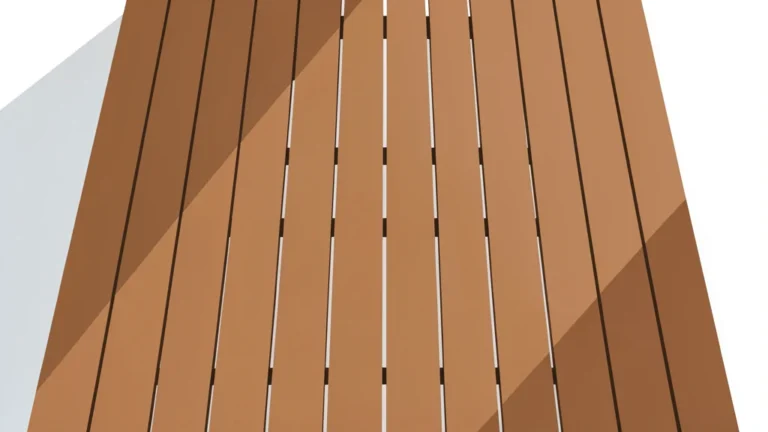
Why do deck boards never sit edge to edge? That small gap between them is not sloppy work, it is doing a real job: letting water drain, air move, and wood breathe as it swells and shrinks with the weather. Getting deck board spacing and quantity right means picking a sensible gap and then using one simple formula to find out exactly how many boards your project needs.
Leave a small gap between deck boards, often around 1/8 to 1/4 inch, for drainage and airflow. This is a general range only, since it changes by material and climate.
Find your board count with this formula: Number of Boards = Deck Width / (Board Width + Gap Spacing).
For a 12 foot wide deck with 5.5 inch boards and a 0.25 inch gap, that works out to about 25 boards.
Always add extra boards on top of that number to cover cuts and waste.
Why Gap Spacing Between Deck Boards Matters
A deck board gap is not a design accident. It gives water somewhere to go instead of pooling on top of the boards after rain.
Standing water is one of the biggest causes of early deck rot and mildew stains. A steady gap lets water drip straight through to the ground or joists below, where it can dry out.
- Drainage: water passes through instead of sitting on the surface.
- Airflow: moving air under and between boards helps everything dry faster.
- Wood movement: boards expand and shrink with humidity and temperature, and the gap gives them room to move.
Skip the gap, and boards can cup, crack, or push against each other as they swell, which shortens the life of your deck.
How Much Gap Should You Leave
A commonly cited general range for deck board spacing is about 1/8 to 1/4 inch. Treat this as a starting point, not a strict rule for every project.
The right gap depends on your material and your climate. Solid wood boards often need a bit more room because they swell more with moisture.
Composite boards usually move less than wood, so manufacturers sometimes call for a smaller or more specific gap. Hot, humid climates can also call for a slightly wider gap than dry climates.
Always check the manufacturer’s spec sheet for your exact decking product before you finalize your spacing. Product guidance should win over any general number in an article like this one.
The Formula for How Many Deck Boards You Need
Once you know your gap, finding the board count is simple math. Each board takes up its own width, plus the width of one gap next to it.
The formula is: Number of Boards = Deck Width / (Board Width + Gap Spacing).
Add the board width and the gap together first. That single number is the space one board plus its neighboring gap takes up across the deck.
Then divide the total deck width by that number. The result tells you roughly how many boards fit side by side.
Worked Example: Boards for a 12-Foot-Wide Deck
Say your deck is 12 feet wide. Convert that to inches first: 12 feet times 12 inches equals 144 inches.
Your boards are 5.5 inches wide, which is standard for common decking sizes. You plan a 0.25 inch gap between each board.
- Add board width and gap: 5.5 in + 0.25 in = 5.75 in per board unit.
- Divide deck width by that unit: 144 in / 5.75 in = 25.04.
- Round to the nearest whole number: about 25 boards.
Twenty five boards at 5.75 inches each cover 143.75 inches, just a quarter inch short of the full 144 inch width. That tiny leftover is normal.
Builders usually close a gap that small by trimming the last board a touch wider, or by spreading the extra fraction of an inch across a few gaps instead. You do not need a whole extra board for a leftover this size.
Tight Gaps vs Wide Gaps: How Spacing Changes Board Count
The size of your gap changes how many boards you need, even on the exact same deck. A tighter gap means each board unit is smaller, so slightly more of them fit across the same width.
Using the same 144 inch wide deck and 5.5 inch boards, a tight 1/8 inch gap needs about 26 boards, while a wider 3/8 inch gap needs about 25 boards. The difference is small, but it is real.
A wider gap can help water and debris pass through more easily, which some builders prefer in wet climates. A tighter gap looks more solid underfoot but needs a hair more boards and a bit more care with drainage.
Step by Step: Planning Your Deck Board Layout
Use this order every time you plan a deck floor, so you do not skip a step that changes your final board count.
- Measure the deck width in feet, then convert it to inches.
- Decide your board width and gap spacing based on your material.
- Calculate boards needed with the formula above.
- Add a waste allowance for cuts and mistakes.
Add a Waste Allowance for Cuts and Mistakes
The formula gives you a clean, ideal board count. Real projects always use a bit more material than the math alone suggests.
Cuts at the edges, boards with defects, and small measuring mistakes all use up extra length. A commonly cited general allowance is about 10 percent more boards than your calculated number, and some builders use up to 15 percent on decks with lots of angles or a complex shape.
For our 12 foot wide example, 25 boards plus 10 percent works out to about 28 boards, rounding up to be safe. Buying slightly more up front is cheaper than a second trip to the store for one mismatched board.
Board spacing and count are only one part of a deck’s total cost. Materials, framing, fasteners, and finish all add up, so once you know how many boards you need, our Deck Building Cost Calculator can help you estimate the full project budget.
What This Guide Does Not Cover
This guide stays focused on deck board gap spacing and how many boards a flat deck surface needs. A few related jobs use different math entirely.
Deck stairs are a separate structural calculation, not just a spacing question. See our guide on stair rise and run for that math, and always confirm stair dimensions against your local building code.
If you still need to find your overall outdoor or home area before planning materials, our guide on how to calculate square footage of a house walks through that separately.
Ready to put your board count into a full budget? Use our Deck Building Cost Calculator to estimate materials, framing, and finish costs for your whole deck project.
Frequently Asked Questions About Deck Board Spacing and Quantity
What Is the Best Gap Spacing for Deck Boards?
A commonly cited general range is about 1/8 to 1/4 inch between boards. This is illustrative only, since the right gap depends on your material, such as wood versus composite, and your local climate. Always check your specific product’s spec sheet before you finalize spacing.
Why Do Deck Boards Need a Gap At All?
The gap lets rainwater drain through instead of pooling on the surface, which helps prevent rot and mildew. It also allows air to move under and between boards so they dry faster. The space gives wood room to expand and shrink with temperature and moisture.
How Do I Calculate How Many Deck Boards I Need?
Use this formula: Number of Boards = Deck Width / (Board Width + Gap Spacing). Add your board width and gap together first, then divide your total deck width by that number. Round to the nearest whole board, and add extra for waste.
Does Composite Decking Need a Different Gap Than Wood?
Often, yes. Composite boards generally move less with moisture than solid wood, so manufacturers sometimes specify a smaller or more precise gap. Wood boards can swell more, so they may need a slightly wider gap. Always follow the manufacturer’s stated spacing for the exact product you buy.
What If My Last Board Does Not Fit Exactly?
This is common, since deck widths rarely divide evenly by a board unit. If the leftover space is small, trim the last board slightly narrower or spread the extra fraction of an inch across a few gaps. If the leftover space is close to a full board, you likely need to round your board count up by one.
How Much Extra Should I Buy for Waste?
A commonly cited general allowance is about 10 percent more boards than your calculated count. Complex layouts with many angles or cuts sometimes use up to 15 percent. This covers defects, miscuts, and small measuring errors without a second trip to the store.
Can I Use a Smaller Gap to Fit More Boards on My Deck?
A smaller gap does let slightly more boards fit across the same width, since each board unit takes up less space. But going too tight can hurt drainage and airflow, and it gives wood less room to expand. Stay within a sensible general range rather than minimizing the gap just to save on boards.
Sources
Authoritative Sources Used in This Article
This article is for general education only, not professional construction or engineering advice. Materials, room shapes, and local building codes vary, so always add extra for waste and check codes or a licensed contractor for structural work like stairs and decks. Reviewed for accuracy by Prof. Dr. Khalil Mudassar, PhD. Last updated September 13, 2026.
Author

Shakeel Muzaffar is the Founder and Editor-in-Chief of MultiCalculators.com, bringing over 15 years of experience in digital publishing, product strategy, and online tool development. He leads the platform's editorial vision, ensuring every calculator meets strict standards for accuracy, usability, and real-world value. Shakeel personally oversees content quality, formula verification workflows, and the platform's commitment to publishing tools that are genuinely useful for students, professionals, and everyday users worldwide.