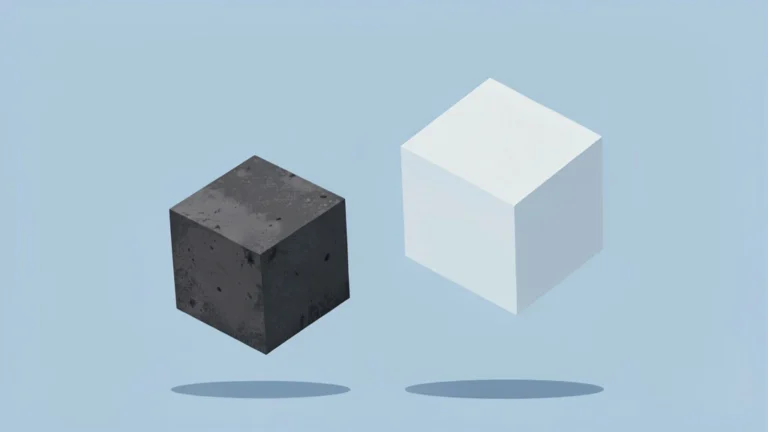
Why does a huge steel ship float on water while a tiny pebble sinks straight to the bottom? Size alone does not explain it. The real answer is density, a simple number that tells you how tightly mass is packed into a given space. Once you understand density, floating, sinking, and even why gold feels so heavy in your hand all make sense.
Density measures how much mass is packed into a given volume. The formula is Density = Mass / Volume, usually written in kg/m^3 or g/cm^3. Water is commonly cited as about 1000 kg/m^3, or 1 g/cm^3, which makes it a handy comparison point. An object less dense than water floats, and an object more dense than water sinks.
What Is Density?
Density is a measure of how much matter, or mass, is squeezed into a certain amount of space, or volume. Two objects can be the same size and still weigh very different amounts, because their material is packed differently.
Picture a block of aluminum and a block of foam that are exactly the same size. The aluminum feels far heavier because its atoms are packed more tightly. That difference in packing is what density describes.
Density does not depend on how big or small an object is. A small gold nugget and a large gold bar have the same density, even though the bar has more total mass and more total volume.
That is what makes density so useful. It lets you compare materials fairly, no matter what size sample you happen to be holding.
The Density Formula
Density has one simple formula that connects mass and volume:
Density = Mass / Volume
Mass is how much matter an object contains, usually measured in grams (g) or kilograms (kg). Volume is how much space it takes up, usually measured in cubic centimeters (cm^3) or cubic meters (m^3).
To find density, you simply divide the mass by the volume. A bigger mass packed into a smaller volume always means a higher density.
Common Units for Density
Density is always written as a mass unit divided by a volume unit. Two unit systems show up most often in science and everyday life.
- kg/m^3 – the standard SI unit, common in engineering and official references.
- g/cm^3 – a smaller, lab-friendly unit, common in chemistry and classrooms.
- Conversion: 1 g/cm^3 equals 1000 kg/m^3, since both mass and volume scale together.
Both units describe the exact same idea. Pick whichever one matches the numbers you are working with, then stay consistent through the whole calculation.
Worked Example: Finding an Object’s Density
Say you have an object with a mass of 500 grams and a volume of 200 cubic centimeters. To find its density, divide mass by volume.
Density = 500 g / 200 cm^3 = 2.5 g/cm^3
Water is commonly cited at about 1 g/cm^3. Since 2.5 g/cm^3 is higher than that, this object is denser than water. Based on that alone, it would sink if placed in water.
Worked Example: Checking a Gold Sample
Now try a sample that measures 193 grams with a volume of 10 cubic centimeters.
Density = 193 g / 10 cm^3 = 19.3 g/cm^3
Gold is commonly cited with a density of about 19.3 g/cm^3, so this sample matches gold’s expected density closely. This is actually one way jewelers and scientists get an early clue about whether a metal sample might be genuine gold.
Comparing Two Objects With the Same Volume
Density becomes easiest to picture when two objects share the same volume. The table below compares the 500 g object above with a lighter object of the exact same size.
| Property | Object A | Object B |
|---|---|---|
| Volume | 200 cm^3 | 200 cm^3 |
| Mass | 500 g | 40 g |
| Density | 2.5 g/cm^3 | 0.2 g/cm^3 |
| Compared to water (1 g/cm^3) | Denser, would sink | Less dense, would float |
Same size, very different outcomes. The mass packed inside each object, not its outer size, decides whether it floats or sinks.
Why Denser Objects Sink and Lighter Ones Float
An object placed in water pushes water out of the way, and the water pushes back with an upward force. Whether the object floats or sinks depends on how that push-back compares to the object’s own weight.
In general terms, an object that is less dense than the fluid around it floats, because the fluid’s push-back is enough to support it. An object that is more dense than the fluid sinks, because its weight overcomes that support.
This is why a solid steel block sinks, but a steel ship shaped into a hollow hull floats. Shaping the same mass into a much larger volume lowers the overall density of the ship below that of water.
Density in Everyday Life
Density quietly explains plenty of things you notice every day, even without thinking about the physics behind them.
- Ice floats on liquid water because ice is slightly less dense than the water around it.
- A helium balloon rises because helium gas is far less dense than the air it displaces.
- Oil floats on top of water in salad dressing because oil is less dense than water.
- Cold air sinks below warm air in a room because cooler air is denser than warm air.
Each example follows the same simple rule. The less dense substance rises or stays on top, and the denser one settles below it.
Density Values for Common Materials
Comparing densities across everyday materials helps put numbers like 2.5 g/cm^3 or 19.3 g/cm^3 into perspective. The values below are commonly cited reference figures, useful for comparison rather than exact measurements of any single sample.
| Material | Density (g/cm^3) | Density (kg/m^3) |
|---|---|---|
| Water | about 1.0 | about 1000 |
| Aluminum | about 2.7 | about 2700 |
| Iron | about 7.8 | about 7800 |
| Gold | about 19.3 | about 19300 |
Density and Pressure in Fluids
Density and pressure are close cousins in fluids: a denser fluid presses harder at the same depth than a less dense one does. That single line barely scratches the surface, so if you want the full picture of pressure units and how they work, see our guide to Pressure Units Explained (PSI, Bar, Pa).
How to Measure Density Step by Step
Finding an object’s density in real life just takes two measurements and one division. Here is the basic process.
- Measure the object’s mass using a scale, in grams or kilograms.
- Measure the object’s volume. For simple shapes, multiply length x width x height.
- For irregular shapes, use water displacement: the water that rises when the object is submerged equals its volume.
- Divide mass by volume to get density, keeping your units consistent throughout.
This same two-step approach is exactly what a Density Calculator automates for you once you have your mass and volume numbers ready.
Common Mistakes When Calculating Density
A few small slip-ups cause most density errors. Watch out for these.
- Mixing units, such as dividing grams by cubic meters instead of cubic centimeters.
- Confusing mass with weight, which are related but not the same quantity.
- Forgetting to subtract container volume when measuring liquid or displaced water.
- Rounding too early, which can shift your final answer noticeably.
- Reading a scale in the wrong unit, such as mixing ounces with grams before dividing.
Double-checking your units before you divide is the single best habit for getting density right every time. A few extra seconds spent lining up units saves you from a wrong answer later.
Density describes matter that is sitting still. If you also want to explore how objects move once forces act on them, our guide on How to Calculate Velocity and Acceleration covers that ground in detail.
Ready to find a density for yourself? Plug in mass and volume with our Density Calculator and get an instant, accurate result without doing the division by hand.
Frequently Asked Questions About Density
What Is Density in Simple Terms?
Density is how much mass is packed into a given amount of space, or volume. Two objects the same size can have very different densities if one has more matter squeezed inside it. Density does not change with the size of the object, only with how tightly its material is packed.
What Is the Formula for Density?
The density formula is Density = Mass / Volume. Mass is usually measured in grams or kilograms, and volume in cubic centimeters or cubic meters. Dividing mass by volume gives you density in units like g/cm^3 or kg/m^3.
What Units Is Density Measured In?
The two most common units are kilograms per cubic meter (kg/m^3), the standard SI unit, and grams per cubic centimeter (g/cm^3), common in labs and classrooms. One g/cm^3 equals 1000 kg/m^3, so you can convert between them by multiplying or dividing by 1000.
What Is the Density of Water?
Water is commonly cited as having a density of about 1000 kg/m^3, which equals about 1 g/cm^3. This figure is widely used as a comparison point: materials denser than water tend to sink in it, and materials less dense tend to float.
Why Do Some Objects Float While Others Sink?
An object floats or sinks in a fluid depending on how its density compares to the fluid’s density. An object less dense than the fluid floats, because the fluid pushes back hard enough to support it. An object more dense than the fluid sinks, because its weight overcomes that support.
How Do You Calculate Density From Mass and Volume?
Measure the object’s mass on a scale, then measure its volume, either by multiplying its dimensions for simple shapes or by water displacement for irregular ones. Divide the mass by the volume, keeping units consistent, to get the density.
Why Is Gold So Much Denser Than Water?
Gold atoms are heavy and pack very tightly together, so a given volume of gold contains far more mass than the same volume of water. Gold is commonly cited with a density of about 19.3 g/cm^3, roughly 19 times denser than water at about 1 g/cm^3.
Sources
Authoritative Sources Used in This Article
This article is for general education only. Formulas and examples use standard physics conventions and idealized conditions (no friction or air resistance unless noted), so real-world results can vary. Reviewed for accuracy by Prof. Dr. Khalil Mudassar, PhD. Last updated September 13, 2026.
Author

Shakeel Muzaffar is the Founder and Editor-in-Chief of MultiCalculators.com, bringing over 15 years of experience in digital publishing, product strategy, and online tool development. He leads the platform's editorial vision, ensuring every calculator meets strict standards for accuracy, usability, and real-world value. Shakeel personally oversees content quality, formula verification workflows, and the platform's commitment to publishing tools that are genuinely useful for students, professionals, and everyday users worldwide.