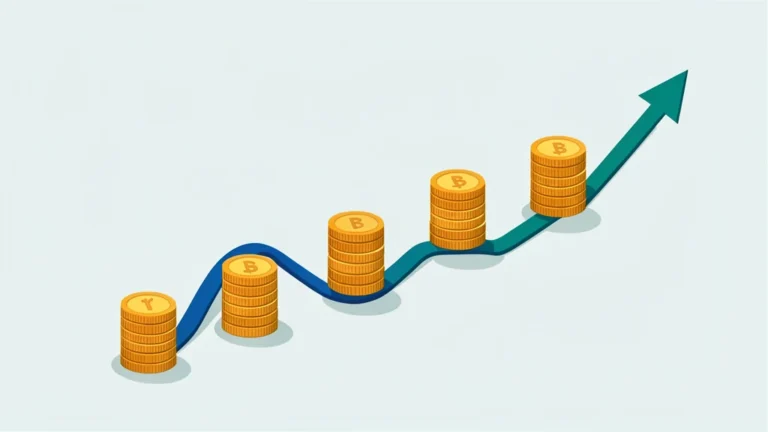
What if you never had to guess the right day to buy crypto again? That is the promise of dollar-cost averaging. Instead of dropping all your money in at once, you invest a fixed dollar amount on a regular schedule, no matter what the price is doing. This simple habit spreads your buys across time. It buys you more coins when prices dip and fewer when prices climb, which can lower the average price you pay per coin.
Dollar-cost averaging crypto means investing the same fixed dollar amount on a set schedule, such as $100 every week, no matter the price. Your money buys more units when prices are low and fewer when prices are high. Over time this can lower your average cost per coin and takes the guesswork and emotion out of timing the market. It does not guarantee a profit, and you can still lose money if prices keep falling.
What Dollar-Cost Averaging Means
Dollar-cost averaging, often shortened to DCA, is a simple buying method. You commit a fixed dollar amount and invest it on a repeating schedule.
The key word is fixed. You spend the same dollars each time, like $50 or $100, and you do not change that amount based on the price. The price can swing wildly, but your buy stays steady.
This approach is common in regular investing, and the idea carries straight over to crypto. Because crypto prices move fast and often, a steady schedule can feel calmer than trying to pick the perfect moment.
Here is what a DCA plan usually includes:
- A fixed dollar amount per buy, such as $25, $100, or $250.
- A set schedule, like weekly, every two weeks, or monthly.
- The same action every time, no matter if the price is up or down.
That is the whole method. The power comes not from any single buy but from repeating the habit over many buys.
How Buying the Same Dollars Changes What You Get
Since your dollar amount stays fixed, the number of coins you receive changes with the price. This is the heart of how DCA works.
When the price is low, your fixed dollars buy more units. When the price is high, those same dollars buy fewer units. You end up buying more when coins are cheap and less when they are pricey.
Say you invest $100 each time. If one coin costs $1,000, you get 0.10 units. If the price jumps to $2,000, that same $100 gets you only 0.05 units. If the price drops to $500, your $100 buys 0.20 units.
You are not trying to predict these moves. The fixed amount does the work for you, leaning your buying toward cheaper prices without any guessing.
A Worked Example Over Three Buys
Numbers make this clear. Imagine you invest $100 every week for three weeks, and the price changes each week.
Each week you divide your $100 by that week’s price to find the units you receive. Then you add up what you spent and what you own.
| Week | Price per Coin | Amount Invested | Units Bought |
|---|---|---|---|
| Week 1 | $2,000 | $100 | 0.05 |
| Week 2 | $1,000 | $100 | 0.10 |
| Week 3 | $1,250 | $100 | 0.08 |
| Total | Average price $1,417 | $300 | 0.23 |
Now find your average cost per coin. You divide the total money spent by the total units you own.
That is $300 divided by 0.23 units, which comes to about $1,304 per coin. Your real average cost is $1,304.
Compare that to the simple average of the three prices, which is $1,417. Your DCA average cost of $1,304 is lower, because your fixed dollars bought extra units during the cheaper weeks.
Why DCA Lowers Your Average Cost
The gap between $1,304 and $1,417 is the whole point. Buying a fixed dollar amount tilts your totals toward the low-price weeks.
When coins are cheap, your $100 scoops up more of them. Those extra cheap units pull your average cost down below the plain average of the prices.
This is sometimes called the benefit of buying more when prices are low. You did not try to time anything. The fixed-dollar rule did it automatically.
DCA also lowers a different kind of cost: stress. You skip the pressure of picking a perfect entry day, which helps you avoid fear-driven or greed-driven choices.
Dollar-Cost Averaging vs Lump-Sum Buying
The main alternative to DCA is lump-sum buying. That means investing all your money at once instead of spreading it out.
Neither choice is always better. Each has trade-offs that depend on the market and on how you handle risk.
| Point | Dollar-Cost Averaging | Lump-Sum Buying |
|---|---|---|
| How you invest | Fixed amount over many buys | All of it in one buy |
| Timing risk | Spread out, so lower | Concentrated on one day |
| If prices rise after | Miss some early gains | Captures the full rise |
| If prices fall after | Keeps buying cheaper | Full amount is down |
| Emotional stress | Usually lower | Often higher |
Pros and Cons of DCA for Crypto
DCA fits the ups and downs of crypto well, but it is not magic. Weigh both sides before you start.
The main benefits are about steadiness and peace of mind:
- It removes the stress of timing a volatile market.
- It can lower your average cost when prices swing.
- It builds a simple, repeatable habit you can automate.
- It guards against putting everything in right before a drop.
The trade-offs are real too:
- In a steadily rising market, lump-sum often wins.
- Frequent small buys can add up fees, so check costs.
- It needs patience and discipline over months or years.
For most beginners, the lower stress and steady habit are the biggest draws.
What DCA Does Not Do
DCA is a buying method, not a promise of profit. It cannot protect you from every risk in crypto.
If a coin’s price keeps falling over your whole buying period, you can still lose money. A lower average cost does not help if the price ends up below that average.
DCA also does not track your gains, handle taxes, or cover rewards like staking. Those are separate topics with their own rules.
To measure your actual gain or loss, see our guide on how to calculate crypto profit and loss. For how buys and sells may be taxed, read crypto tax basics explained. You can also test how a steady buying plan might have played out using the Crypto What-If Calculator.
Curious how a DCA habit could have grown over time? Try different amounts, schedules, and dates with the Crypto What-If Calculator and see the average cost and outcome for yourself. It turns the ideas here into real numbers in seconds.
Frequently Asked Questions About Dollar-Cost Averaging Crypto
What Is Dollar-Cost Averaging in Crypto?
Dollar-cost averaging in crypto means investing a fixed dollar amount on a regular schedule, such as $100 every week, no matter the price. Your money buys more units when prices are low and fewer when prices are high. The goal is to spread buys over time and lower your average cost per coin.
How Do I Calculate My Average Cost per Coin?
Add up all the money you invested, then add up all the units you bought. Divide the total dollars by the total units. For example, $300 spent for 0.23 units gives an average cost of about $1,304 per coin. This is your true cost basis, not the average of the prices.
Is Dollar-Cost Averaging Better Than Lump-Sum Buying?
Neither is always better. Lump-sum often wins when prices rise steadily after you buy, since all your money is working sooner. DCA tends to help in choppy or falling markets and lowers timing stress. Your choice depends on the market and how comfortable you are with risk.
Does DCA Guarantee I Will Make a Profit?
No. DCA is a buying method, not a profit guarantee. If the price keeps falling across your whole buying period, you can still lose money. A lower average cost only helps if the price later rises above that average. Crypto is volatile and risky, so any outcome is possible.
How Often Should I Buy When Using DCA?
There is no single right schedule. Common choices are weekly, every two weeks, or monthly. More frequent buys smooth out price swings more but can add up fees. Pick a schedule you can stick with and that keeps your total fees low. Consistency matters more than the exact timing.
How Much Money Do I Need to Start DCA?
You can start small, since the method is about consistency, not size. Many people begin with a modest fixed amount like $25 or $50 per buy. Choose an amount you can afford to invest regularly without strain. Never invest money you cannot afford to lose, because crypto prices can fall sharply.
Do Fees and Taxes Affect My DCA Results?
Yes. Each buy may carry a fee, and many small buys can add up over time, so check your platform’s costs. Selling crypto can also trigger taxes in many countries. Tax rules vary and change fast, so review our crypto tax basics guide and consult a professional for your situation.
Sources
Authoritative Sources Used in This Article
This article is for general education only, not financial or investment advice. Crypto is volatile and risky, and prices, fees, rewards, and tax rules change fast and vary by country, so do your own research and consult a professional. Reviewed for accuracy by Prof. Dr. Khalil Mudassar, PhD. Last updated September 12, 2026.
Author

Shakeel Muzaffar is the Founder and Editor-in-Chief of MultiCalculators.com, bringing over 15 years of experience in digital publishing, product strategy, and online tool development. He leads the platform's editorial vision, ensuring every calculator meets strict standards for accuracy, usability, and real-world value. Shakeel personally oversees content quality, formula verification workflows, and the platform's commitment to publishing tools that are genuinely useful for students, professionals, and everyday users worldwide.