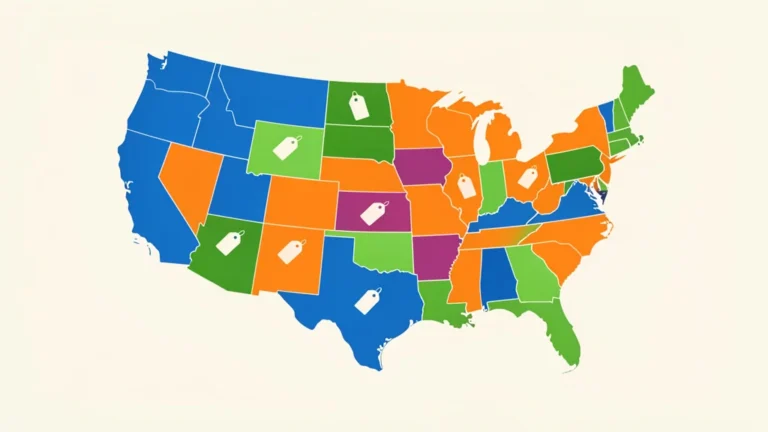
Why does the same $20 item cost more at the register in one city than in another? The answer is sales tax by state. There is no national sales tax in the United States. Instead, each state sets its own rules, and many cities and counties add their own tax on top. That is why the final price can change when you cross a state line or even a county line.
There is no federal sales tax in the US. Each state sets a base rate, and local areas can add their own rate on top. Together they form the combined rate you pay at checkout. Five states have no statewide sales tax. Rates and rules change often, so confirm current figures before you rely on them.
How Sales Tax Works in the US
Sales tax is a tax added to the price of many goods and some services. You pay it at the register, and the seller sends it to the government. It is charged as a percentage of the price.
The key thing to know is that there is no single federal sales tax. The US handles this at the state level instead. Each state decides its own base rate, what items are taxed, and which ones are exempt.
On top of the state rate, many cities, counties, and special districts add their own local sales tax. So two buyers in the same state can pay different totals depending on where they shop. Because these rules are set locally, sales tax by state is really a mix of state and local rules working together.
Sales tax is also a consumption tax, which means it is tied to what you buy rather than what you earn. You pay it in small amounts throughout the year as you shop. That makes it easy to overlook, but it adds up on big purchases like a car or appliances.
State Rate Plus Local Rate Equals Combined Rate
The rate you actually pay is called the combined rate. It is simply the state base rate plus any local rates that apply at the point of sale.
Here is a simple way to see it. Say a state charges a 6% base rate. Your city and county add 2% more. Your combined rate is 8%. That 8% is what gets applied to your purchase.
- State base rate: set by the state for the whole state.
- Local rate: added by a city, county, or district.
- Combined rate: the two added together, charged at checkout.
A Worked Example: Tax on a $1,000 Purchase
The math behind sales tax is short. You multiply the price by the combined rate to get the tax. Then you add the tax to the price to get your total.
Say you buy something for $1,000. Your state charges 6%, and your local area adds 2%, so your combined rate is 8%. The tax comes to $80, and your total is $1,080.
You do not have to do this by hand every time. Our Sales Tax Calculator handles the math once you enter the price and the combined rate.
States With No Statewide Sales Tax
Five states do not charge a statewide sales tax. People often remember them by the nickname NOMAD.
- New Hampshire
- Oregon
- Montana
- Alaska
- Delaware
There is a catch worth knowing. Some of these states still allow local sales taxes in certain areas, so you may still pay a small amount at checkout. This list can change, so confirm current rules before you plan a big purchase around it.
What Is Usually Taxable vs Commonly Exempt
Most states tax the sale of physical goods you can touch, like electronics, furniture, and clothing. Some services are taxed too, but the rules vary a lot by state.
Many states carve out exemptions to ease the cost of basic needs. These common exemptions are worth knowing.
- Groceries: many states exempt unprepared food or tax it at a lower rate.
- Prescription drugs: commonly exempt across many states.
- Some medical items: certain states exempt items like medical devices.
These exemptions are not the same everywhere. A prepared hot meal may be taxed even where raw groceries are not. Always check your state rules for the exact items.
| Often Taxable | Often Exempt or Reduced |
|---|---|
| Electronics and appliances | Unprepared groceries |
| Furniture and home goods | Prescription medicine |
| Prepared and restaurant meals | Certain medical devices |
| Many everyday retail goods | Some necessities, depending on the state |
Use this table as a general guide, not a rule. The exact treatment of any item depends on your state and can change, so confirm before a large purchase.
Origin vs Destination Sourcing in One Line
Sourcing decides which rate applies: origin-based states use the seller’s location, while destination-based states use where the buyer receives the item.
For shoppers, this mostly matters with shipping and online orders. It can change whether you pay the seller’s local rate or your own.
Use Tax on Out-of-State and Online Purchases
Use tax is the partner to sales tax. If you buy something and no sales tax is charged, you may owe use tax at your state’s rate instead.
This often comes up with online orders or purchases made in a no-tax state and brought home. The idea is to keep things fair so untaxed purchases do not skip the tax entirely.
Many states ask you to report use tax on your state income tax return. The amount is usually based on your combined rate at home.
Today, many large online sellers collect sales tax for you at checkout based on your shipping address. When that happens, you usually do not owe separate use tax on that order. Smaller or out-of-state sellers may not collect it, so the duty can still fall to you.
Can You Deduct State Sales Tax?
If you itemize on your federal return, you can deduct either your state and local sales tax or your state and local income tax, but not both. Most people pick whichever is larger.
This choice only helps if you itemize instead of taking the standard deduction. To see which path fits you, read our guide on Standard vs Itemized Deductions.
Tax deduction rules, limits, and the standard deduction amount change often. Confirm the current IRS rules before you file, and consider a tax professional for your situation.
Ready to check the math on your next purchase? Enter the price and your combined rate in our Sales Tax Calculator to see the tax and total in seconds, no manual math needed.
Frequently Asked Questions About Sales Tax by State
Is There a Federal Sales Tax in the US?
No. The United States does not have a national sales tax. Sales tax is set at the state level, and many cities and counties add their own local rate on top. That is why the rate you pay changes depending on where you shop.
How Is the Combined Sales Tax Rate Calculated?
The combined rate is the state base rate plus any local rates that apply at the point of sale. For example, a 6% state rate plus a 2% local rate gives an 8% combined rate. That combined rate is multiplied by the price to find the tax you owe.
Which States Have No Statewide Sales Tax?
Five states have no statewide sales tax: New Hampshire, Oregon, Montana, Alaska, and Delaware. A common nickname for them is NOMAD. Some of these states still allow local sales taxes in certain areas, and this list can change, so confirm current rules.
Are Groceries and Prescriptions Taxed?
It depends on the state. Many states exempt unprepared groceries or tax them at a lower rate, and prescription drugs are commonly exempt. Prepared foods, like a hot meal, are often taxed even where raw groceries are not. Always check your state’s specific rules.
What Is Use Tax?
Use tax applies when you buy something and no sales tax is charged, such as some online orders or purchases from a no-tax state. You may owe use tax at your home state’s rate instead. Many states ask you to report it on your state income tax return.
Can I Deduct Sales Tax on My Federal Return?
If you itemize, you can deduct either state and local sales tax or state and local income tax, but not both, and most people choose the larger one. This only helps if you itemize rather than take the standard deduction. Confirm current IRS rules before filing.
Why Do Sales Tax Rates Change So Often?
States, cities, counties, and special districts can adjust their rates and rules over time. New local taxes can be added, and exemptions can change. Because of this, any specific rate you see today may be different later, so always confirm the current figure before relying on it.
Sources
Authoritative Sources Used in This Article
This article is for general education only, not tax advice. Tax laws, rates, brackets, and limits change often and vary by state and situation, so check the current IRS rules and consult a tax professional for your situation. Reviewed for accuracy by Prof. Dr. Khalil Mudassar, PhD. Last updated September 12, 2026.
Author

Shakeel Muzaffar is the Founder and Editor-in-Chief of MultiCalculators.com, bringing over 15 years of experience in digital publishing, product strategy, and online tool development. He leads the platform's editorial vision, ensuring every calculator meets strict standards for accuracy, usability, and real-world value. Shakeel personally oversees content quality, formula verification workflows, and the platform's commitment to publishing tools that are genuinely useful for students, professionals, and everyday users worldwide.