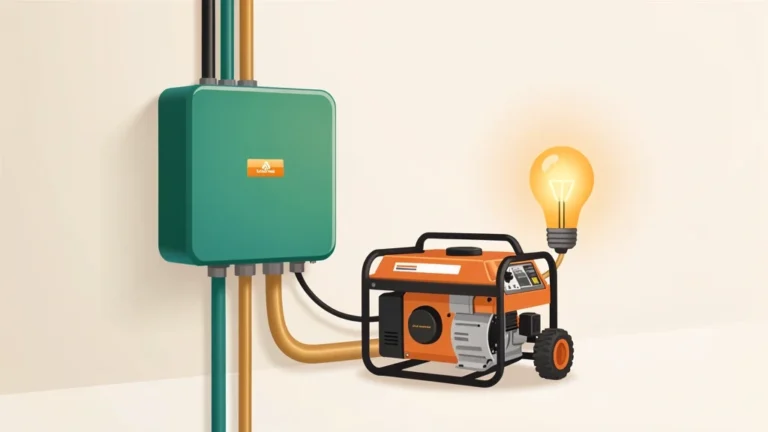
The power just went out. What size generator or battery will keep your essentials running? The answer starts with one simple step: add up the watts of everything you want to power at the same time. That running-watts total tells you the size you need, then you add extra headroom for motors that spike when they start. This guide walks the watt-summing method step by step, with real numbers you can copy.
To size a home backup battery or generator, add up the running watts of every device you want to power at once. Essentials like a fridge, lights, a furnace fan, and phones often total about 1,000 W. For a generator, add surge watts because motors spike when they start, so a 2,000 to 3,000 W unit fits typical essentials. For a battery, use watt-hours: capacity divided by your load equals runtime. A 5,000 Wh battery running 500 W lasts about 10 hours.
Step 1: List What You Want to Run
Backup power is about choices. You rarely need to run the whole house, so start by listing only the items that matter during an outage. Write each one down with its typical wattage.
Most appliances show their watts on a label or in the manual. If you only see amps, multiply amps by volts to get watts. Here are common essentials and their typical running watts:
- Refrigerator: about 150 W
- Household lights (several LED bulbs): about 100 W
- Furnace blower fan: about 600 W
- Phone and laptop charging: about 100 W
- Wifi router and modem: about 20 W
- Sump pump (if you have one): about 800 W to 1,000 W
These are typical figures, not exact ones. Your own labels give the real numbers, so check them before you buy.
Step 2: Add Up the Running Watts
Running watts are what a device draws while it works normally. To find your target size, add the running watts of everything you plan to power at the same time.
Using the essentials above, the math is simple:
150 + 100 + 600 + 100 + 20 = 970 W running.
That rounds to about 1,000 W. This is your baseline load, the steady power your backup source must supply. If you want to add the sump pump too, your running total climbs toward 1,800 W, which changes the size you need.
Do Not Forget Surge Watts
Running watts are only half the story for a generator. Anything with a motor needs a short burst of extra power to start. That burst is called surge watts, or starting watts, and it can be much higher than the running number.
A fridge that runs at 150 W can spike to about 1,200 W for a second or two when its compressor kicks on. Sump pumps, well pumps, and air conditioners surge hard too. If your generator cannot supply that spike, the motor may not start.
Generators are rated with two numbers: running watts and surge watts. You size the running number to your steady load and make sure the surge rating covers your biggest starting spike.
For our 1,000 W essentials, a fridge surge of about 1,200 W is the largest single spike. A generator rated around 2,000 to 3,000 W running gives comfortable headroom for both the steady load and that spike. That is a safe fit for basic essentials.
Battery Sizing Uses Watt-Hours
Batteries work differently from generators. A generator makes power as long as it has fuel, so you size it by watts. A battery holds a fixed amount of energy, so you size it by watt-hours.
Watt-hours (Wh) measure stored energy. The formula is simple:
Watt-hours = watts x hours.
Turn it around to find runtime:
Runtime (hours) = battery watt-hours / your load in watts.
Say you have a 5,000 Wh (5 kWh) battery. Running a steady 500 W load, it lasts 5,000 / 500 = 10 hours. Running the full 1,000 W of essentials, it lasts 5,000 / 1,000 = 5 hours. The heavier the load, the faster the battery drains.
So for a battery, first decide how many hours you want, then multiply your load by those hours to find the capacity you need. Real-world runtime is a bit shorter because no battery is 100 percent efficient.
Generator vs Battery: Which Fits You?
Both keep the lights on, but they suit different outages. A generator shines in long outages if you can store fuel. A battery shines for quiet, short backup with no fumes. Here is a quick comparison:
- Runtime: A generator runs as long as you have fuel. A battery runs until its watt-hours are gone.
- Noise and fumes: Batteries are silent and safe indoors. Generators are loud and must run outside, far from windows.
- Refueling: Generators need gas, propane, or diesel on hand. Batteries recharge from the grid, a generator, or solar.
- Startup surge: Generators handle motor spikes well. Batteries vary, so check the inverter’s surge rating.
- Best use: Generators fit long, multi-day outages. Batteries fit short outages and sensitive electronics.
Many homes use both: a battery for quiet, instant backup and a generator for extended outages.
Not sure how your numbers add up? Use our free Power Calculator to convert watts, amps, and volts and total your backup load in seconds. It takes the guesswork out of sizing a generator or battery.
Safety and Wiring: Call a Pro
Sizing the watts is the easy part. Connecting backup power to your home safely is not a do-it-yourself job. Get this wrong and you risk fire, damaged equipment, or electrocuting a utility worker.
The most important rule: never backfeed. Backfeeding means plugging a generator into a wall outlet to power your house. It is dangerous and illegal, and it can send deadly voltage back onto power lines.
To power your home’s wiring safely, you need a transfer switch or an interlock kit installed by a licensed electrician. This isolates your house from the grid so power flows only one way. For portable use without wiring, run appliances on heavy-duty extension cords straight from the generator instead.
Backup power also affects your energy use. To understand your everyday consumption and rates, see our sibling guide on how to read your electricity bill and cut kWh.
Frequently Asked Questions About Sizing Backup Power
How Many Watts Do I Need for Home Backup?
Add the running watts of everything you want to power at once. Basic essentials like a fridge, lights, a furnace fan, phones, and wifi often total about 1,000 W. Add more for a sump pump or air conditioner. Your target size is that total plus surge headroom for a generator.
What Is the Difference Between Running Watts and Surge Watts?
Running watts are the steady power a device uses while working. Surge watts are the short spike a motor needs to start, which can be several times higher. A fridge running at 150 W may surge to about 1,200 W. Generators list both numbers, so match your steady load and cover your biggest spike.
How Do I Calculate Battery Runtime?
Divide the battery’s watt-hours by your load in watts. A 5,000 Wh battery running a 500 W load lasts 5,000 / 500 = 10 hours. The same battery running 1,000 W lasts 5 hours. Real runtime is slightly shorter because batteries are not 100 percent efficient, so leave a little margin.
What Size Generator Runs a Whole House?
Whole-home standby generators are often 10,000 to 20,000 W, depending on the house, its heating and cooling, and which loads run together. Sizing a whole-house unit is a job for a professional who reviews your panel and appliances. Most people back up only essentials instead, which needs far less power.
Can I Plug a Generator Into a Wall Outlet?
No. Plugging a generator into an outlet, called backfeeding, is dangerous and illegal. It can electrocute utility workers and start fires. To power your home’s wiring, use a transfer switch or interlock installed by a licensed electrician, or run appliances on extension cords straight from the generator.
Is a Battery or Generator Better for Backup?
It depends on the outage. Batteries are silent, fume-free, and safe indoors, which suits short outages and sensitive electronics. Generators run as long as you have fuel, which suits long, multi-day outages. Many homes use a battery for instant quiet backup and a generator for extended power.
How Do I Find an Appliance’s Wattage?
Check the label on the appliance or its manual, which usually lists watts. If you only see amps, multiply amps by volts to get watts. For example, 5 amps times 120 volts equals 600 W. Use these figures to build your running-watts total before you shop for backup power.
Sources
Authoritative Sources Used in This Article
This article is for general education only, not professional energy, electrical, or financial advice. Real needs and savings vary by home, climate, equipment, and utility rates, so get a professional assessment and quotes. Reviewed for accuracy by Prof. Dr. Khalil Mudassar, PhD. Last updated September 12, 2026.
Author

Shakeel Muzaffar is the Founder and Editor-in-Chief of MultiCalculators.com, bringing over 15 years of experience in digital publishing, product strategy, and online tool development. He leads the platform's editorial vision, ensuring every calculator meets strict standards for accuracy, usability, and real-world value. Shakeel personally oversees content quality, formula verification workflows, and the platform's commitment to publishing tools that are genuinely useful for students, professionals, and everyday users worldwide.