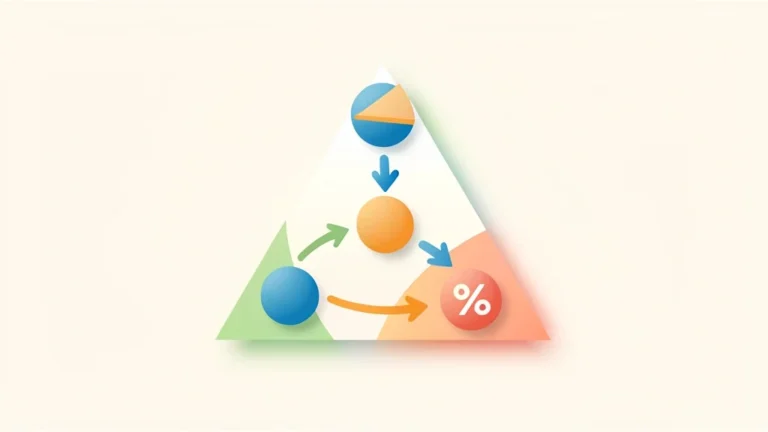
Is 3/4, 0.75, or 75 percent the biggest? Trick question: they are all the same value written three ways. Fractions, decimals, and percentages are simply three languages for one amount, and switching between them takes only a few easy moves. This guide walks through all six conversions with clear steps, worked examples, and a table of equivalents worth memorizing.
To convert a fraction to a decimal, divide the top by the bottom. To turn a decimal into a percentage, multiply by 100 and add a % sign. To go from a percentage back to a decimal, divide by 100. To make a decimal or percentage into a fraction, write it over its place value or over 100, then simplify.
There are six conversions in total, one for each direction between the three forms. The good news is that they reuse the same two moves: dividing and multiplying by simple numbers. Learn the pattern once and every conversion becomes routine. The sections below take them one at a time, from the most common to the least, with a worked example in each.
Fraction to Decimal
A fraction is a division problem waiting to happen. The line between the two numbers simply means divide. To get the decimal, divide the top number (the numerator) by the bottom number (the denominator).
Take 3/4. You compute 3 / 4 = 0.75. Try 1/5 next: that is 1 / 5 = 0.2. The steps never change, no matter the fraction you start with.
- Write the fraction as top / bottom.
- Divide the top by the bottom.
- The answer is your decimal.
When the top is smaller than the bottom, the answer is less than 1, so it starts with “0.” like the examples above. When the top is larger, you get a number bigger than 1. For instance, 5/4 = 5 / 4 = 1.25. If long division feels slow, a calculator gives the same result instantly, but the idea behind it stays exactly the same.
Some fractions give a repeating decimal. For example, 1/3 = 1 / 3 = 0.333…, where the 3s go on forever. In that case, round to a sensible spot, such as 0.333, and note that it is approximate. Two or three decimal places is usually plenty for everyday math.
Decimal to Percentage
Percent means “per hundred,” so a percentage is just a decimal scaled up. To show a decimal as a percentage, multiply it by 100 and add a % sign.
Multiplying by 100 moves the decimal point two places to the right. So 0.75 x 100 = 75%, and 0.2 x 100 = 20%. A small decimal like 0.05 becomes 5%.
If the decimal has fewer than two places, add zeros as you shift the point. For 0.2, think of it as 0.20, then move two places to reach 20%. A whole number works too: 1.0 x 100 = 100%, and 1.5 x 100 = 150%.
A handy shortcut for the point-shift: 0.4 becomes 40%, 0.04 becomes 4%, and 0.004 becomes 0.4%. Each place you move the decimal changes the percent by a factor of ten, so keeping track of zeros is the whole trick.
This is the move you use to report a result as a percent, such as a test score or a growth rate. If you want to find a percent of a number instead, see our guide on how to calculate a percentage.
Percentage to Decimal
A percentage is already a number out of 100, so going back to a decimal is easy. Divide the percentage by 100 and drop the % sign.
Dividing by 100 moves the decimal point two places to the left. So 75% / 100 = 0.75, and 20% / 100 = 0.2. A single-digit percent like 8% becomes 0.08, because you need a placeholder zero after the point.
Percentages above 100 work the same way. For example, 150% / 100 = 1.5. The result is greater than 1, which makes sense because you have more than a whole. A tiny percent goes the other way: 0.5% / 100 = 0.005.
A quick check helps you catch mistakes. A percent under 100 should always give a decimal under 1, and a percent over 100 should give a decimal over 1. If your point landed in the wrong spot, count the two places again.
This step matters because most calculators and formulas want a decimal, not a percent. Convert the percent first, then multiply or divide as your problem needs. For example, to take 20% of a bill, change 20% to 0.2 and multiply. Skipping the conversion is the most common mistake people make with percents.
Percentage and Decimal to Fraction
Both of these start the same way. You write the number over its place value, then simplify the fraction to its smallest whole numbers.
For a percentage, put it over 100. So 75% becomes 75/100. Divide the top and bottom by 25, and you get 3/4.
For a decimal, use the place value of the last digit. One decimal place means tenths, and two places means hundredths. Since 0.75 has two decimal places, it is 75/100, which again simplifies to 3/4. Likewise, 0.2 is 2/10, which reduces to 1/5.
- Write the number over 100 (percent) or its place value (decimal).
- Find a number that divides both top and bottom evenly.
- Divide both by it until no common factor is left.
To simplify quickly, look for a shared factor like 2, 5, or 10. With 75/100, both numbers divide by 25, which takes you straight to 3/4 in one step. If you divide by a smaller factor, just keep going until nothing divides both evenly.
This is about single values, not part-to-part comparisons. For those, read ratios and proportions explained.
Common Equivalents Worth Memorizing
A handful of conversions show up again and again in shopping, cooking, grades, and sports stats. Knowing them by heart lets you skip the math and just recognize the value on sight. The table below lines up the most useful ones side by side.
| Fraction | Decimal | Percentage |
|---|---|---|
| 1/2 | 0.5 | 50% |
| 1/4 | 0.25 | 25% |
| 3/4 | 0.75 | 75% |
| 1/5 | 0.2 | 20% |
| 1/10 | 0.1 | 10% |
| 1/3 | 0.333… | 33.3% |
Notice that 1/3 repeats, so its decimal and percent are rounded. Every other row here is exact. Once these six are automatic, you can estimate many other values in your head, since they act like anchor points on the number line.
- See “half off” and know it means 0.5 or 50%.
- Spot 1/4 in a recipe and read it as 25%.
- Combine anchors: 1/2 plus 1/4 gives 3/4, or 75%.
You can also build new values from these anchors. Since 1/10 is 10%, then 3/10 must be 30%.
Want to skip the pencil work? Switch between forms and check any conversion in seconds with our Percentage Calculator. It handles the divide-and-multiply steps so you can focus on the answer.
Frequently Asked Questions About Converting Fractions, Decimals, and Percentages
Are a Fraction, Decimal, and Percentage Really the Same Thing?
Yes, they are three ways to write the same value. For example, 3/4, 0.75, and 75% all describe the exact same amount. The form you choose depends on the situation, but the value never changes when you convert correctly.
How Do I Convert 3/4 to a Decimal and a Percentage?
Divide the top by the bottom: 3 / 4 = 0.75. That is the decimal. To get the percentage, multiply by 100 and add a % sign: 0.75 x 100 = 75%. So 3/4 equals 0.75 equals 75%.
What Is 1/3 as a Decimal and Percentage?
Divide 1 by 3 to get 0.333…, a repeating decimal where the 3s never stop. Multiply by 100 for the percentage, which gives about 33.3%. Because it repeats, you round both the decimal and the percent to a sensible number of places.
How Do I Turn a Percentage Into a Decimal Quickly?
Divide the percentage by 100, which moves the decimal point two places to the left. So 75% becomes 0.75 and 8% becomes 0.08. Then drop the % sign. Most calculators need this decimal form before you multiply or divide.
How Do I Convert a Decimal to a Fraction?
Write the decimal over its place value, then simplify. Since 0.75 has two decimal places, it is 75/100, which reduces to 3/4. A shorter decimal like 0.2 is 2/10, which simplifies to 1/5. Always divide top and bottom by their common factor.
Why Do I Multiply by 100 to Get a Percentage?
Percent means “per hundred,” so a percentage counts how many parts you have out of 100. A decimal is a value out of 1, so multiplying by 100 rescales it to that per-hundred count. That is why 0.5 becomes 50%.
Do I Always Need to Simplify the Fraction?
Not always, but simplest form is usually clearest. Writing 3/4 is easier to read than 75/100, even though both are correct. Simplify by dividing the top and bottom by their largest common factor until no shared factor remains.
Sources
Authoritative Sources Used in This Article
This article is for general education only, not professional or financial advice. Always double-check the math for your own numbers before you rely on it. Reviewed for accuracy by Prof. Dr. Khalil Mudassar, PhD. Last updated September 11, 2026.
Author

Shakeel Muzaffar is the Founder and Editor-in-Chief of MultiCalculators.com, bringing over 15 years of experience in digital publishing, product strategy, and online tool development. He leads the platform's editorial vision, ensuring every calculator meets strict standards for accuracy, usability, and real-world value. Shakeel personally oversees content quality, formula verification workflows, and the platform's commitment to publishing tools that are genuinely useful for students, professionals, and everyday users worldwide.