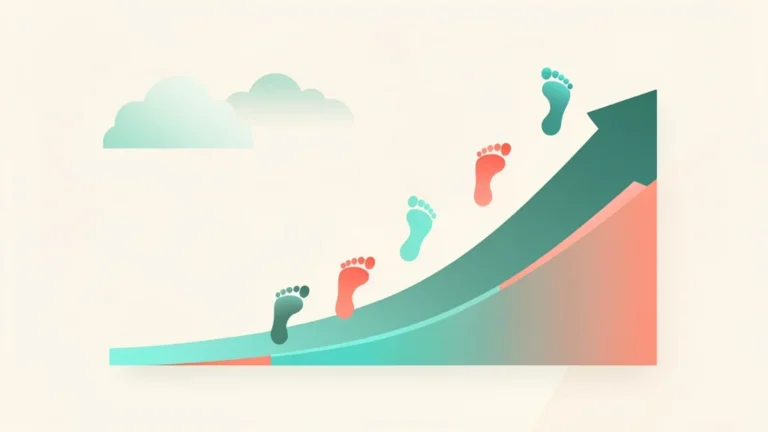
There is no magic in 10,000 steps a day. The best evidence shows that health benefits climb steadily as you move more and then flatten out, with most of the payoff arriving well before you hit five figures. For older adults the curve tends to level off around 6,000 to 8,000 steps a day, and for younger adults around 8,000 to 10,000. In other words, a realistic daily target for most people sits below the famous round number, and any steady increase over your current baseline is worth chasing.
The 10,000-step goal came from a 1960s pedometer name, not from research. Large studies show that the risk of dying early falls as daily steps rise and then plateaus: roughly 6,000 to 8,000 steps a day for adults over 60, and roughly 8,000 to 10,000 for younger adults. Benefits start well below 10,000, so if you currently walk 3,000 a day, getting to 6,000 matters more than reaching a perfect number. Treat these as general ranges, not medical prescriptions, and build up gradually. Consistency and a bit of brisk pace count more than a single daily total.
Where 10,000 Steps Came From (Marketing, Not Science)
The 10,000-step goal has a surprisingly specific origin, and it is not a laboratory. In the mid-1960s, around the 1964 Tokyo Olympics, a Japanese company began selling a pedometer called the manpo-kei, which translates roughly to “10,000-step meter.” The name was memorable, the round number was easy to sell, and the target stuck. It spread through fitness culture for decades before researchers had large datasets to test whether that figure meant anything.
None of this makes 10,000 steps a bad goal. It is a reasonable, active target for many people. The point is that it was never derived from health outcomes. It began as a product name, and only much later did scientists measure what different step counts actually do for the body. When they did, the tidy round number turned out to be higher than most people need to capture the bulk of the benefit.
What the Research Actually Shows
The clearest picture comes from a 2022 meta-analysis published in The Lancet Public Health, led by Amanda Paluch, which pooled data from tens of thousands of adults across multiple studies. The headline finding is consistent and encouraging: as daily step counts rise, the risk of dying from any cause falls. Movement helps, and more of it generally helps more, at least up to a point.
That point is the important part. The benefit does not keep climbing forever. It rises steeply at first and then flattens into a plateau. For adults aged 60 and older, the risk reduction largely leveled off somewhere around 6,000 to 8,000 steps a day. For younger adults, the plateau arrived a bit higher, around 8,000 to 10,000. Beyond those ranges, additional steps were not linked to meaningfully lower mortality risk in the pooled data.
Two practical lessons follow. First, benefits begin far below 10,000: going from very low activity to a moderate amount produces the biggest relative gains. Second, the person with the most to gain is the one starting lowest. If you average 3,000 steps a day, adding a couple of thousand likely matters more for your health than a habitual 9,000-stepper squeezing out another 1,000.
How Many Steps by Goal and Age
Because the plateau shifts with age and because people walk for different reasons, a single number does not fit everyone. The table below turns the evidence into practical ranges. Read them as sensible targets to aim toward, not as thresholds you must hit every single day.
| Goal or Age Band | Approx Daily Steps | Why This Range |
|---|---|---|
| Adults 60+ (general health) | 6,000 – 8,000 | Mortality benefit largely plateaus here in older adults |
| Adults under 60 (general health) | 8,000 – 10,000 | Plateau arrives a bit higher for younger adults |
| Getting started from low activity | Current + 2,000 | Biggest relative gains come from leaving the lowest counts |
| Weight management support | 8,000 – 12,000 | More movement adds to daily energy use, alongside diet |
| High activity or training | 10,000 – 12,000+ | Reasonable for active people; extra steps add little mortality benefit |
Notice that even the highest rows do not treat 12,000 as clearly better than 10,000 for longevity. Past the plateau, extra steps are fine and often enjoyable, but they buy little additional protection. If your aim is weight management, steps help mainly by nudging up your daily energy expenditure; how that fits your calorie needs is where a BMR calculator gives you a personal baseline to plan around.
Steps vs the Official Activity Guidelines
Public health bodies do not actually set their recommendations in steps. The World Health Organization and the U.S. Physical Activity Guidelines both frame the target in time and intensity: at least 150 to 300 minutes of moderate-intensity aerobic activity per week, or 75 to 150 minutes of vigorous activity, plus muscle-strengthening work on two or more days.
Steps are a convenient stand-in because most people carry a phone or wear a tracker that counts them automatically. As a rough bridge, brisk walking tends to land around 100 steps per minute. So 150 minutes of it across a week is on the order of 15,000 purposeful steps, on top of the incidental steps you take just living your day. That is one reason total daily counts in the 7,000 to 8,000 range often line up with meeting the guidelines, provided a meaningful share of those steps are brisk rather than a slow shuffle.
Steps and the official guidelines are two ways of describing one idea: move regularly, and let some of that movement raise your breathing and heart rate. To understand the intensity side more precisely, see our explainer on heart rate zones.
Steps, Distance, and Calories – Rough Conversions
People often want to translate steps into distance and calories, so here are honest approximations. A common rule of thumb is that about 2,000 steps equals roughly 1 mile, though this varies with height and stride: taller people cover more ground per step, shorter people fewer. At that rate, 8,000 steps is in the neighborhood of 4 miles of walking spread across a day.
Calories are messier. The energy you burn depends on your body weight, pace, and terrain, so any “calories per step” figure is a loose estimate. A frequently cited ballpark is around 40 to 50 calories per 1,000 steps for an average adult at an easy pace, putting 8,000 steps near 320 to 400 calories. Treat that as a rough order of magnitude, not a precise readout.
The more useful insight is that intensity matters more than the raw count. Ten thousand slow, ambling steps do less for cardiovascular fitness than a shorter block of brisk walking that raises your heart rate. If your goal is fitness rather than movement volume, pace deserves as much attention as the number on your tracker. For a deeper look at aerobic capacity, our guide to VO2 max covers that ground.
How to Add Steps Without Overhauling Your Life
You do not need a treadmill or a new routine to add a couple of thousand steps. The trick is to attach walking to things you already do, so it costs almost no extra willpower.
A few reliable tactics: take a short walk after each meal, which also helps with digestion; park farther away or get off transit a stop early; take stairs on short climbs; and turn one phone call a day into a walking call. Ten minutes of brisk walking is roughly 1,000 steps, so three short walks can quietly move you from sedentary to a solid daily total.
Build up gradually rather than doubling your count overnight. Check your current weekly average, then add about 1,000 to 2,000 steps a day and hold that for a couple of weeks before nudging it up again. That progression protects your joints and keeps the habit sustainable. Consistency across the week beats one heroic 15,000-step day followed by three days on the couch.
Curious how your daily movement fits your overall energy needs? Start with your resting baseline using our BMR Calculator, then layer your step habit on top to see the bigger picture of how much you burn in a day.
Frequently Asked Questions About Daily Steps
Do I Really Need 10,000 Steps a Day?
No. The 10,000 figure came from a 1960s pedometer name, not from research. Studies show most of the health benefit arrives earlier, with the mortality-risk curve flattening around 6,000 to 8,000 steps for older adults and 8,000 to 10,000 for younger adults. Ten thousand is a fine goal if you enjoy it, but it is not a required threshold.
How Many Steps a Day Is Healthy for Most Adults?
A practical general-health range is roughly 7,000 to 8,000 steps a day for many adults, shifting a bit lower for those over 60 and a bit higher for younger, more active people. The single most valuable move is leaving the lowest counts behind, so getting from very low activity up to a moderate amount matters most.
Is 6,000 Steps a Day Enough?
For older adults, yes, 6,000 steps a day sits within the range where the mortality benefit largely plateaus. For younger adults, 6,000 is a solid baseline that still delivers real benefit, though the evidence suggests the plateau arrives a little higher. Either way, 6,000 consistent daily steps is far better than a sedentary routine.
How Many Steps Are in a Mile?
About 2,000 steps equals roughly 1 mile for an average adult, but it varies with height and stride length. Taller people take fewer steps per mile and shorter people take more. If you want a personal figure, count your steps over a measured distance and divide, rather than relying on the generic average.
Do Steps Count Toward the 150-Minutes-a-Week Guideline?
Yes, when they are brisk enough to count as moderate-intensity activity. The official guidelines are written in minutes, but brisk walking at roughly 100 steps per minute qualifies. Around 150 minutes of that pace across a week adds up to a large share of a healthy daily step total, on top of your incidental movement.
Does Walking Pace Matter or Just Total Steps?
Pace matters. Raw step count reflects movement volume, but intensity drives much of the cardiovascular and fitness benefit. A shorter block of brisk walking that raises your heart rate does more for fitness than the same number of slow, ambling steps. Aim to make at least some of your daily steps genuinely brisk.
How Fast Should I Increase My Daily Steps?
Gradually. Check your current weekly average, then add about 1,000 to 2,000 steps a day and hold it for a couple of weeks before increasing again. This protects your joints and keeps the habit sustainable. If you have a heart, joint, or other health condition, check with a healthcare provider before ramping up activity.
Sources
Authoritative Sources Used in This Article
- Paluch et al. (2022), The Lancet Public Health: Daily steps and all-cause mortality meta-analysis
- PubMed: Steps per day and mortality in adults (cohort evidence)
- World Health Organization: Physical Activity fact sheet
- U.S. Physical Activity Guidelines for Americans, 2nd edition
- MedlinePlus (NIH): Exercise and Physical Fitness
This article is for general educational purposes only and is not medical or health advice. The step ranges here are general guides drawn from population research, not personalized prescriptions, and individual needs vary. If you have a heart condition, joint problems, or any other health concern, or if you are inactive and planning a significant increase in activity, talk with a healthcare provider before starting. Content reviewed for accuracy by Dr. Abdullah Khalil, MBBS. Last updated September 11, 2026.
Author

Shakeel Muzaffar is the Founder and Editor-in-Chief of MultiCalculators.com, bringing over 15 years of experience in digital publishing, product strategy, and online tool development. He leads the platform's editorial vision, ensuring every calculator meets strict standards for accuracy, usability, and real-world value. Shakeel personally oversees content quality, formula verification workflows, and the platform's commitment to publishing tools that are genuinely useful for students, professionals, and everyday users worldwide.