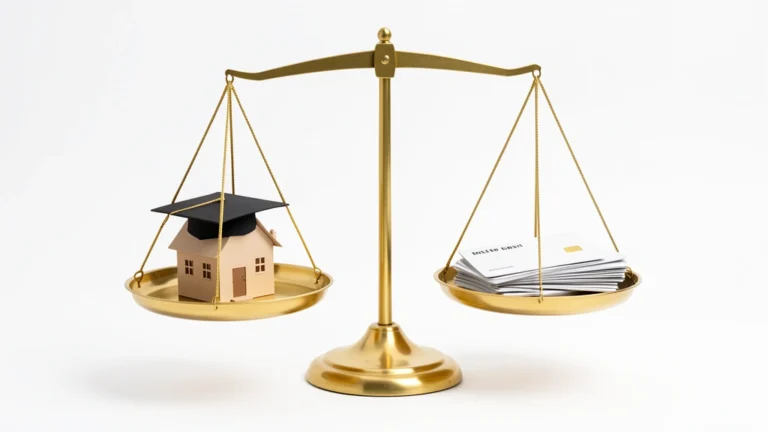
Good debt is low-cost borrowing that builds long-term value or income, like a mortgage, a student loan for a strong career, or sometimes a business loan. Bad debt is high-interest borrowing for things that lose value or get consumed, like credit-card balances, an auto loan stretched too long, or a payday loan. The APR you pay and what the money buys are what decide which side any debt lands on.
- Good debt carries a low APR and finances something that grows in value or raises your income over time.
- Bad debt carries a high APR and pays for things that lose value, wear out, or get used up quickly.
- The same loan can be good or bad depending on its rate, its term, and whether you can afford the payment.
- Not all debt is bad, but any debt turns costly when the interest outruns the value you get from it.
- Watching your overall debt load, not just one loan, is what keeps good debt from quietly becoming a burden.
Good Debt vs Bad Debt: How to Tell the Difference
The short answer is that good debt is cheap money that buys something lasting, and bad debt is expensive money that buys something fleeting. A mortgage at a single-digit rate helps you own an asset that tends to hold or grow its value. A credit-card balance at a rate several times higher pays for purchases that are often long gone by the time the bill arrives. Same word, debt, but very different outcomes.
Two things sort one from the other. The first is the annual percentage rate, or APR, which is the yearly price of the money you borrow. The second is what the money actually buys. When both point the right way, a low rate paired with something that builds value or income, the debt is working for you. When they point the wrong way, a high rate paired with something that fades, the debt is working against you.
It helps to think of debt on a spectrum rather than in two boxes. Some borrowing sits clearly on the good side, some clearly on the bad, and plenty falls in a gray middle where the details decide. The rest of this guide shows how to place any debt on that spectrum and what to do when yours drifts toward the costly end.
The Two Questions That Decide: APR and What You Buy
You can classify almost any loan by asking two plain questions. Answer them honestly and the label usually becomes obvious.
Question one: what is the APR? A low rate means the money is cheap to carry, so even a large balance grows slowly. A high rate means the balance can snowball, since interest piles onto interest faster than most people expect. The CFPB describes a credit card’s interest rate simply as the price you pay for borrowing money, and that price is the clearest signal of how heavy a debt will feel.
Question two: what does the money buy? An asset that appreciates, like a home, or an investment that raises your earning power, like an education or a productive business, can pay back more than it costs. A depreciating item, like a car, or a consumable, like a restaurant meal charged to a card, gives nothing back once the money is spent. If the thing you bought is worth less than the debt against it, that is a warning sign.
Put the two answers together. Low rate plus lasting value is the recipe for good debt. High rate plus fading value is the recipe for bad debt. Everything else is a judgment call, and that is where most real borrowing lives.
How Common Debts Stack Up
The table below places six familiar debts on the good-to-bad spectrum, with a typical APR range and the reason each lands where it does. Rates are broad illustrations, not quotes, and your own rate depends on your credit, the lender, and the day you borrow.
| Debt Type | Typical APR Range | Generally | Why |
|---|---|---|---|
| Mortgage | 6 to 8 percent | Good | Low rate, secured by a home that tends to hold or grow value. |
| Student loan | 5 to 9 percent | Good to mixed | Can raise lifetime income, but only if the degree and the balance are affordable. |
| Personal loan | 8 to 20 percent | Mixed | Depends entirely on the rate and whether it funds value or just spending. |
| Auto loan | 7 to 15 percent | Mixed to bad | Buys a depreciating asset; a long term can leave you owing more than the car is worth. |
| Credit-card balance | 20 to 30 percent | Bad | High rate on purchases that are usually consumed long before they are paid off. |
| Payday loan | Often near 400 percent | Bad | Extreme short-term cost that can trap borrowers in a cycle of rollovers. |
Notice how the APR climbs as you move down the table and how the good label falls away with it. The chart below shows those same rates side by side, which makes the gap between a mortgage and a payday loan hard to miss.
Good Debt: Borrowing That Builds
Good debt earns its name by leaving you better off than before you borrowed. A mortgage is the classic example. You pay a modest rate to own a place to live, and over the years the home often gains value while your balance falls. A student loan can work the same way when the degree lifts your earning power by more than the loan costs to repay. A business loan that funds equipment or inventory that generates profit belongs here too.
The common thread is that the money creates something durable, an asset, a skill, or a stream of income, that outlasts the debt and helps repay it. Good debt is not free, and it is not risk-free. It is simply borrowing where the math has a realistic chance of coming out ahead. Keep the rate low, keep the payment affordable, and keep the purpose productive, and a debt tends to stay on the good side.
Bad Debt: Borrowing That Costs
Bad debt leaves you worse off. The clearest case is a revolving credit-card balance carried month to month at a rate that often runs from the low twenties into the thirties. Because you can avoid card interest entirely by paying the balance in full each month, a balance that lingers is a choice to rent money at a steep price for things you have usually already used.
Payday loans sit at the extreme end. A typical two-week payday loan with a fifteen-dollar fee per hundred borrowed works out to an APR of almost 400 percent, and rollovers stack fee upon fee. The FTC warns that these loans can trap borrowers in a cycle that is hard to escape. An auto loan is milder but still risky when it is stretched over a long term, because the car loses value faster than the balance falls and you can end up owing more than the vehicle is worth. If a card balance is what is weighing on you, the Credit Card Payoff Date Calculator shows how quickly a steady monthly payment can clear it.
The Gray Area: When Good Debt Turns Bad
Most real borrowing is not purely good or bad, and the same loan can shift sides. A student loan that funds a degree with strong job prospects is good debt; the same balance for a credential that does not raise income can become a burden. A personal loan at a fair rate that consolidates costlier debt can help, while the same loan spent on a vacation only moves cost around. Even a mortgage turns dangerous when the payment strains a household that is already stretched.
Three signals tell you a debt is drifting toward the bad end. The rate is high relative to what the money buys. The term is so long that you are still paying after the value is gone. Or the payment crowds out your other obligations. When you spot these, the fix is usually to lower the rate, shorten the term, or reduce the balance, in whatever order your budget allows.
How to Keep Debt on the Good Side
Sorting a single loan is useful, but lenders and your own budget care about your total picture. The most common yardstick is the debt-to-income ratio, which compares your monthly debt payments to your gross monthly income. A low ratio signals that even good debt is not crowding your finances, while a high one warns that the load is heavy no matter how each loan is labeled. You can measure yours with the Debt-to-Income Ratio Calculator to see where you stand overall.
If that number is higher than you would like, two sibling guides walk through the next steps. One covers practical ways to improve your debt-to-income ratio by trimming payments or lifting income. The other weighs whether rolling several balances into one is right for you in is debt consolidation a good idea. Both start from the same principle you have seen here: keep the rate low, the term sensible, and the payment comfortable, and debt stays a tool rather than a trap.
FAQs About Good and Bad Debt
What Is the Difference Between Good Debt and Bad Debt?
Good debt is low-cost borrowing that builds long-term value or income, like a mortgage or a well-chosen student loan. Bad debt is high-rate borrowing for things that lose value or get consumed, like credit-card balances or payday loans.
Is All Debt Bad?
No. Debt is a tool, and borrowing at a low APR to buy something that grows in value or raises your income can leave you better off. Debt becomes bad mainly when the interest outweighs the value you get from it.
Why Is a Mortgage Usually Considered Good Debt?
A mortgage carries a relatively low rate and is secured by a home that tends to hold or grow its value. Over time you build equity while the balance falls, so the borrowing helps you own a lasting asset.
Why Are Credit Cards and Payday Loans Usually Bad Debt?
Both charge high APRs on money that typically buys things already used up. Card balances often run above 20 percent, and a two-week payday loan can reach an APR near 400 percent, so the cost can quickly outrun any benefit.
Can Good Debt Turn Into Bad Debt?
Yes. A student loan for a degree that does not raise income, or a mortgage with a payment you cannot afford, can behave like bad debt. Rate, term, and affordability decide the outcome as much as the loan type.
Is a Car Loan Good or Bad Debt?
It sits in the middle and leans toward bad when stretched over a long term. A car loses value while you pay, so a long loan can leave you owing more than the vehicle is worth. A shorter term at a fair rate is safer.
How Do I Know If My Debt Is a Problem?
Check your debt-to-income ratio, which compares monthly debt payments to gross monthly income. A high ratio, high-rate balances, or payments that crowd out other bills all signal that your debt has drifted toward the costly side.
Sources
Authoritative Sources Used in This Article
- Consumer Financial Protection Bureau, What is a credit card interest rate and what does APR mean: consumerfinance.gov
- Consumer Financial Protection Bureau, What is a payday loan: consumerfinance.gov
- Consumer Financial Protection Bureau, What is a credit score: consumerfinance.gov
- Federal Trade Commission, What To Know About Payday and Car Title Loans: consumer.ftc.gov
Educational note: This article is general information, not financial, tax, or legal advice. Interest rates, loan terms, and what counts as an affordable payment vary by lender and by your situation. Confirm the exact APR and terms on your written loan documents and speak with a licensed professional before you borrow. Reviewed for accuracy by Prof. Dr. Khalil Mudassar, PhD, as part of our editorial review process. Content last reviewed September 9, 2026.
Author

Shakeel Muzaffar is the Founder and Editor-in-Chief of MultiCalculators.com, bringing over 15 years of experience in digital publishing, product strategy, and online tool development. He leads the platform's editorial vision, ensuring every calculator meets strict standards for accuracy, usability, and real-world value. Shakeel personally oversees content quality, formula verification workflows, and the platform's commitment to publishing tools that are genuinely useful for students, professionals, and everyday users worldwide.