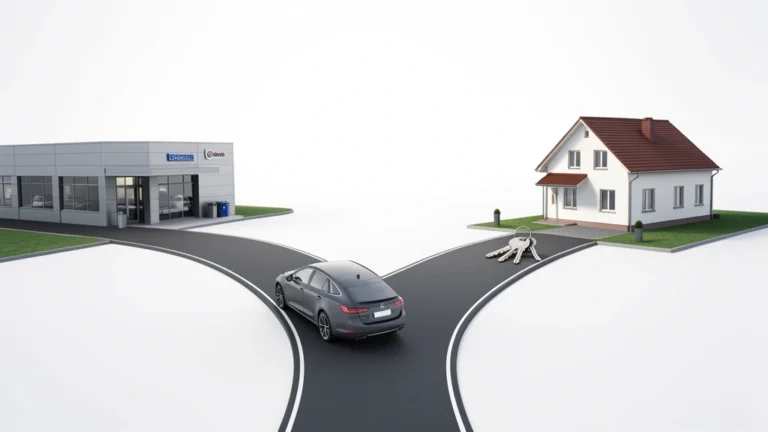
Should you lease or buy a car? Buying is usually cheaper over the long run because your payments end and you keep an asset you own, while leasing gives you lower monthly payments and a newer car more often but leaves you with no equity when the term ends. The right answer depends on whether you value the lowest lifetime cost or the lowest monthly cost.
Buy if you plan to keep a car for many years, drive a lot of miles, and want payments to stop once the loan is paid off; over time you spend less and own something you can sell or drive for free. Lease if you want lower monthly payments, a car under warranty, and a new model every two or three years, and you drive within a set mileage limit. Buying builds equity; leasing does not.
The Core Difference in Plain Terms
When you weigh leasing vs buying, the key is to see what you actually pay for. Both paths hand you the same car but treat ownership in opposite ways.
When you buy a car, usually with an auto loan, you are paying for the entire vehicle. Each payment covers interest plus a slice of the full price, so every month you own a bigger share of the car. Once the loan is paid off, the payments stop and the car is yours, free to drive or sell.
When you lease a car, you pay only for the portion of the vehicle you use during the term, mainly its depreciation plus rent charges and fees. You never pay for the whole car, which is why the monthly payment is lower. At the end of the lease you return the vehicle and walk away with nothing to show for the payments, unless you buy it at a preset price. In short, a car lease or purchase is a choice between renting value and owning value.
Before you compare offers, it helps to see the real monthly number for either path. Our Auto Loan and Car Payment Calculator estimates a loan payment from the price, rate, and term so you can line it up against a lease quote.
Lease vs Buy a Car: The Side-by-Side Comparison
The table below sets the two options side by side on the factors that most often decide the question. Read it top to bottom, because the trade-off is rarely about a single row.
| Factor | Leasing | Buying |
|---|---|---|
| Monthly payment | Lower for the same car, since you pay only for depreciation and fees | Higher while the loan runs, then falls to zero once it is paid off |
| Ownership and equity | None; you return the car and build no equity | Full; you own an asset you can keep or sell |
| Mileage limits | Capped, often 10,000 to 15,000 miles a year, with per-mile fees over the cap | Unlimited; drive as much as you want |
| Customization | Restricted; the car must be returned in near-original condition | Full freedom to modify, wrap, or upgrade |
| Long-term cost | Higher if you lease continuously, because payments never end | Lower over many years once payments stop |
| Wear and tear | Charged for damage beyond normal wear at return | Your problem, but never a surprise penalty fee |
| Best fit | Lower payments, a newer car often, predictable, moderate mileage | Lowest lifetime cost, high mileage, long ownership |
Neither column is simply better. Leasing trades long-term value for a lower payment and a newer car; buying trades a higher payment now for ownership and a cheaper cost later. Your driving habits and how long you keep a car decide which trade-off wins.
Why Buying Usually Wins on Long-Term Cost
The strongest case for buying is simple arithmetic across time. A loan has an end date. Once you make the final payment, the car keeps running with only fuel, insurance, and maintenance to pay. Keep it another five or six years and those are years of driving with no finance cost at all.
Leasing has no such finish line. Because each lease covers only a few years of a car’s life, a driver who leases continuously signs a new contract when the old one ends and starts paying again. Over a long horizon that means paying forever for the newest slice of a car you never keep. The lower monthly number feels easier, but the meter never stops.
Ownership also gives you an asset. A paid-off car has resale or trade-in value, and even an older vehicle can be sold for cash. A returned lease gives you none of that. The Federal Trade Commission advises focusing on the total cost of any car deal rather than the monthly payment alone, and that cuts to the heart of the lease question: a low payment is not the same as a low cost.
Mileage, Wear, and Customization
Beyond the money, a lease comes with rules that a purchase does not, and these limits are where many drivers get an unwelcome surprise.
The biggest is the mileage cap. A typical lease allows about 10,000 to 15,000 miles a year, and every mile beyond that is billed at a set per-mile rate when you return the car. A long commute or frequent road trips can turn a cheap lease into an expensive one. When you buy, mileage is your business alone; high miles lower resale value, but you are never handed a bill for driving your own car.
Wear and tear works the same way. At lease end the vehicle is inspected, and damage beyond normal wear, such as dents, stained seats, or bald tires, can trigger charges. A car you own can be scuffed, loaded with gear, or driven hard without a return penalty. Customization is also limited on a lease, since the car must go back close to original condition, while owners are free to add roof racks, tint, or a new stereo.
None of this makes leasing bad. If you drive moderate miles and keep a car clean, the caps may never bite. The point is to match the contract to how you actually drive.
Which Should You Choose? A Quick Decision Guide
Match your situation to the scenario that fits best. Most drivers land clearly in one column once they frame their habits honestly.
You Keep Cars a Long Time and Drive a Lot
If you hold a vehicle well past the loan payoff and rack up serious miles, buy. You get years of payment-free driving, no mileage penalties, and an asset with resale value. This is the lowest lifetime cost path by a wide margin.
You Want the Lowest Monthly Payment and a Newer Car
If a lower monthly payment matters most and you like a car that is always under warranty and only a few years old, leasing fits. You accept the mileage cap and the lack of equity for a smaller payment and a fresh model every term.
You Value Certainty and Simplicity
If you dislike surprise repair bills, a lease keeps you in warranty coverage and swaps the car before major maintenance hits. Buyers can get the same peace of mind by budgeting for repairs and using our true cost of car ownership breakdown to plan ahead.
You Want Freedom and Ownership
If you want to modify your car, drive unlimited miles, and eventually own it outright, buying is the clear choice. The higher early payment buys full control and an end to payments that leasing can never offer.
Ready to compare the real numbers? Estimate a purchase payment from any price, rate, and term with our Auto Loan and Car Payment Calculator, then keep a cushion for repairs or a lease return either way with the Emergency Fund Calculator.
FAQs About Leasing vs Buying a Car
Is It Cheaper to Lease or Buy a Car?
Leasing is usually cheaper month to month, but buying is cheaper over the long run. A lease has a lower payment because you pay only for depreciation, yet the payments never end if you keep leasing. When you buy, the loan ends and you drive for free, so total cost over many years is lower.
Why Are Lease Payments Lower Than Loan Payments?
A lease payment covers only the value the car loses during the term, plus rent charges and fees, not the full price of the vehicle. A loan payment covers the entire purchase price plus interest. Because you finance far less of the car with a lease, the monthly payment is smaller for the same model.
Do You Build Any Equity When You Lease?
No. Leasing builds no equity, because you never own the car and return it at the end of the term. Buying builds equity with every payment until you own the vehicle outright, giving you an asset you can sell, trade in, or keep driving with no further payments.
What Happens If I Go Over the Mileage Limit on a Lease?
You pay a per-mile charge for every mile above the cap when you return the car, set in your contract and often a few cents to more than twenty cents per mile. Heavy drivers can owe hundreds or thousands of dollars, which is a key reason high-mileage drivers usually do better buying.
Can I Buy the Car at the End of a Lease?
Usually yes. Most leases include a buyout option at a price, called the residual value, set when you signed. If the car is worth more than that price, buying it can be a good deal. If it is worth less, you can simply return it and walk away instead.
Is Leasing a Good Idea for a Business?
It can be, because businesses may deduct lease costs and value predictable payments and frequent upgrades. The right answer still depends on mileage, how long the vehicle is kept, and the tax situation. Confirm the specifics with a qualified accountant before deciding, since business rules differ from personal ones.
Should You Lease or Buy a Car If You Drive a Lot?
If you drive a lot, buying is almost always the better choice. Leases charge for every mile over the cap, so high mileage makes a lease expensive fast. Owning a car sets no mileage penalty, and keeping it past the loan payoff spreads the cost of those miles over many payment-free years.
Sources
Authoritative Sources Used in This Article
This article is for general educational purposes only and is not financial, tax, or legal advice. A car is a large purchase, so confirm rates, fees, mileage terms, and lease conditions with a licensed dealer or lender before signing. Content reviewed for accuracy by Prof. Dr. Khalil Mudassar, PhD. Last updated September 9, 2026.
Author

Shakeel Muzaffar is the Founder and Editor-in-Chief of MultiCalculators.com, bringing over 15 years of experience in digital publishing, product strategy, and online tool development. He leads the platform's editorial vision, ensuring every calculator meets strict standards for accuracy, usability, and real-world value. Shakeel personally oversees content quality, formula verification workflows, and the platform's commitment to publishing tools that are genuinely useful for students, professionals, and everyday users worldwide.