Deck Building Cost Calculator: Estimate Your Deck Cost
Estimate the full cost to build a wood, composite, or PVC deck in the United States. Enter your size, material, height, and features to see a total price range, a line-by-line breakdown, and what you would save doing it yourself.
Quick Answer
Building a deck in the United States typically costs $30 to $60 per square foot installed. Most projects total $4,300 to $12,650. A 16-by-20-foot deck averages about $18,000 in wood and about $25,000 in composite. Size, material, height, and local labor drive most of the price. Use the calculator below for a custom estimate.
Estimate Your Deck Cost
Your estimate
Enter your size
| Line | Low | Typical | High |
|---|---|---|---|
| Materials | |||
| Labor | |||
| Features | |||
| Permit | |||
| Demolition | |||
| Total |
How to read this estimate
This private insight uses fixed rules on this page. It does not call an AI service, predict outcomes, or replace professional advice.
In this guide
How the Deck Cost Formula Works
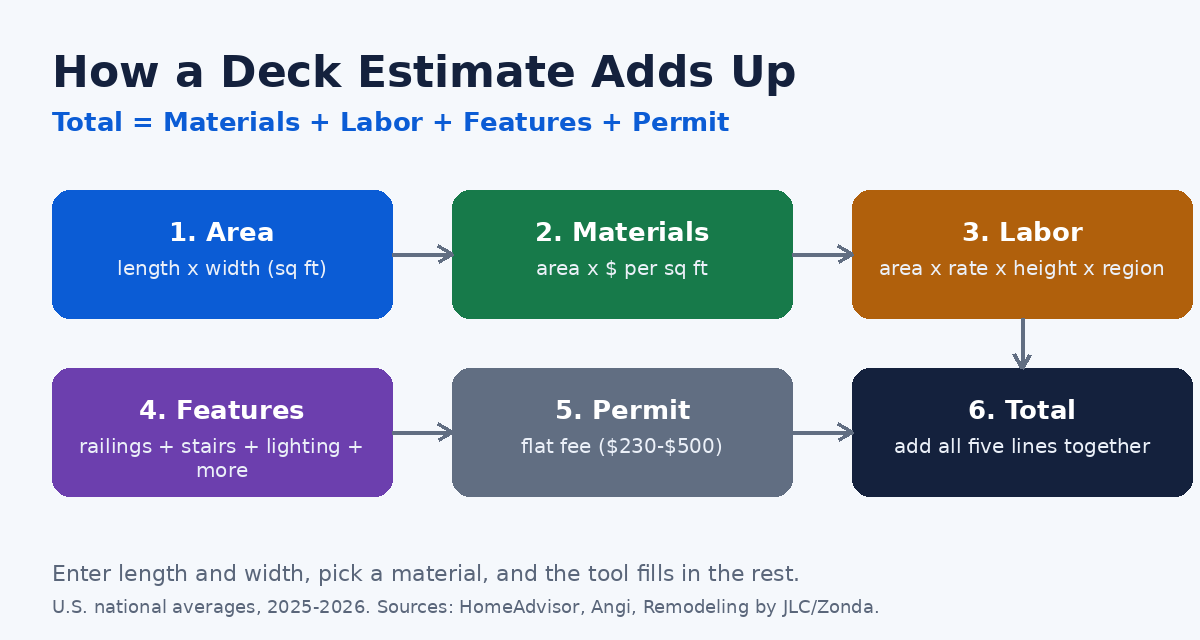
This calculator adds five lines to reach your total: materials, labor, features, permit, and demolition. The formula is the same one contractors use for a rough bid.
The formula in plain words
Total cost = materials + labor + features + permit + demolition. Area is length times width. Materials equal area times a per-square-foot price for your material. Labor equals area times a labor rate, adjusted for deck height and your region. Features are flat add-ons like railings and stairs.
What changes the price
- Size. More square feet means more boards, framing, and labor.
- Material. Pressure-treated pine is cheapest. Premium composite, PVC, and tropical hardwood cost the most.
- Height. Second-story decks need bigger beams, more footings, and more labor. Ground-level decks need the least.
- Features. Railings, stairs, lighting, pergolas, and seating each add a fixed cost.
- Region. Labor in coastal and metro areas can run 10% to 25% above the national average.
Deck Cost by Material
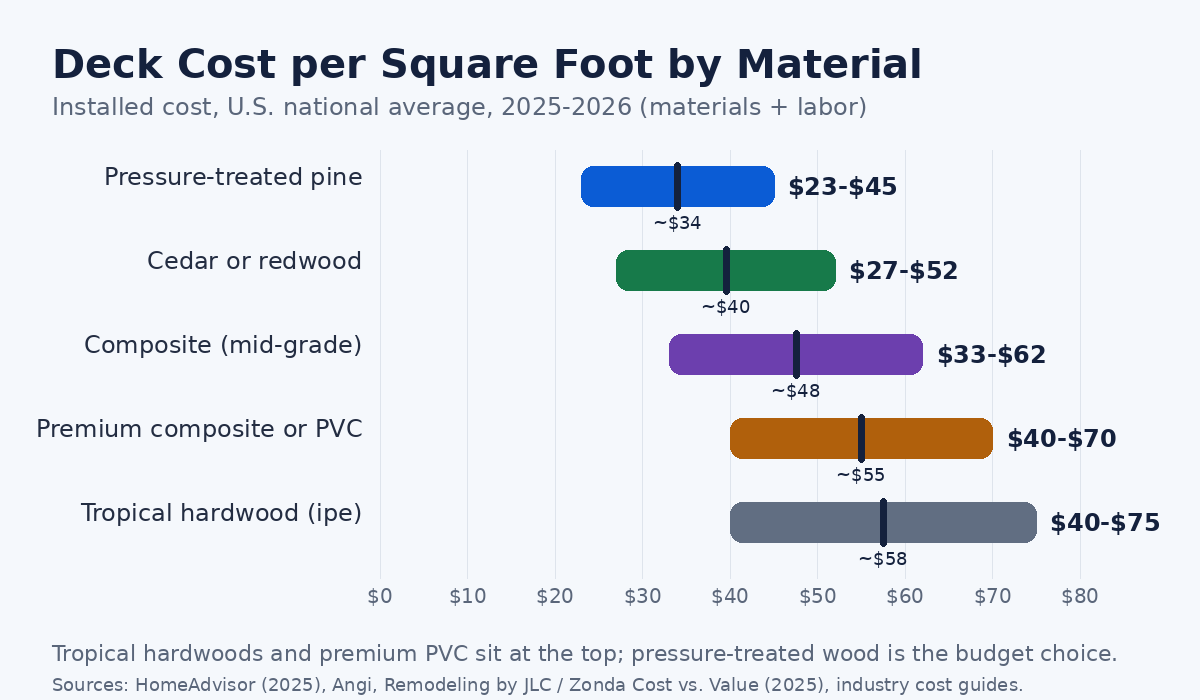
Installed prices below combine materials and labor and reflect U.S. national averages for 2025 to 2026. Mid-grade composite lands in the middle; premium PVC and tropical hardwood sit at the top.[1][2]
| Material | Materials per sq ft | Labor per sq ft | Installed per sq ft | Typical lifespan |
|---|---|---|---|---|
| Pressure-treated pine | $8-$15 | $15-$30 | $23-$45 | 10-15 years |
| Cedar or redwood | $12-$22 | $15-$30 | $27-$52 | 15-25 years |
| Composite (mid-grade) | $18-$32 | $15-$30 | $33-$62 | 25-30 years |
| Premium composite or PVC | $25-$40 | $15-$30 | $40-$70 | 30-50 years |
| Tropical hardwood (ipe) | $25-$45 | $15-$30 | $40-$75 | 25-40 years |
Deck Cost by Size
The table shows the deck platform only, installed by a pro, at national-average rates, with no railings, stairs, or permit yet. Add those separately in the calculator.[1]
| Size | Area | Pressure-treated wood | Mid-grade composite |
|---|---|---|---|
| 10 x 10 | 100 sq ft | $2,300-$4,500 | $3,300-$6,200 |
| 12 x 12 | 144 sq ft | $3,300-$6,500 | $4,800-$8,900 |
| 12 x 16 | 192 sq ft | $4,400-$8,600 | $6,300-$11,900 |
| 16 x 20 | 320 sq ft | $7,400-$14,400 | $10,600-$19,800 |
| 20 x 20 | 400 sq ft | $9,200-$18,000 | $13,200-$24,800 |
Three Real Deck Examples
These use the same rates as the calculator. They are planning examples, not quotes.
Budget starter deck
A 10-by-10-foot ground-level deck in pressure-treated pine, built by a pro, with no railings or permit. Materials run $800 to $1,500 and labor $1,200 to $2,400. Total: $2,000 to $3,900 (about $2,700), or about $27 per square foot.
Family composite deck
A 16-by-12-foot elevated deck in mid-grade composite with railings and one set of stairs, at national-average labor, with a permit. Total: $7,900 to $18,500 (about $11,700), or about $61 per square foot.
Premium entertainment deck
A 20-by-20-foot second-story deck in premium PVC with railings, stairs, lighting, and a pergola, in a high-cost metro region. Total: $24,000 to $52,400 (about $33,400), or about $83 per square foot.
What Your Estimate Means
The typical number is your best planning figure. The low and high numbers show how cheap or expensive the same deck could get with different material grades and labor bids. Use the typical figure to set a budget, then add 10% to 15% as a cushion for surprises.
Decks hold value well. The 2025 Remodeling Cost vs. Value report says a wood deck addition recoups about 94.9% of its cost at resale and a composite deck about 88.5%.[2] That makes a deck one of the stronger outdoor return-on-investment projects.
If a contractor quote lands far outside your range, ask why. Common reasons include a second-story build, hard site access, premium fasteners, or an older deck underneath that must be removed first.
Limitations and Who Should Not Use This
- This is a planning estimate, not a bid, quote, or structural plan. Final quotes often differ by 20% or more.
- It is for simple residential decks. It does not cover multi-level decks, roof decks, commercial work, or decks on steep slopes that need engineered retaining.
- It does not include HOA fees, landscaping, electrical work, foundation repair, financing costs, or price changes after you receive a quote.
- It does not assess an existing deck's safety. If a current deck is damaged, rotted, or sagging, have a pro inspect it before building on or near it.
- Region and height adjustments are approximations. Local codes and labor rates vary.
See the Sources and Methodology section for how every number was chosen.
How This Calculator Fits Your Other Tools
Each tool below answers a different question, so they do not overlap. Use the right one for the job:
- This page: the total cost to build an outdoor deck, in U.S. dollars.
- Flooring Installation Cost Calculator: the cost to install indoor flooring like hardwood, laminate, or tile.
- Asphalt Driveway Cost Calculator: the cost to pave or resurface a driveway.
- Tile Flooring Calculator: how many tiles you need and what they will cost.
- Paint Coverage Calculator: how much paint a wall or room needs.
Browse the full home cost calculators hub for more project estimators.
Frequently Asked Questions
How much does it cost to build a deck in 2026?
In the United States, a professionally built deck usually costs $30 to $60 per square foot, with most projects between $4,300 and $12,650. A 16-by-20-foot deck averages about $18,000 in wood and about $25,000 in composite, per the 2025 Remodeling Cost vs. Value report.[1][2]
How much is a 12-by-16 or 16-by-20 deck?
A 12-by-16 deck (192 sq ft) runs roughly $4,400 to $8,600 in pressure-treated wood and $6,300 to $11,900 in mid-grade composite for the platform. A 16-by-20 deck (320 sq ft) runs about $7,400 to $14,400 in wood and $10,600 to $19,800 in composite, before railings, stairs, and permits.
Is composite cheaper than wood over time?
Upfront, wood is cheaper. Over 20 years, composite often narrows the gap because it needs no sanding or restaining. At resale, a wood deck recoups about 94.9% of cost and composite about 88.5%, per the 2025 Cost vs. Value report.[2]
Can I build a deck myself to save money?
Yes. Doing it yourself removes the labor line, which is usually 40% to 50% of the total. Materials alone run about $8 to $45 per square foot. DIY still requires permits and code-compliant footings and framing. For elevated decks, hire a pro or have an engineer check your plan.[1][3]
Do I need a permit to build a deck?
Most cities require a permit for attached or elevated decks. Fees typically run $230 to $500. Ground-level decks under 30 inches sometimes do not need one, but always confirm with your local building department first.[1]
What makes a deck cost more?
Five things raise the price most: size, material (composite and PVC cost more than pressure-treated wood), height (second-story decks need more structure), features (railings, stairs, lighting, pergolas), and region (coastal and metro labor costs more). Removing an old deck adds $5 to $12 per square foot.[1][4]
Sources and Methodology
Methodology
This tool multiplies deck area by per-square-foot material and labor rates, applies a height multiplier (0.8x ground-level to 1.3x second-story) and a region multiplier (0.9x to 1.25x) to labor, then adds flat feature costs and a permit. Rates are U.S. national averages for 2025 to 2026 drawn from the sources below. Everything runs in your browser; nothing you type is sent to a server or stored.
Sources
- HomeAdvisor. "How Much Does It Cost to Build a Deck?" 2025. homeadvisor.com (installed cost per square foot, total range, permits, stairs, deck types).
- Remodeling by JLC / Zonda. "2025 Cost vs. Value Report." remodeling.hw.net (wood deck $18,263 and composite deck $25,096 national averages, 94.9% and 88.5% resale recoup).
- International Code Council. International Residential Code (deck footings, ledger attachment, guardrails). iccsafe.org; North American Deck and Railing Association, nadra.org.
- HomeGuide. "Cost to Demolish a House" (deck removal $3-$10 per sq ft). homeguide.com; LawnLove, "How Much Does It Cost to Build a Deck in 2026?", lawnlove.com.
Evidence note: per-square-foot rates vary by metro and by material tier. National averages are a starting point, not a promise. Where sources disagree, we used the mid-range and say so.
Related Calculators
Author

Shakeel Muzaffar is the Founder and Editor-in-Chief of MultiCalculators.com, bringing over 15 years of experience in digital publishing, product strategy, and online tool development. He leads the platform's editorial vision, ensuring every calculator meets strict standards for accuracy, usability, and real-world value. Shakeel personally oversees content quality, formula verification workflows, and the platform's commitment to publishing tools that are genuinely useful for students, professionals, and everyday users worldwide.